
A follow-up to Financing Both Sides
On Friday, Iran fired two intermediate-range ballistic missiles at Diego Garcia, a joint US-UK military base sitting in the Indian Ocean roughly 2,500 miles from Iranian soil. Both missed. One failed in flight, the other was intercepted by an SM-3 aboard a US warship. By any military measure, it was a failure.
By any strategic measure, it may have been something worse.
Within hours of the strike, the UK reversed weeks of careful hedging and granted the US permission to use British bases — including Diego Garcia and RAF Fairford in England — for strikes on Iranian missile sites. The Israeli military wasted no time pointing out that Berlin, Paris, and Rome all fall within the demonstrated range. A joint statement from 22 nations condemned Iran's closure of the Strait of Hormuz. And just like that, the very Western coalition that the administration had been struggling to assemble materialized — handed to them by Tehran.
I wrote last week in Financing Both Sides that the timing of the February 28th strikes — landing hours after Iran had conceded to nearly every American demand at the negotiating table — suggested the administration was committed to a military path regardless of diplomatic progress. I still believe that. But what has unfolded since then reveals something more troubling: both sides appear to be miscalculating, and the errors compound each other in ways that make escalation more likely, not less.
Iran's Miscalculation
Iran's strategic logic for the past several decades has been built on a simple principle: keep the conflict local, use proxies, avoid giving the West a reason to unify. It worked. For years, the European posture toward Iran was one of engagement, diplomacy, and deliberate distance from American maximalism. Spain refused base access. Italy raised legal objections. Even the UK drew careful lines around "defensive" versus "offensive" use of its facilities.
The Diego Garcia strike obliterated that framework in a single afternoon.
By demonstrating a capability they had spent years denying — and doing so against a target that put European capitals within theoretical range — Iran did not deter the West. They activated it. The distinction between a "US-Iran conflict" and a "global security threat" collapsed the moment those missiles left Iranian soil, and the political calculus in London, Berlin, and Paris shifted from "how do we stay out of this" to "how do we protect ourselves."
This is not a subtle point, and the Iranians are not stupid. Which means one of two things is true: either they miscalculated the European response, believing the strike would function as deterrence rather than provocation; or they have already concluded that European involvement is inevitable and chose to demonstrate capability on their own terms. If the former, it is a serious strategic error. If the latter, it suggests Tehran has accepted a much darker endgame than anyone in the West is publicly acknowledging.
I lean toward a third possibility, which I raised in my earlier piece: Iran called the administration's bluff at the negotiating table and lost. Having conceded diplomatically and been bombed anyway, the regime may have concluded that restraint is no longer rewarded — that the path of "strategic patience" leads to the same place as provocation, just slower. If that is the calculus, then the Diego Garcia strike is not a miscalculation at all but a signal that Iran has shifted from a strategy of survival to one of maximum cost imposition. Draw the US in deep. Shut the Strait. Bleed the global economy. Make the "victory" taste like ash.
The problem is that this strategy only works if the US is fighting alone — politically isolated, absorbing all the economic and diplomatic blowback domestically. The moment Europe joins, the burden distributes, the narrative shifts from "American adventurism" to "collective defense," and the war becomes logistically and politically sustainable in ways it currently is not.
Iran may have just solved the administration's biggest problem for them.
The Administration's Miscalculation
And yet the administration is making its own errors, ones that are less visible but potentially more consequential.
The polling tells a story the White House does not appear to be reading. A Quinnipiac survey from March 9th found 53% of voters opposing military action, with 60% of independents aligned against it. The Marist/NPR/PBS poll found only 36% approve of the president's handling of Iran — down from 42% during the last period of heightened tensions. YouGov tracked independent approval of Trump's Iran handling collapsing to 24% approve versus 63% disapprove, a staggering 16-point swing in a single week. Even among Republicans, the numbers are softer than they appear: white evangelical support sits at 68%, well below the usual floor for this president on most issues.
More damning than the topline numbers is the underlying sentiment. Across five separate polls, Americans consistently say this war makes them less safe, not more. The Washington Post found 65% believe the administration has not clearly explained its goals. More than six in ten say the casualty count — thirteen service members killed as of this writing — is unacceptable given what we are getting in return. This is not a public that is confused or undecided. This is a public that has looked at the proposition and rejected it.
The administration's response has been to escalate. Last night, the president issued a 48-hour ultimatum: reopen the Strait of Hormuz or the US will "obliterate" Iranian power plants, starting with the largest. Iran responded by threatening to target all US and allied energy infrastructure in the Gulf. The cycle tightens.
The "Rally 'Round the Flag" theory — the old playbook that says wars bring people together behind their commander-in-chief — assumes a public that trusts the stated rationale, believes the conflict is necessary, and does not have ready access to contradictory information. None of those conditions hold in 2026. The administration launched strikes hours after a diplomatic breakthrough it never wanted to succeed. Pentagon officials admitted in closed briefings that no specific intelligence supported the "imminent threat" narrative. Sanctions waivers on Iranian oil flow simultaneously with bombing campaigns — a contradiction so transparent it insults the intelligence of anyone paying attention.
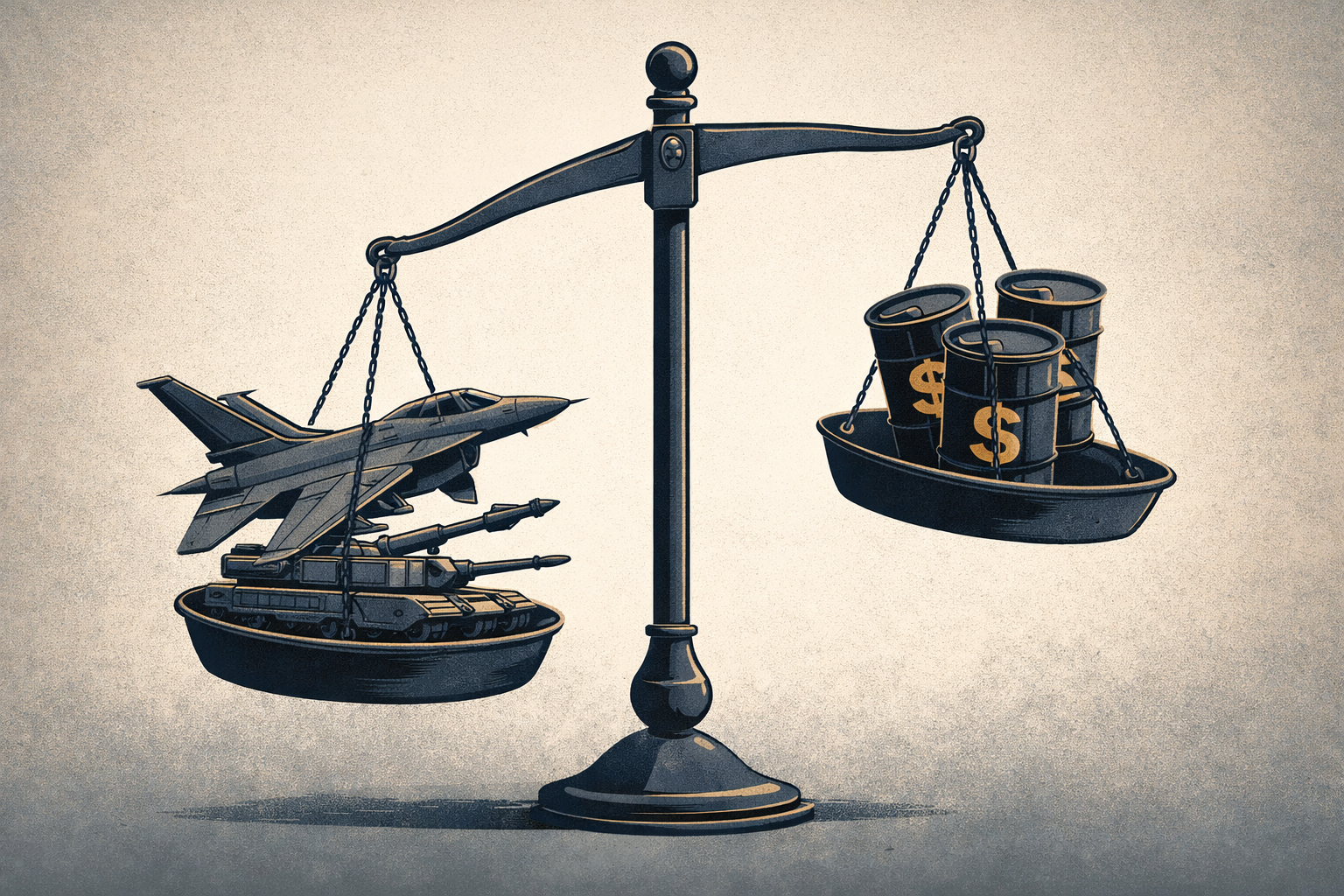
The president appears to believe, in his old-school way, that a common enemy unites the country. That if the missiles fly and the flags wave, the middle and even some of the left will fall in line. This was already a questionable bet before the war started. Three weeks in, with gas prices up nearly a dollar a gallon and the administration unable to articulate what "winning" looks like, it is looking worse. You cannot simultaneously fund and bomb the same country and expect the public not to notice. You cannot tell people this war makes them safer while their grocery bills say otherwise.
The Compound Error
What makes this moment genuinely dangerous is not that one side is miscalculating. It is that both are, and in ways that feed each other.
Iran's escalation to global targeting gives the administration the coalition it needed. The administration's escalation — ultimatums, power plant threats, the relentless widening of the target set — gives Iran evidence that restraint was never going to be rewarded. Each side's overreach validates the other's worst-case assumptions about the conflict, and both use those assumptions to justify the next step up the ladder.
Meanwhile, the 48-hour clock on the Strait of Hormuz ticks. Iran says the strait is open to everyone except its enemies. The administration says that is not good enough. Twenty percent of the world's oil supply hangs in the balance. European capitals that were on the sidelines two weeks ago are now calculating missile trajectories. The Pope is calling the suffering a "scandal to the whole human family."
And somewhere in the gap between what was offered at the negotiating table and what was chosen instead, a war that did not have to happen this way continues to find new ways to get worse.
This is what happens when both sides convince themselves they are playing the other. The Iranians believe they can bleed the US into retreat. The administration believes it can shock the Iranians into submission. Both are probably wrong. But the cost of proving it will not be borne by the people making the decisions. It never is.


Comments