They didn't take her to a court. They dragged her into the center of the courtyard.
That detail matters. The scribes and Pharisees who brought this woman before Jesus - caught, we're told, in the very act of adultery - had options. There were legal processes. There were elders. There was a system designed to handle exactly this kind of situation. They bypassed all of it and went straight to the most public space available, positioned her where everyone could see, and turned to Jesus with a question they already knew the answer to.
"Moses commanded us to stone such women. What do you say?"
This wasn't a legal proceeding. It was a production. And like every good production, it needed three things: a villain, an audience, and a stage. The woman provided the first. The crowd in the courtyard provided the second. And the Pharisees had built the third by hauling her into the center of it all, making sure no one could look away.
If that machinery feels familiar, it should.
We live in a courtyard economy. The stages are screens. The audiences are algorithmically assembled. And there is never a shortage of villains, because the system requires a steady supply of them to function.
Every day, someone is dragged into the center. A public figure caught in a contradiction. A stranger whose worst moment was filmed. A group whose beliefs have been distilled into their most grotesque caricature. They are placed where everyone can see them, and the question goes out - not as a question, really, but as an invitation: What do you say?
The expected answer is always the same. Condemn. And quickly.
What interests me about the John 8 story isn't that the Pharisees were wrong about the sin. Adultery was, in fact, a violation of the law. They had their facts straight. What they got wrong was everything else - the motive, the method, the purpose. They weren't pursuing justice. They were leveraging someone's failure to consolidate their own authority and to trap a rabbi they found threatening. The moral framework was real. The way they wielded it was corrupt.
That distinction gets lost constantly today. We've become a culture that confuses the identification of wrong with the work of righteousness. Naming the sin has become a substitute for doing the hard, unglamorous work of actually being good. The Pharisees didn't have to examine their own lives. They just had to point at the woman.
Here is the part we don't talk about enough: this economy runs on money.
Not metaphorically. Literally. When you click on a headline that makes your blood boil, someone gets paid. When you share a post that makes your tribe feel validated and the other tribe feel threatened, an algorithm registers that engagement and serves you more of the same. When you hate-watch a cable news pundit from the other side, their ratings go up and their ad rates follow.
Fox News and MSNBC and every other slanted outlet, podcast, and influencer channel are not, in any meaningful business sense, opponents. They are collaborators in a shared enterprise. Each one needs the others to exist because the product they're selling isn't information. It isn't even ideology. The product is a feeling - the feeling of being right combined with the feeling of being threatened. Those two emotions together are the most potent engagement drivers ever discovered, and the entire media ecosystem is optimized to produce them.
The woman in John 8 was content. That's a cold way to say it, but it's precise. She was the raw material for someone else's transaction. Her sin was real, but it wasn't the point. The point was what her sin could do for the people who dragged her into the courtyard. It could make them look righteous. It could force Jesus into a lose-lose. It could generate the ancient equivalent of engagement.
When you feel that familiar surge of outrage at your screen - that hot, satisfying certainty that someone out there has crossed a line and deserves to be called out - it's worth asking a question the Pharisees never asked themselves: Who benefits from this reaction? Because if your moral conviction is someone else's revenue stream, that doesn't necessarily mean the conviction is wrong. But it means you should hold it up to the light before you let it drive your next move.
The political dimension of this is where the damage compounds. The outrage economy doesn't just reflect the divisions in American life - it manufactures and deepens them. The pipeline doesn't run the way most people assume. We like to think we arrive at our convictions through reason and then find media that represents us. But for a growing number of people, the pipeline runs the other direction. The media ecosystem shapes what we feel outraged about, calibrates it for maximum engagement, and then sells that outrage back to us as identity. We mistake curated emotional responses for deeply held beliefs.
And the solidarity that forms around shared outrage feels real - it feels like community, like standing for something. But there's a critical difference between solidarity built on a shared vision of the good and solidarity built on a shared enemy. The first creates. The second consumes. The first requires sacrifice, patience, the willingness to be wrong. The second only requires someone to point at.
Bonhoeffer called it cheap grace - the appearance of moral seriousness without the cost of actual transformation. I think that's what most political outrage amounts to. It lets us feel like we're doing something righteous while requiring nothing of us except our attention and our anger. It asks nothing about our own lives, our own contradictions, our own stones.
Which brings us back to the courtyard and to the most subversive thing Jesus does in the entire scene. He doesn't engage the framework they've set up. He doesn't debate the finer points of Mosaic law. He doesn't defend the woman's sin. He doesn't attack the Pharisees. He does something far more disruptive than any of those options.
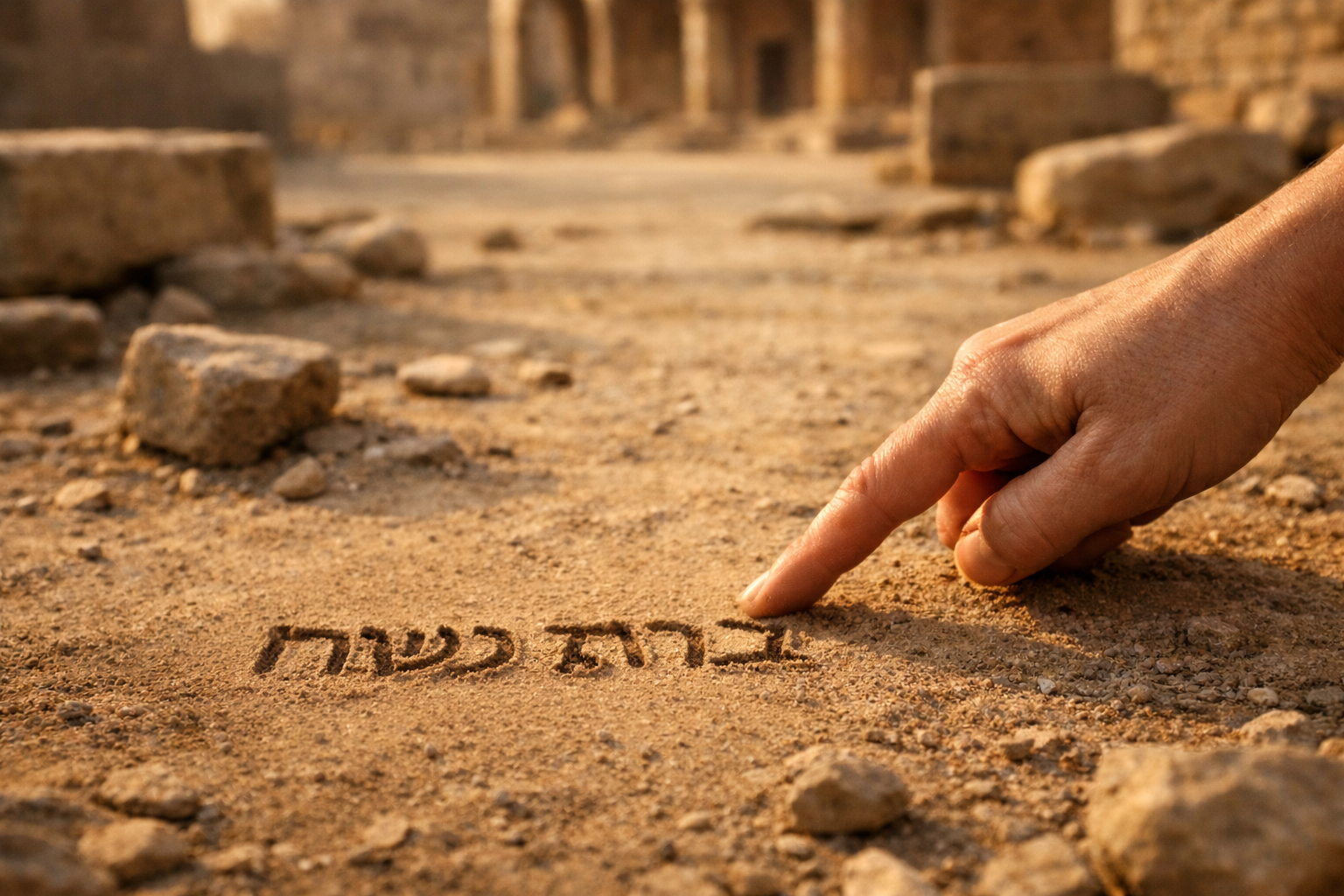
He bends down and writes in the dirt.
We don't know what He wrote. Scholars have speculated for centuries, and it doesn't matter. What matters is what He didn't do. He didn't match their urgency. He didn't perform for the crowd. He introduced slowness into a situation that was designed for speed, silence into a space that demanded noise. He literally looked away from the spectacle.
And then, when He finally spoke, He didn't pronounce judgment on the woman or on the Pharisees. He turned the lens: "He who is without sin among you, let him be the first to throw a stone."
In one sentence, He collapsed the entire economy. There were no more untouchable accusers and condemned sinners. There was just a courtyard full of people who had to reckon with their own condition before they acted on someone else's.
They left, we're told, one by one, beginning with the eldest. The ones who had lived long enough to know themselves.
I don't think the answer to our courtyard economy is to stop caring about right and wrong. That would be its own kind of cheap grace. The Pharisees were right that adultery was a sin. The things that spark our outrage are often genuinely wrong. The question isn't whether to care. The question is what we do with the caring.
So here is what I'm learning to ask myself - three questions, borrowed from a rabbi who wrote in the dirt while a mob clutched their stones.
Am I being invited to understand, or to condemn? Most outrage content is structured to skip everything hard - nuance, context, the possibility that the full picture might complicate the verdict - and go straight to judgment. If the story gives me everything I need to feel righteous but nothing that slows me down, that's a design choice. And it's the same design choice the Pharisees made when they positioned the woman in the center of the courtyard.
Who benefits from my reaction? Follow the money, follow the engagement. When I feel that surge, someone has put this in front of me, and they gain something from my emotional response. A click, a share, a subscription, a vote. That doesn't invalidate the underlying concern. But it means I owe it to myself - and to the person being dragged into the courtyard - to separate my conviction from someone else's business model. It might also be worth asking a harder question about the sources we consume in the first place. Seek out the ones that complicate your thinking rather than confirm it. The ones that leave you with more questions than certainty. The ones that don't need a villain in every headline to hold your attention. If your go-to source fits neatly into the rubric of right and wrong without ever turning the lens on you, it's probably not informing you. It's performing for you.
Does this draw me toward people or against them? Jesus' response moved everyone in the courtyard toward self-examination and ultimately toward mercy. The Pharisees' move was designed to draw lines - us and her, righteous and condemned, in-group and out-group. When a story or post makes me feel closer to my tribe and more hostile toward the other, that's the Pharisee pattern. When it moves me toward empathy, complexity, or my own need for grace, that's closer to what Jesus modeled.
There's one more thing I'm learning to watch for, and it's harder than the three questions because it requires honesty about what's happening inside me rather than discernment about what's happening on a screen.
Righteous anger over genuine injustice is heavy. It grieves. It costs something. If the outrage feels good - if there's a rush in it, a satisfaction, a sense of moral elevation - that's a signal that something else is operating. The Pharisees enjoyed dragging that woman into the courtyard. That enjoyment should have been their first clue that whatever they were doing, it wasn't justice.
The same goes for the impulse to share before I've sat with something. To make sure everyone sees what I've seen, feels what I feel. That impulse is the modern equivalent of positioning someone in the center of the courtyard. It's the outrage economy recruiting me as a distributor.
Jesus wrote in the dirt. He created time where the situation demanded immediacy. He refused to let the speed and certainty of the crowd override the slow, costly work of seeing people as they actually are.
That's the model. Not indifference. Not passivity. Not moral relativism. Just the hard, countercultural discipline of pausing long enough to remember that the line between the righteous and the condemned doesn't run between people. It runs through every one of us. Beginning with me.



Comments