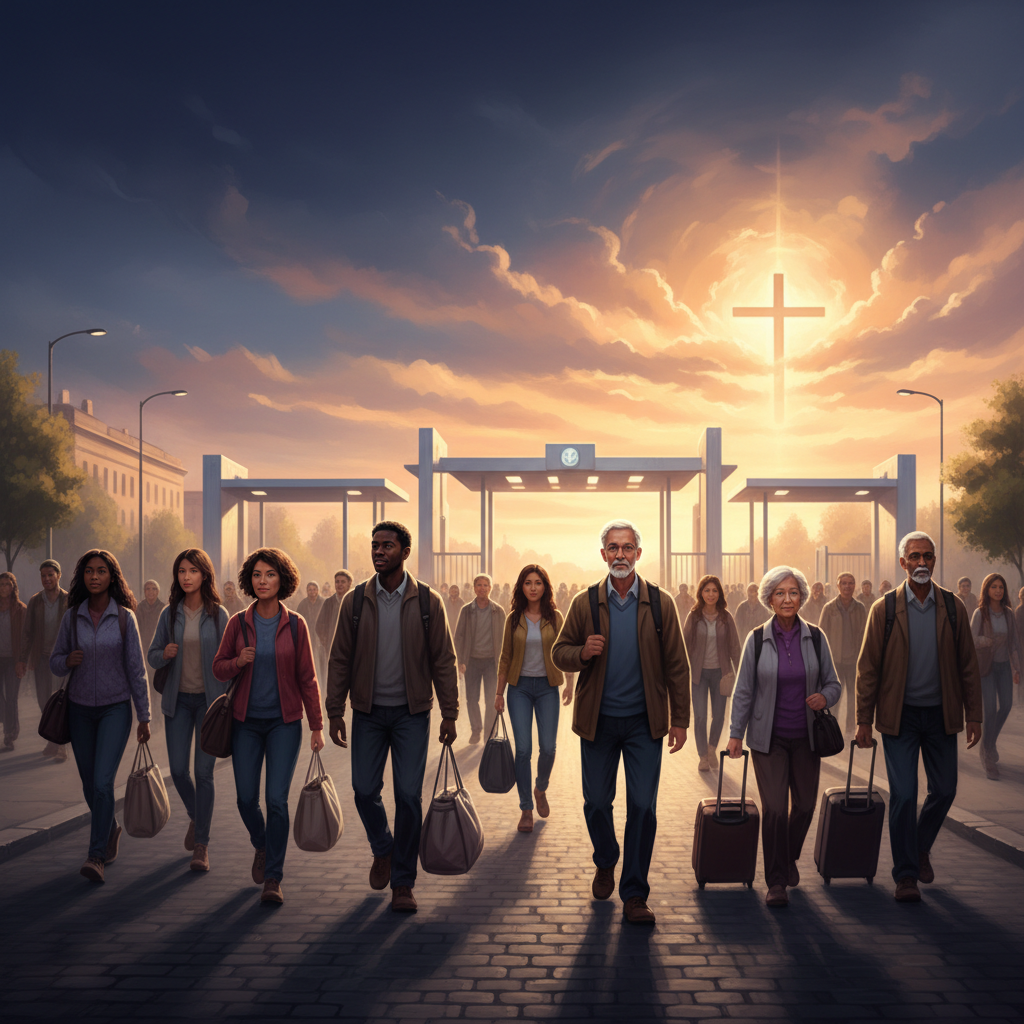
In conversations about immigration, it is easy to get pulled toward the loudest voices. Some call for “open borders” with almost no limits. Others want to “shut it all down” with almost no compassion. Neither extreme reflects the heart of God, and neither matches what most ordinary Christians in the pews actually desire.
Most of us feel a real tension.
We want our country to have real laws, real borders, and real order.
We also want to care for vulnerable people made in the image of God.
The problem is not that we care about both. The problem is that our current policies and practices often fail at both. As followers of Jesus, we need a better way—one shaped by Scripture, not by cable news.
A more sane immigration policy begins here: we need to restore order at the border and throughout the system, and we need to do it in a way that honors the God-given dignity of the sojourner, the stranger, the immigrant among us.
We Are Sojourners Too
Before we ever talk about “them,” Scripture reminds us who we are.
“Beloved, I urge you as sojourners and exiles to abstain from the passions of the flesh, which wage war against your soul.”
— 1 Peter 2:11
“Our citizenship is in heaven, and from it we await a Savior, the Lord Jesus Christ.”
— Philippians 3:20
For Christians, the deepest passport we carry is not American; it is heavenly. We are citizens of a kingdom that is not yet fully seen. We live in this world as resident aliens—present, engaged, and responsible, but not ultimately at home.
That matters for immigration because it reframes our posture. When we look at men and women who have crossed borders, fleeing poverty, violence, or despair, we do not first see “intruders.” We see fellow sojourners. Their physical journey mirrors our spiritual reality. We, too, depend on grace. We, too, know what it is to be welcomed into a kingdom we did not earn.
This should soften our hearts. Our identity as heavenly citizens ought to stir empathy, not indifference. We look at the plight of immigrants—confusing laws, broken families, fear of deportation, exploitation at work—and we remember: “We were strangers. We were outsiders. God had mercy on us.”
God’s Heart for the Stranger
The Old Testament makes God’s concern for the outsider unmistakable.
“You shall not oppress a stranger nor torment him, for you were strangers in the land of Egypt.”
— Exodus 22:21
“Do justice and righteousness, and save one who has been robbed from the power of his oppressor. And do not mistreat or do violence to the stranger, the orphan, or the widow; and do not shed innocent blood in this place.”
— Jeremiah 22:3
God ties Israel’s treatment of the sojourner to their own story of rescue. Oppressing the stranger is not just a social mistake; it is a spiritual betrayal. It forgets what God has done.
Applied to immigration, that means at least this: even when someone has broken civil law, we do not gain the right to dehumanize them. We may have to say “no” to some requests. We may have to enforce laws and even deport at times. But we must never do it in a way that forgets their God-given dignity.
A Blessed Nation: Stewarding Abundance
We also need to be honest about where God has placed us. Whatever our national sins and failures, the United States has been given immense resources—financial, agricultural, technological, educational, and more. We are, by global standards, a richly blessed people.
With blessing comes responsibility.
“From everyone who has been given much, much will be demanded; and from the one who has been entrusted with much, even more will be asked.”
— Luke 12:48 (principle applied)
As a nation, we ought to see ourselves not as mere gatekeepers of privilege but as stewards of abundance. Our role in the world should increasingly look like this:
- Protector of the oppressed, the persecuted, the trafficked, the exploited.
- Provider for the downtrodden and needy, within wise limits, so that our help is real, not symbolic.
This does not mean we can welcome everyone without discernment. It does mean that our debates should be framed by a sense of calling: God has entrusted us with much; therefore, we seek policies that reflect his heart for the vulnerable, while recognizing real limits.
God’s Purpose for Government: Order in the Service of Good
Scripture also affirms the good of government and law.
“Every person is to be subject to the governing authorities. For there is no authority except from God, and those which exist are established by God… for it is a servant of God to you for good.”
— Romans 13:1–4
Government’s God-given task is to restrain evil, promote good, and maintain basic order. In our context, that includes:
- Defining borders and categories of entry.
- Creating clear and fair procedures.
- Enforcing those procedures consistently.
So Christians do not glorify lawlessness. A world without immigration policies would quickly flood our systems and exhaust our resources. In that chaos, the weakest suffer most. Without thoughtful limits and enforcement, we would actually reduce our ability to help meaningfully. Compassion without structure eventually collapses on the backs of the poor.
What Is Going Wrong in Current Enforcement?
Affirming the need for law does not mean ignoring the failures of how law is often enforced.
Too often, deportations and removals are carried out with little regard for the real lives involved:
- Parents removed while spouses and children—some of them citizens—are left behind in sudden crisis.
- Individuals with deep roots in communities, churches, and workplaces treated as if their only identity were a file number.
- Cases rushed or mishandled without genuine due process, careful review of family obligations, or consideration of legal paths that were never explained or accessible.
- People with legal ties—pending applications, mixed-status families, or even citizenship questions—swept up in systems that do not pause long enough to ask, “Who is this person, really?”
When enforcement ignores family ties, responsibilities, and even questions of legal status or citizenship, it stops being just. It stops reflecting a God who cares about the widow and the fatherless and who commands us not to “do violence to the stranger.”
We can say, at the same time:
- We need enforcement.
- Enforcement must respect due process, truth, and the full reality of a person’s situation.
Anything less shortchanges both justice and mercy.
Why Policies and Limits Still Matter
In reacting to harsh or unjust enforcement, some voices swing to the opposite extreme: “Just let everyone in. No questions asked.” That, too, is unwise and unbiblical.
Love is not the same as unstructured sentiment. If we ignore limits, we risk:
- Overwhelming local schools, hospitals, and shelters.
- Straining churches and charities beyond what they can realistically bear.
- Creating the very conditions—scarcity, resentment, and fear—that harden hearts instead of opening them.
Good policies and real limits are not the enemies of compassion; they are tools that help us target compassion. Clear processes, enforceable rules, and thoughtful caps allow us to:
- Offer meaningful help to those we do receive.
- Protect the most vulnerable from both exploitation and backlash.
- Maintain social trust so that neighbors can continue to support generous, ordered welcome.
In other words: policies are not opposed to love; they help love land in reality.
A Call to Ordered Mercy
So where does all this leave us as believers and as a church?
Remember who we are.
We are sojourners and exiles whose true citizenship is in heaven. That identity should stir empathy, not suspicion, when we look at those crossing borders in desperation.
See our national blessings as a call, not a cushion.
God has entrusted us with resources. That should move us to use our influence and abundance to protect and provide for the oppressed and needy, within wise, sustainable limits.
Hold justice and mercy together.
We should support policies that:
- Establish clear, enforceable borders and processes.
- Reject deportations and enforcement that ignore due process, family bonds, and genuine legal questions.
- Create realistic, accountable paths forward for those with deep roots here.
- Maintain limits so that the help we offer is real and sustainable.
Live this out locally.
Even while national debates continue, we can:
- Befriend immigrants in our neighborhoods and churches.
- Help them navigate systems with patience and advocacy.
- Speak about them with honor, never with dehumanizing language.
- Pray and work for leaders who will pursue ordered mercy rather than chaos or cruelty.
We will not all land on the same policy details. But we can agree on this: whatever we support, whatever we say, and however we vote, our posture toward immigrants must be shaped by our identity as sojourners, our calling as stewards of great blessing, and our allegiance to a King who welcomed us when we were strangers.
May God give us hearts that feel the weight of others’ journeys, minds that think clearly about order and limits, and hands that are ready to serve the stranger in his name.



Comments