
Every morning you trust that the floor will hold your weight when you step out of bed. You don't test it. You don't think about it. You just step. That trust is so constant, so woven into the way you move through the world, that it doesn't feel like trust at all. It just feels like the floor.
But it is trust. You are making a commitment, tiny, unconscious, but real, that the world will behave the way it behaved yesterday. And you cannot prove that it will. You can only believe it and act accordingly.
This is what Newbigin means when he talks about presuppositions: the things we have already decided are true before we begin thinking about anything else. Not conclusions we arrived at through careful reasoning, but starting points we assumed before reasoning was even possible. They are so foundational that they become invisible. Like the floor. You don't notice them until someone asks you to look down.
And Newbigin's provocation is that honest thinking requires exactly that. Looking down. Being explicit about what you're standing on. It sounds like a modest request. It is not. It is one of the most disruptive things a person can be asked to do, because most people, most disciplines, most institutions, have never done it. The presuppositions are there, holding everything up, but they are unnamed. They function like gravity: so constant that no one thinks to account for them.
I've been sitting with this line and I think it names something bigger than an epistemological observation. It names the task.
Not the task of the church. Not the task of the apologist. The task of anyone who wants to think honestly in this cultural moment. And the task is not to convince anyone of the existence of God. It is something at once simpler and more unsettling: to convince people that they already have faith.
Consider something as basic as the uniformity of nature, the assumption that the laws of physics will behave tomorrow the way they behaved today. Every experiment ever conducted, every bridge ever engineered, every medication ever dosed rests on this assumption. But it cannot be proven. You cannot use the past behavior of nature to prove that nature will continue behaving that way, because that argument already assumes the very thing it's trying to demonstrate. It reasons in a circle. David Hume pointed this out three centuries ago and no one has solved it since. We simply trust it and move on.
Or take the principle that the universe is rationally ordered, that it operates according to consistent, discoverable laws rather than chaos. Why should that be the case? Nothing within physics can answer that question. Physics depends on it being the case in order to function at all, but it cannot account for why it is so. It is assumed. It is believed. And everything we call scientific knowledge is built on top of that belief.
The physicist trusts the intelligibility of the universe. The ethicist presupposes that moral categories mean something. The materialist assumes that only material explanations count, but that assumption is not itself a material fact. From the most basic to the most sophisticated, the mechanism is the same. We commit before we can confirm.
If you are a Christian, sit with that for a moment. Because we have been told, by the culture, by the academy, sometimes even by our own internal monologue, that we are the ones operating on faith while everyone else operates on something firmer. That our mechanism for arriving at truth is belief, and that this makes us uniquely vulnerable, uniquely subjective, uniquely unserious. We feel it in conversations where our convictions are handled like antiques. Interesting, maybe even charming, but certainly not load-bearing. And over time, that framing does its work. It makes us feel alienated. It makes us feel incompetent. As if we showed up to an exam with the wrong materials.
But Newbigin is saying that we are not unique in this. The most towering intellect who would dismiss your faith because it is "merely belief" is using the same mechanism to hold up everything they claim to know. They have simply decided not to call it faith. And when you see that, when you really see it, the game changes. Not because you've won an argument, but because you've been released from a false one. You are not the exception. You are not the one person in the room operating on trust while everyone else has proof. Everyone is operating on trust. You're just the one who has been honest enough to name it.
This is not an argument against science or reason. It is an observation about what science and reason are standing on. And it is an observation that the modern secular mind has been trained to resist, because to admit it would be to surrender the one advantage it thought it had over religion: the claim to operate without belief.
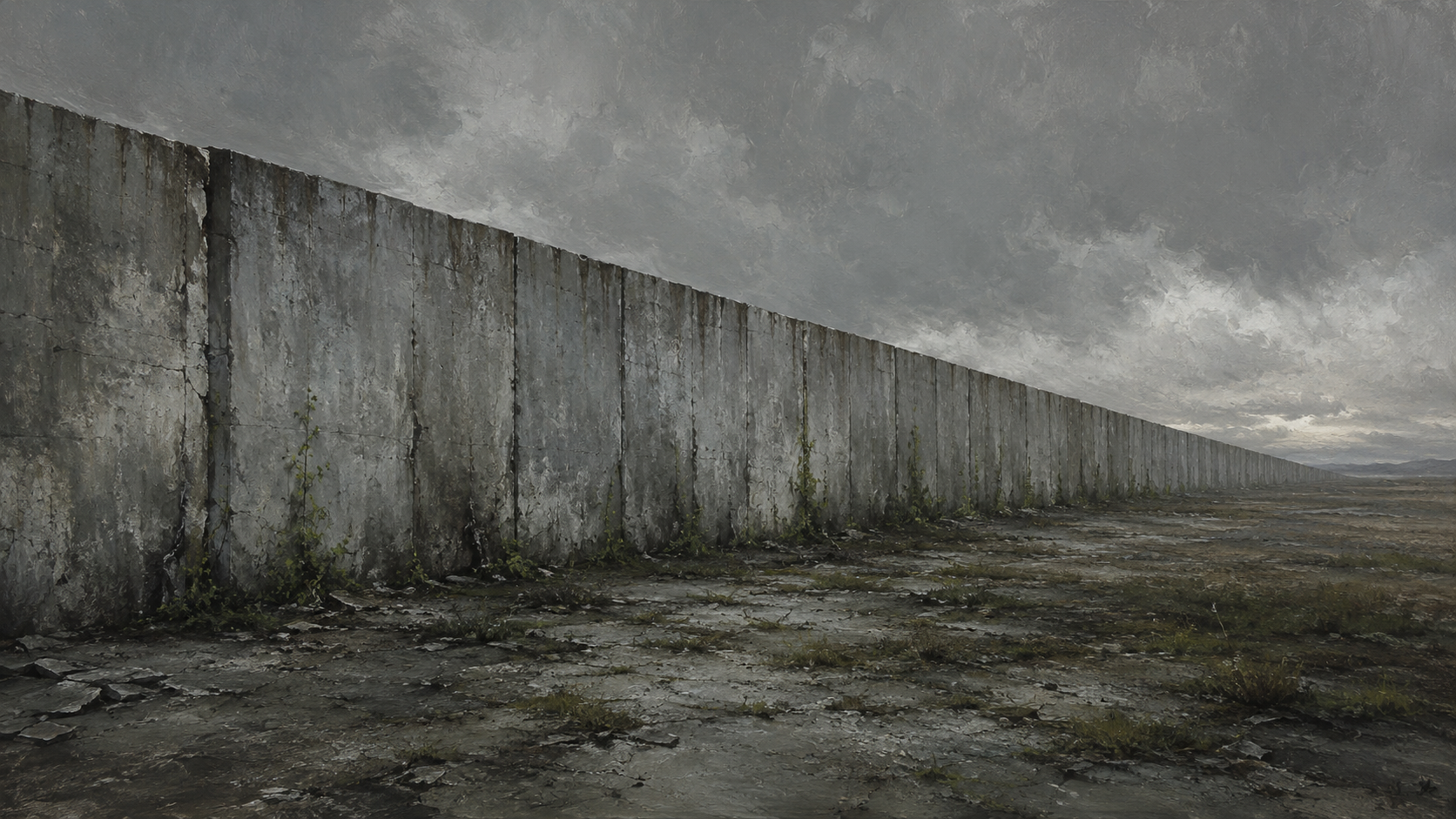
The instinct here is to build an apologetical framework from this. I feel it pulling. If everyone already operates by faith, then you can trace the thread. Faith in what? On what ground? Toward what end? Eventually the question of God becomes unavoidable. And I think that's true. But I also think that reaching for apologetical technique at this point is a mistake. It jumps too far ahead. It skips the moment that matters most, which is the moment a person realizes that the ground beneath their feet is not concrete. It is trust. And they have been standing on it their whole life without knowing.
That realization does not need to lead immediately to God. It does not need to lead anywhere immediately. What it needs to do is land. Because once a person sees that their deepest commitments are acts of faith, not conclusions derived from evidence but starting points assumed before evidence is even possible, then the posture changes. The conversation is no longer between the rational and the religious. It is between two people who both believe something they cannot prove, and who might, for the first time, be honest about it.
And I think this is the message that the church cannot deliver. Not because it is untrue, but because the church has been categorized. It has been filed under "religion" in the Enlightenment's taxonomy, and anything that comes from that shelf gets processed as advocacy. But the harder truth is that the church has contributed to its own disqualification. The evangelical project turned the gospel into a product and faith into a closing technique. It built a culture of insider certainty that looks, to anyone on the outside, like exactly the kind of unexamined presupposition Newbigin is warning about, except without the honesty. The credibility required to deliver this message has been spent, and it was not stolen. It was squandered. The moment the church says "you have faith too," it sounds like recruitment. It sounds like a trick, like the real sentence is "you have faith too, so come have ours."
But a thinker, someone not tethered to the institution, someone simply pursuing what is true, who arrives at this conclusion and names it plainly? That lands differently. That is not threatening. That is not asking anyone to join anything. It is just an honest observation about what is already happening beneath every act of reasoning and every claim to knowledge.
And there are people arriving there. You can feel it in the culture. A restlessness, a suspicion that the materialist story is thin, that the techno-optimist story is brittle, that the political story is exhausting. People who are not looking for church but who are looking for something that accounts for what they already sense: that there is more going on than what can be measured, and that the refusal to name it is its own kind of dishonesty.
Newbigin would say the gospel has always been this. Not a philosophy competing for market share in the bazaar of ideas, but an announcement about something that happened, something that reframes everything. And maybe the first step toward hearing that announcement again, in this exile, in this period when the institutional voice has gone quiet, is not proclamation at all. It is simply honesty. The willingness to look at what you're standing on and call it what it is.


Comments