Newbigin makes a move in this chapter that I want to stay with for a while. He is addressing the posture of doubt — not casual doubt, not honest questioning, but the kind of doubt that has become a cultural credential. The kind that presents itself as intellectual humility but is, on closer inspection, something else entirely. It is the doubt that says, "You cannot really know that," and then walks away as though it has said something modest.
Newbigin calls this out for what it is. It is not humility. It is arrogance concealed. The person who says "your creed cannot be known to be true" is making a knowledge claim every bit as ambitious as the one they are dismissing. They are claiming to know enough about the limits of human knowledge to rule out an entire category of conviction. That is not a small claim. That is an enormous claim. And it is almost never examined.
I think Newbigin is right about this, but I also think there is a simpler response than the ones he offers, one that gets to the root of the problem more directly. It is four words: How do you know?
That is it. When someone tells you that the divine cannot be known, that religious claims are inherently unverifiable, that faith is a category of feeling rather than knowledge, the most honest thing you can do is ask them to account for their own certainty. How do you know that it cannot be known? What framework are you standing in that gives you the authority to draw that line? And who built that framework?
Now someone might say this puts the Christian in a trap. If they cannot answer the question, then neither can I. If their foundation is unjustified, mine is too. But that misses the point entirely. I am not trying to win the argument. I am not trying to demonstrate that what I know is the truth. I am trying to demonstrate that it — the unknowable, the thing they have filed under "inaccessible" — can be known. The playing field is not level because I have a better argument. The playing field is level because neither of us is standing on self-evident ground. And once that is established, the question changes. It is no longer "can this be known?" It is "has this been revealed?"
That is where the Areopagus comes in.
In Acts 17, Paul arrives in Athens and finds the city full of altars. Among them is one inscribed ΑΓΝΩΣΤΩ ΘΕΩ — Agnōstō Theō — "To an Unknown God." The word on that altar is agnostos. It is the word we get "agnostic" from. Paul is literally standing in front of a monument to agnosticism.
And what does he do? He does not pitch God. He does not open with the gospel. He does not hand them a tract. He looks at the altar and says: "What therefore you worship agnoountes — not knowing — this I proclaim to you" (Acts 17:23). The word he uses for their worship — agnoountes — shares the same root as the word on the altar. Agnostos. Agnoountes. Unknown. Not knowing. Paul is using their own inscription against their epistemological posture. You built an altar to the unknown and then you worshiped at it unknowingly. You enshrined your ignorance and then called it piety.
But here is what Paul is not doing, and I think most readings of this passage miss it. He is not saying, "Let me tell you about this god you've been missing." That frames it as a sales pitch, as though God were one more product on the shelf that the Athenians had simply failed to pick up. No. Paul's move is more fundamental than that. He is saying: this god can be known. The category you have filed him under — the permanently unknowable, the forever shrouded — is wrong. He is not unknown because he is unknowable. He is unknown because you have not looked.
The Athenians had built a ceiling and mistaken it for the sky. They had made a virtue out of their ignorance, hallowed it with an altar, and Paul's challenge is not to fill in the content of what is on the other side. It is to get them to recognize that the boundary they erected is their own construction, not a feature of reality.
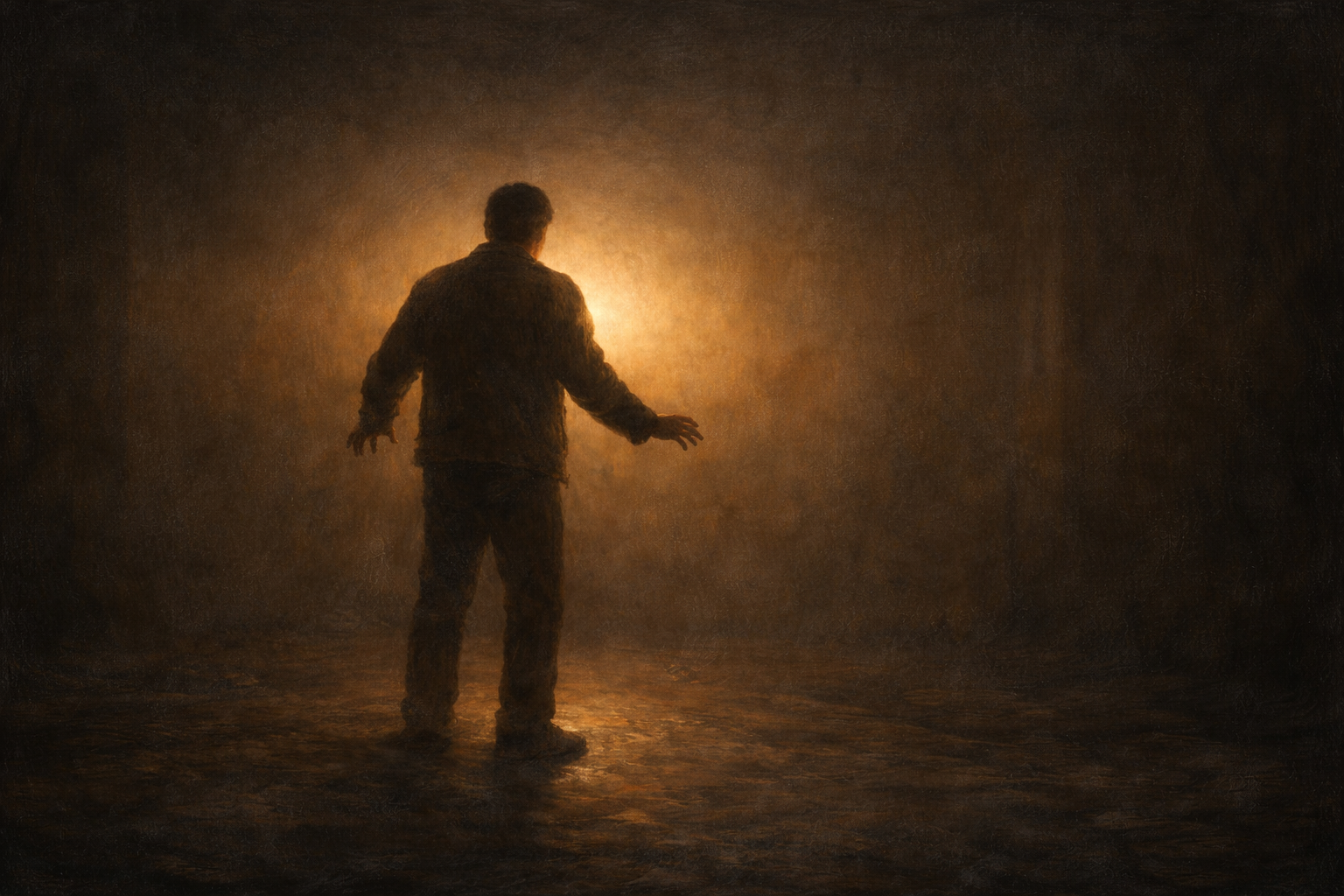
This becomes even more striking when you follow the Greek a few verses further. In verse 27, Paul says God arranged human history so that people would "seek him and perhaps psēlaphēseian — reach out for him and find him, though he is not far from each one of us." That verb, psēlaphaō, does not mean "reach out" in some vague spiritual sense. It means to grope, to handle, to touch physically. It is the word used for a person feeling their way through a dark room. It is the same word Jesus uses in Luke 24:39 when he tells the doubting disciples to touch him — handle me, feel my flesh and bones, verify that I am real.
Paul is saying: you are fumbling around in the dark for something that is right next to you. The problem is not distance. The problem is not that God is hiding. The problem is that you have convinced yourselves the room is empty.
And then in verse 30, Paul closes the loop. "The times of agnoias — of ignorance — God overlooked. But now he commands all people everywhere to repent." Same root again. Agnostos. Agnoountes. Agnoias. The entire speech is bookended by the same word family. The age of the respectable shrug, the era where not-knowing was enshrined as wisdom — God overlooked it. Past tense. That era is over. The unknown can be known. The question is whether you are willing to open your eyes.
What strikes me about this passage is how precisely it maps onto the situation we find ourselves in today. The modern doubter is not all that different from the Athenian philosopher. Both have constructed an epistemological framework that rules out revelation before it arrives. Both have mistaken their framework for neutral ground. And both treat their doubt as a sign of intellectual maturity rather than recognizing it for what it is — a faith commitment about the limits of knowledge that is every bit as unexamined as anything they would critique in a creed.
This is what I meant earlier when I connected it to gnosticism. The doubters are a modern form of the same impulse Paul confronted — a spiritual posture that treats the divine as permanently inaccessible and then builds an entire intellectual culture around that inaccessibility. Paul challenged it by pointing at their own altar and saying: you already know something is out there. You carved it in stone. Now let me tell you that what you are groping for in the dark is not far from you.
But here is where it gets uncomfortable for the church.
Here is what makes Paul's position at the Areopagus even more interesting than it first appears. He was not standing there from neutral ground. If anyone had lost the credibility war, it was him. He was a Pharisee — steeped in the religious establishment, the institutional religion of the Jews, which the Greek philosophers would have regarded with suspicion at best. He was not some blank slate outsider with no baggage. He was the baggage. He had been the culture warrior. He had literally been the man who arrested people for their beliefs.
And yet there he stood. Not saying, "Let me tell you what I have always known." Not even saying, "I have found something." Saying something closer to: I think you can know, if you seek. I was where you are. I had the system, the training, the credentials, the zeal. And I was groping in the same dark. He was right there all along.
That is the posture. Not the expert who has it figured out. The man who was undone by what he found, or rather, by what found him.
Much like the Judaism of Paul's day, the evangelical church today has lost its credibility, and it earned that loss. Decades of fusing the gospel to a political project, evangelical gnosticism — the idea that a true believer separates from and transcends the world rather than entering it — have taken the name of Jesus down as collateral damage. When someone hears "Christian" today, the first thing that comes to mind is not the Sermon on the Mount. It is culture war. It is hypocrisy. It is a power grab dressed up in worship music. That is not a media caricature. That is an earned reputation.
Which means the front door is bricked shut. You cannot lead with "let me tell you about Jesus" when the listener has already categorized that sentence as the opening move of someone who wants to control them, judge them, or recruit them into a political tribe.
But Paul could not lead with his credentials either. His credentials were the problem. So he did something else. He came alongside the Athenians on their own ground and asked them to examine it. He did not need institutional authority to point at their altar and say: you know something is there. He did not need a church's credibility to ask the honest question. He needed only the willingness to admit that he, too, had been wrong — and that the God he was groping for in the dark turned out to be standing right next to him.
That is a human conversation, not a religious one. And it is in that human conversation that the space opens up. Not because you convinced anyone of anything, but because you put them in a position where God can do what only God can do — reveal himself.
That is the posture Newbigin is building toward, and I think it is the only one available to us now. We cannot reveal God to anyone. We never could. But we can do the preparatory work. We can ask the honest question. We can point at the altar they have already built and say: you know something is there. You carved it in stone. Now stop telling yourself the room is empty.
Open your eyes.
This is Part 2 of an ongoing series of notes on Lesslie Newbigin's The Gospel in a Pluralist Society. Chapter 2 (Part 1), "The Edge of the Map," examined how reason displaced revelation as the only valid mode of knowing. Chapter 1 explored presuppositions, plausibility structures, and the collapse of evangelical credibility.



Comments