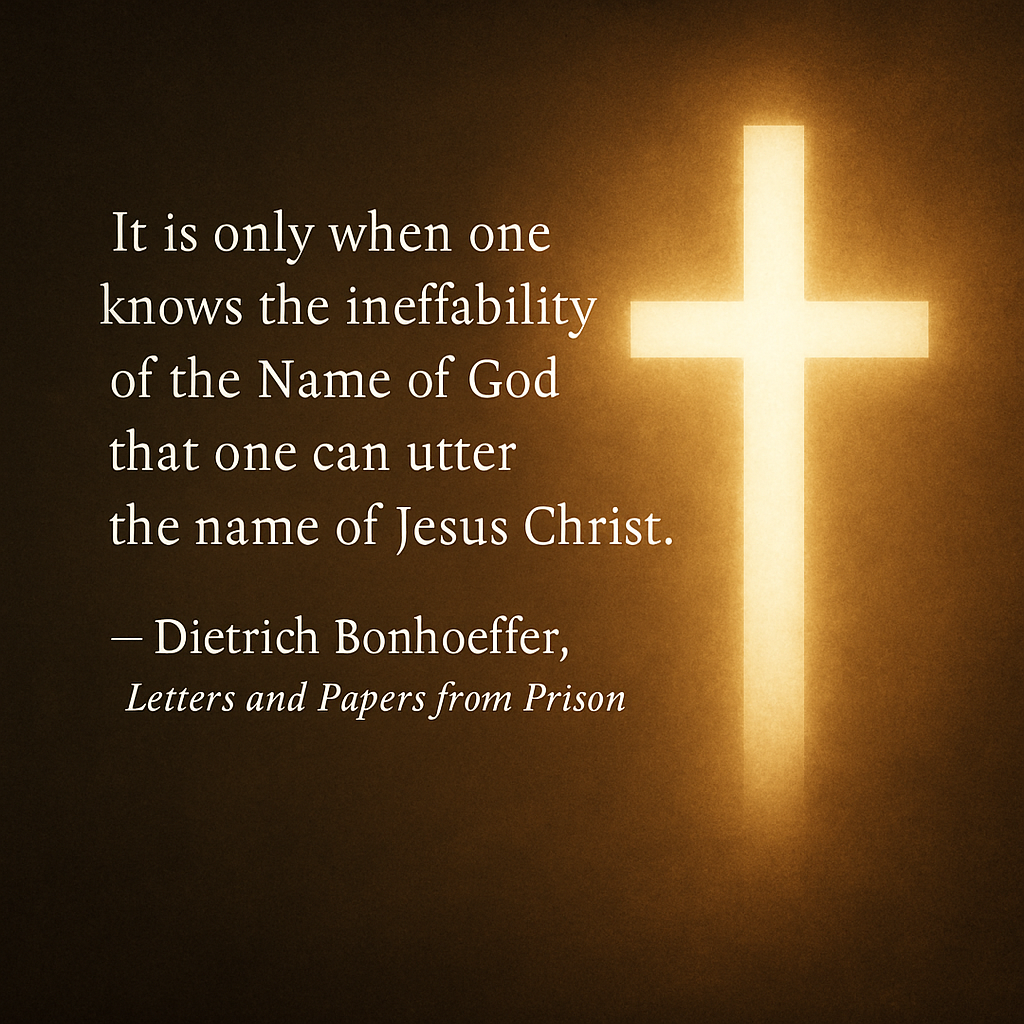
“It is only when one knows the ineffability of the Name of God that one can utter the name of Jesus Christ.”
— Dietrich Bonhoeffer, Letters and Papers from Prison
There are some realities that break language. We can circle them with words, we can gesture toward them with metaphors and doctrines, but we cannot contain them. The biblical witness insists that God is such a reality. The Name of God is not just another label to place alongside the names of people or places or ideas. It is the sign of a reality that cannot be reduced to our categories, our concepts, or our control.
That is what “ineffability” means. God’s nature is too great, too holy, too complete to be fully expressed or captured in human speech. The moment we think we have wrapped language around God, we have shrunk God down to our size.
And yet, Bonhoeffer dares to say that it is precisely when we know this ineffability that we can truly utter another Name: Jesus Christ.
The God Who Cannot Be Contained
To say that God’s Name is ineffable is not to say that God is vague or distant. It is to say that God is more real than anything we can name.
Our words, at their best, are partial and approximate. Our understanding is always incomplete, always in process, always limited by our finitude and our sin. But God is not an unfinished thought. God is not a rough draft. Divine perfection means that there is no flaw in God’s being, no shadow, no fracture. Nothing in God needs correcting or improving.
Perfection also implies a kind of boundary: nothing impure can stand in the unveiled presence of perfect holiness. This is not a rule God arbitrarily sets outside of God’s own life. It flows from who God is. For perfection to be truly perfect, there can be no stain of imperfection in its presence.
If that is true, then our situation as sinful creatures is not just unfortunate. It is impossible. Before the holy God who is everywhere present, people like us — conflicted, impure, compromised — should not be able to stand at all. We should be judged and, to use the hard phrase, “obliterated from existence.”
The Impossible Persistence of Human Life
But that is not what we see.
Instead of a creation wiped clean of sinners, we see a world somehow sustained. We wake up to new mercies. We continue to breathe, to eat, to receive kindness, to give and receive love, to enjoy beauty in a world held together by the very God whose holiness should undo us.
This persistence of our lives is not an accident. It is evidence.
It tells us that the holy God, who should righteously judge and erase all that is unclean, instead chooses to cherish life. The continued existence of sinful creatures is not a sign that God has lowered the bar of perfection. It is a sign that God has acted in a way we could never have imagined.
The One Who Is Obliterated
The gospel tells us that God has not ignored the tension between holiness and mercy. God has not looked away from judgment. Instead, God has stepped into the very place where judgment should fall.
In Jesus Christ, the eternal Son takes on our humanity. The One through whom all things were made enters the creation that has rebelled against its Maker. At the cross, the judgment that should rightly fall on us falls instead on him.
The One who is perfectly pure becomes, in Paul’s shocking phrase, “sin for us,” so that we might become “the righteousness of God in him” (2 Corinthians 5:21). The only truly innocent One takes the place of the guilty. The only One who should never be “obliterated” for sin becomes the One who bears sin’s full consequence, all the way down into death.
In this way, God does not relax the demands of holiness. God satisfies them in God’s own self. The perfection that should have erased us instead falls upon the Son, so that those who trust in him might stand in the presence of the Holy One without being destroyed.
Knowing the Name of Jesus
This is where Bonhoeffer’s sentence presses in.
It is only when we begin to know the ineffability of the Name of God — the weight of divine holiness, the absolute purity, the impossibility of our survival before such a God — that the name Jesus can be heard as good news.
If God is safe, tame, and easily understood, then Jesus becomes a mere religious figure, a moral teacher, or an inspiring example. But if God is the ineffable One whose perfection should unmake us, then the crucified and risen Jesus is not an optional spiritual upgrade. He is our only hope.
To utter the name of Jesus rightly is to confess:
- God is more holy than I can grasp.
- My sin and impurity are more serious than I admit.
- God’s love is more costly and more determined than I ever imagined.
The Name above every name can only be spoken in truth by someone who knows that the Name of God cannot be contained by language at all.
Advent and the Ineffable God
This offers a different way to approach Advent.
We often rush to the comfort of the season: the child in the manger, the tenderness of the scene, the warmth of candles and carols. All of that has its place. But the comfort only becomes truly deep when we remember who this child is.
The baby in Bethlehem is the ineffable God made visible. The One whose holiness should erase us takes on flesh and blood, subjecting himself to time, hunger, weakness, rejection, and ultimately death. Advent is not the story of a manageable God visiting nice people. It is the story of the holy God crossing an infinite distance to rescue those who could not survive the light of God’s unmediated presence.
When we know something of God’s ineffable perfection, Advent becomes an earthquake in gentler form. The manger is a quiet scandal: the unnameable God now bears a human name.
Held in a Love We Cannot Measure
Our understanding of all this will always remain partial. We will never fully comprehend the depths of God’s holiness or the heights of God’s love. Our words will always lag behind reality.
But grace does not depend on our capacity to explain. The gospel does not wait for us to find the perfect language. The God whose Name we cannot fully speak has already spoken a Word to us — a Word made flesh, a life laid down, a tomb emptied.
We do not stand before God because we have finally found the right words. We stand because Jesus stood in our place and fell in our place, so that in him we might live.
In that light, to whisper the name Jesus Christ is to lean into a mystery that surpasses our comprehension yet secures our lives. The ineffable God has given us a Name we can call on — not because we have grasped God, but because God has grasped us.

Comments