This morning the lectionary put me in Psalm 69, and one verse held me longer than the rest. Because for Your sake I have endured disgrace, dishonor has covered my face. It is a prophetic verse, a verse about Christ, and the part that stops me is the direction of it. We are trained from the first to read the cross as an act done for us. Christ died for our sins, full stop, and that is true as far as it goes. But the psalm does not say for man's sake. It says for Your sake, and the Your is the Father. The disgrace was endured looking upward, not outward. Not my will but Thy will be done. Father, glorify Your name. The whole motion of the cross is a Son giving Himself for the Father, and our redemption comes as the result of that giving, swept up in a will to reconcile not just man but the whole of creation.
I have been turning that over recently, and on the Thursday before Father's Day it stopped being abstract. Because that motion, self-gift aimed at Another that lands as full attention on the ones included, is the plainest description of a father I know.
I want to say this carefully, because Father's Day writing tips into sentiment so easily, and that is not what I am after. I am not writing to scold anyone, and I am not drawing up a portrait of the bad father to make the rest of us feel better by contrast. I am writing to the men who are already in it, already giving themselves to children who cannot yet pay any of it back, and I want to tell them that what they are doing has a shape, and the shape is the cross.
Here is what I mean. The easy account of fatherhood runs on a ledger. I provide, I sacrifice, and somewhere in the back of the mind there is an expected return, respect, or compliance, or children who turn out in a way that reflects well on me. Even the affectionate version of this can quietly make the child into a project, a legacy, an extension of the self. And I do not think the men I have in mind are free of that pull, because none of us are. But the thing that pulls against it is the same thing the psalm showed me. A father's giving is meant to be for the Father's sake first, oriented upward, willing God's will for these particular people He has handed me. And the strange grace of that orientation is that it does not make a man cold or dutiful toward his kids. It makes him more attentive, not less.
That used to seem like a contradiction to me, and the verse that resolved it is the one John gives us. We love because He first loved us. The love a father is conformed to is not a love he generates and then aims dutifully past his children toward God. It is a love he received first, the Father's own love, and it moves through him toward the child bearing the Father's character, which is to say patient, seeing, not keeping the ledger, not requiring repayment. So the child is not the ceiling of the man's devotion, and the child is not a means to the man's significance. The child is loved within the father's willing of God's will, caught up in it, and therefore loved more truly than the legacy-minded version could manage. The verticality does not bypass the child. It supplies what the child is loved with. John is blunt about the alternative a few lines later, that the man who claims to love God and has no love for the brother in front of him is fooling himself, because the love of God is not an escape from the person in the room. It is the ground of being fully in it.
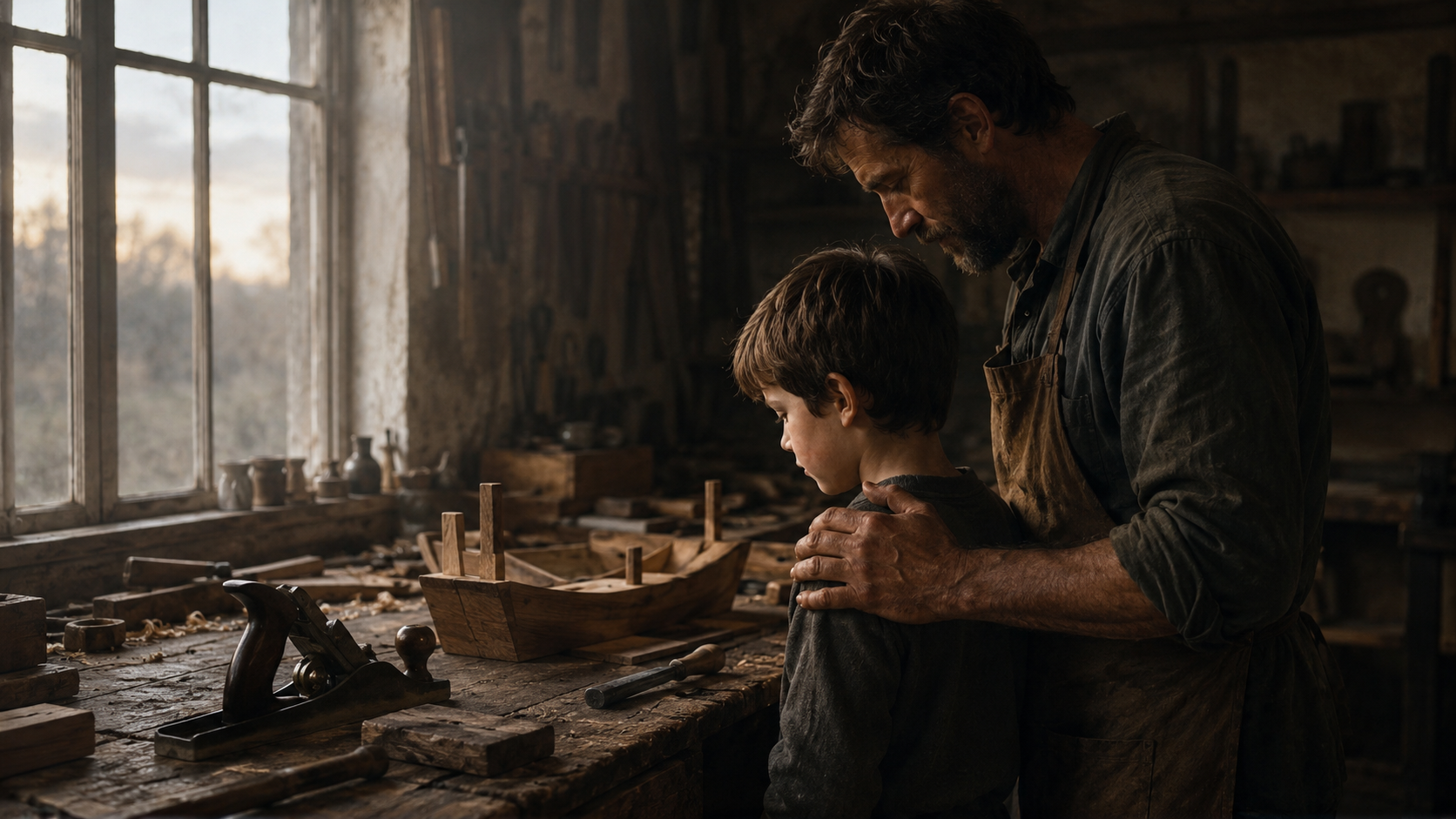
I think this is why the daily work of a father is so easy to miss and so hard to fake. It is unglamorous and largely unseen. It is the showing up, the patience with a son learning a trade he is not yet good at, the attention to a daughter chasing questions that do not have tidy answers, the tender response to a child who has hurt him once again through rebellious acts, the thousand small givings that yield nothing back in the moment and are not meant to. I have a son who has come to work alongside me and a daughter at school reaching for the deep things, and what I am learning, slowly, is that the work is not to make them into a version of me. It is to give myself to them in a way that lets them become who God is making them. That is a harder and quieter thing than building a legacy, and it is closer to what the cross was.
There is a creative dimension to it too, the one I keep coming back to in other contexts. We are made in the image of a Father, and we are therefore makers. We take what is given and we form something out of it. Most of what a man makes is ordinary, the work of his hands, the place he keeps, the things he builds from a blank space. But a father is given the most demanding material of all, a person, and the forming runs over years, slow and unfinished, the patient labor of raising a child against the corrosive pull of a world that wears everything down. That is the most literal kind of creative work there is, and it is redemptive not because the father accomplishes the redemption, he does not, that work is Christ's and finished, but because he is given a genuine part in it. He participates. He is invited into the thing the Father is already doing.
Bonhoeffer called the Christian life the sharing in the sufferings of God in the secular life, and I have been asking myself what those sufferings actually were. The answer the psalm gives is the giving of oneself for Another with no agenda for the self. That is what a father does on his best days, and the men I am writing to are doing it on ordinary days when no one is watching and there is no Father's Day card to mark it. I want them to know it counts, and that it is not a lesser or merely natural thing. It is an image of the truest act in the history of the world.
And here is the part that takes the pressure off without lowering the cost. Christ's gift was for the Father, and Christ still wept at His friend's tomb. The upward orientation did not thin out His tenderness toward the people in front of Him. It grounded it. So a father does not have to choose between giving himself to God and giving himself to his children, as if the one drained the other. Done rightly, the first produces the second. The proof that a man's love for his child is more than a transaction is not that he feels it less. It is that it no longer depends on what the child gives back. That is a love that endured disgrace for Another's sake and counted it worth it, and on Sunday I am grateful for the men who are quietly imaging it, mostly without knowing that is what they are doing.


Comments