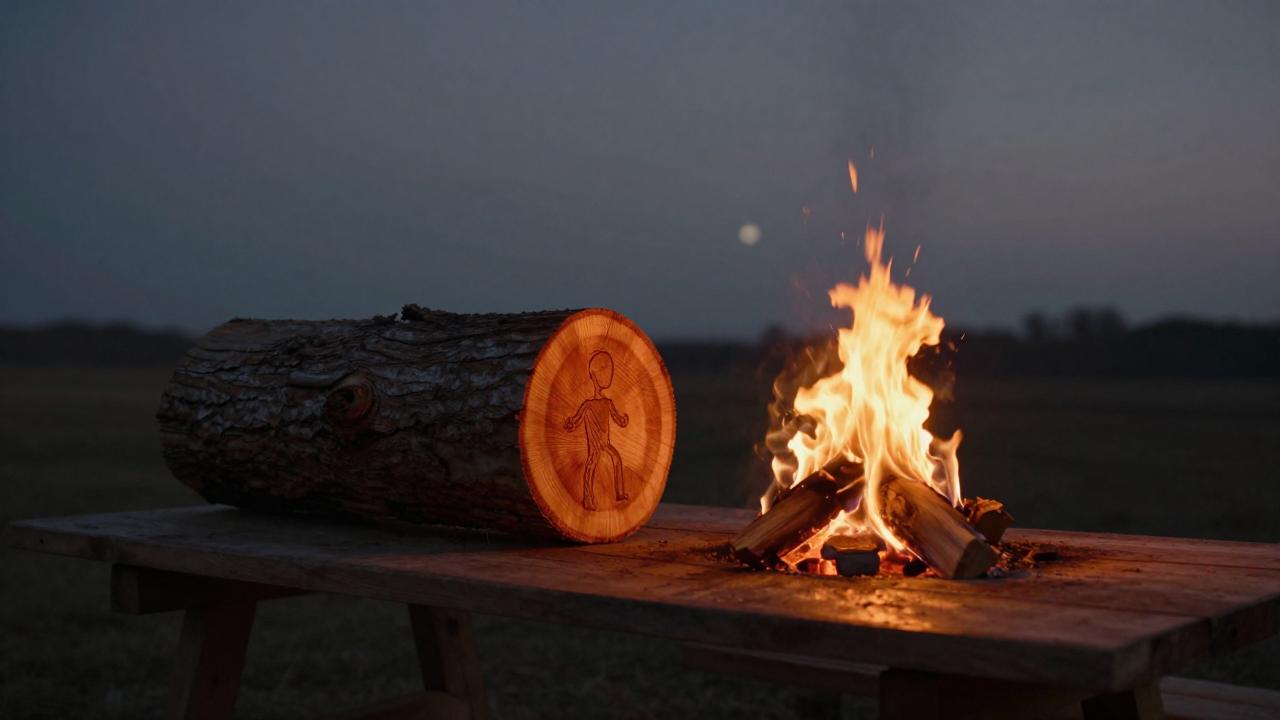
They do not know, nor do they understand, for He has smeared over their eyes so that they cannot see, and their hearts so that they cannot comprehend. No one remembers, nor is there knowledge or understanding to say, "I have burned half of it in the fire and also have baked bread over its coals. I roast meat and eat it. Then I make the rest of it into an abomination, I bow down before a block of wood!" He feeds on ashes; a deceived heart has misled him. And he cannot save himself, nor say, "Is there not a lie in my right hand?"
Isaiah 44:18–20
The image is almost comical. A man stands before a fire he built, using half a tree as fuel to bake his bread and roast his meat. The other half of that same tree he carves into a god. He bows before it. He prays to it. He begs for mercy from the very object that just warmed his hands and fed his belly.
The prophet does not treat this as a quaint relic of ancient superstition. He treats it as a mirror.
This is not about a guy in a dusty temple holding a stick. This is about the mechanics of human blindness. The text says God has smeared their eyes. The blindness is not accidental. It is judicial. But the cause is not ignorance. It is not a lack of data. The text is explicit: "a deceived heart has misled him."
The deception is not in the mind. It is in the affections. The heart, the inner seat of desire and will, has been sold a lie. It believes it can manage the infinite. It believes it can package the Creator into a form it can hold, control, and understand.
Culture is a series of shortcuts we build to survive an unmanageable world. We create heuristics, habits, and systems to navigate the unknown. But when we turn those shortcuts into gods, we cross a line. We take the infinite God and compress Him into a block of wood, a lump of metal, an ideology, or an institution. We make Him understandable. We make Him safe.
And in doing so, we miss Him entirely.
Why do we do this? Why does the heart insist on the compression?
The answer lies in the garden. The original sin was not merely a desire for more knowledge. It was a conviction that equality with God was something to be seized. Adam and Eve did not just want to know like God. They wanted to be God. They wanted to possess the authority, the autonomy, the prerogative of the Creator. They viewed their own worthiness as the justification for the theft.
Pride is the engine of idolatry. It is the assumption that we have the right to define reality, to set the terms of our existence, to grasp at divinity rather than receive it as a gift. Every subsequent sin, every lie, every theft, every act of violence, is rooted in this same claim: "I am the authority here. I deserve to do what I want."
We are still burning the wood. We are still baking our bread. And we are still bowing to the remainder.
But there is another way. There is a pattern of humanity that was never broken.
Paul writes of Christ in Philippians 2:6: "Who, being in very nature God, did not consider equality with God something to be grasped."
Look at the contrast. Adam, who was not God, grasped for equality. Christ, who was God, did not grasp for it. He did not cling to His status. He did not demand His rights. He emptied Himself. He took the form of a servant. He assumed the position of the creature. He descended into the dirt, into limitation, into vulnerability.
Christ is the pattern of man perfected. He is the one who fully inhabited the role of the creature without ever trying to usurp the role of the Creator. He saw the Father clearly because His heart was never deceived. He never grasped, so the smear was never applied.
The only way to see God is to stop trying to hold Him.
The idol falls not when we learn it is false. It falls when we open the hand. The blindness lifts not when we acquire better information. It lifts when we relinquish the claim to authority. We cannot transcend our way to a God who descended. We cannot rise above the world to reach a God who entered it.
The path to sight is the path of surrender. It is the refusal to grasp. It is the willingness to be the creature, to receive life as a gift, to trust the One who holds us rather than the idols we build with our own hands.
In Christ, the gaze is restored. The heart is un-deceived. The fire burns, the bread is baked, but the wood is no longer a god. It is just wood. And the One who made it is the One who saves.


Comments