There is a phrase tucked into the first chapter of Acts that I walked past for years without stopping. Luke is describing the moments after the Ascension, the disciples standing on the Mount of Olives having just watched the Lord taken from their sight, and then this: "Then they returned to Jerusalem from the mountain called Olivet, which is near Jerusalem, a Sabbath day's journey away."
A Sabbath day's journey. It reads at first like a throwaway, the kind of geographic aside Luke is fond of, the documentary instinct that gives us census records and the names of minor officials. And it is that. But it is not only that. A Sabbath day's journey was not a casual measure of distance. It was a legal limit. Rabbinic tradition fixed it at roughly two thousand cubits, a little over half a mile, the distance a person could travel on the Sabbath without crossing the line into forbidden work. The Sabbath was the day of rest, the day of ceasing, and in the strict schema even travel beyond that small radius was a violation.
So Luke, telling us how far the disciples walked back to the city, reaches not for a unit of distance but for a unit of law. He measures the road in the currency of a world that is still fully intact. The men walking that road have just witnessed the hinge of redemptive history. The Lord has ascended. Pentecost is days away. And they are still counting their steps by the Sabbath. The most explosive newness imaginable is unfolding, and the people at the center of it are still observant Jews keeping the boundary, still thinking in terms of what is and is not permitted on a holy day. They go to the temple at the hours of prayer. They have not broken from anything yet. The new thing is being born inside the old house, and the people carrying it do not yet know how far it will eventually carry them.
I have been thinking about this because of a story a pastor told me years ago.
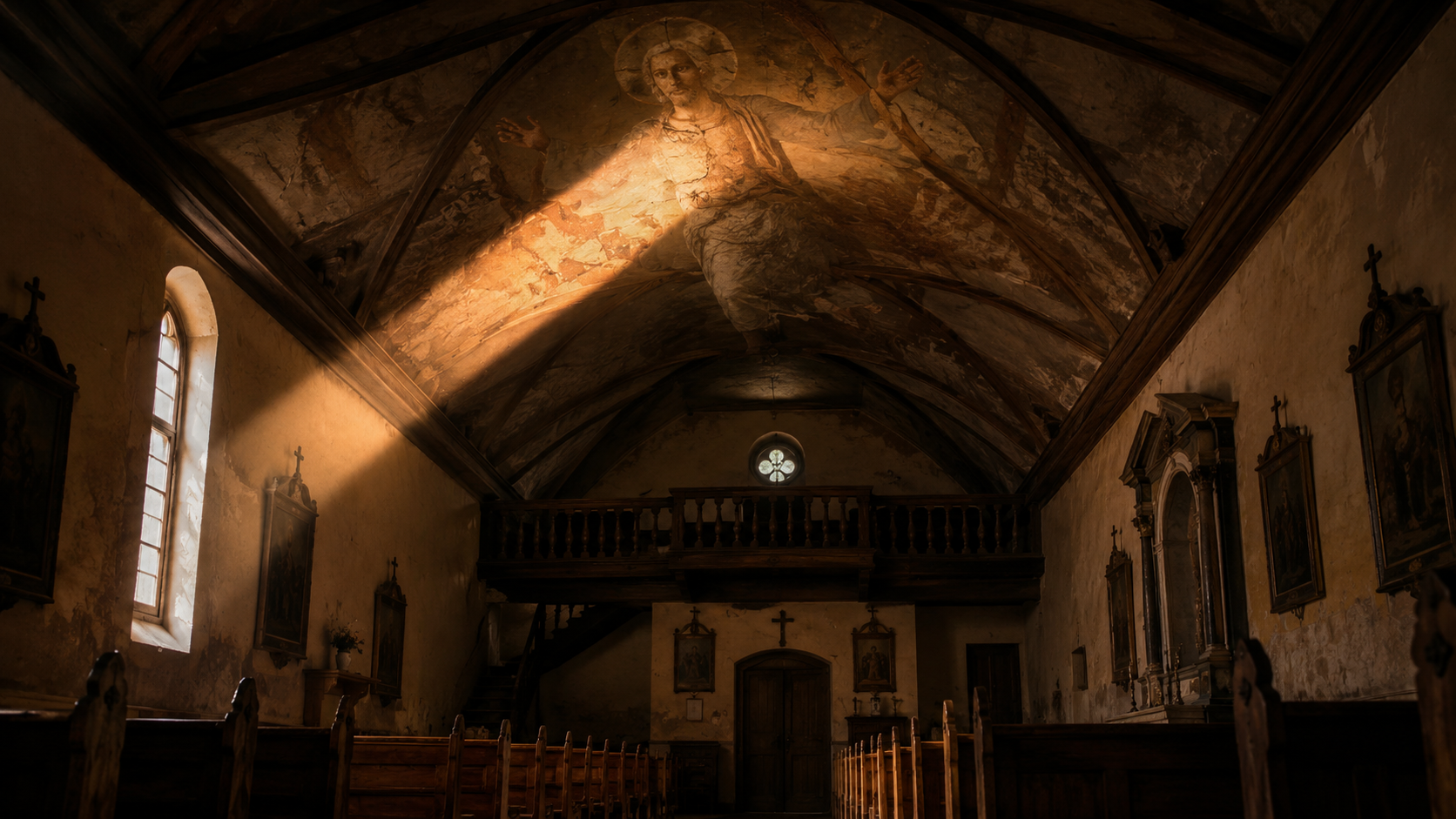
We attended Grace Lutheran in Red Lion for a season. The pastor was German, and one Sunday she told us about a church back home, an ordinary rural church, the kind you could set down in the Pennsylvania countryside and no one would look twice. By every measure a normal Lutheran congregation, in the very country that had been ground zero for the Reformation. But if you looked up, if you tilted your head back and studied the ceiling of the sanctuary, you found a painting. A pagan figure. An idol, or something close to it, left over from before Christianity had fully taken root in that place.
It had simply stayed there. Generation after generation gathered for worship beneath the image of the thing the gospel had come to displace, and nobody looked up. Or they looked up and no longer saw it, because it had stopped being an idol and become ceiling. It had become furniture, the unremarkable backdrop of the familiar. The figure did not survive by being defended. It survived by being forgotten in plain sight.
What strikes me is not the failure of that congregation. It is the patience of the pattern. The painting was not kept out of rebellion. It was kept because no one had yet asked the question that would make it visible as a problem. The truth that it did not belong was already true. It had been true the whole time. It simply had not been noticed to be true there yet.
This is, I have come to believe, one of the most honest patterns in the spiritual life. We do not arrive immediately. The conversion of a person, of a parish, of a whole culture, is not a single event but a long settling. The decisive turn happens, and it is real, and yet vast stretches of the old life go untouched by it for years, sometimes for generations, because the light has not yet reached that corner. The German village was not pretending. It was mid-journey, and a journey means you are genuinely on the road even on the day you are still far from home.
Scripture shows this everywhere once you start looking for it. The law made room for hardness of heart. Israel kept asking for a king. The Jerusalem church kept the temple hours. Peter, who had walked with Jesus and preached at Pentecost, still needed a vision on a rooftop and an argument with the Spirit before he understood that the gospel had already outgrown a boundary he was still policing. Revelation does not come as a single overwhelming download of the whole truth. We could not bear it if it did. It comes as a companion who walks with us at the pace of a journey.
And here is the line I keep returning to. That pace is typically ours, not his.
We tend to assume the slowness belongs to God. He is silent, he is withholding, he has not gotten around to us yet. But I think the order is reversed. The slowness is ours. What looks like divine delay is more often divine accommodation, God consenting to begin with people in the middle of their confusion and to stay with them there. He does not wait at the finish line and call to us. He walks the actual road at the actual speed we are able to walk it, which is not fast, and which doubles back, and which spends decades circling the same few miles.
I find this more hopeful than discouraging, though it took me a while to feel it that way. The unexamined ceiling is not first of all a verdict on the German church's failure. It is evidence of how long God is willing to remain in a room that is not yet what it should be. The Reformation itself makes the point. Ground zero, and yet the reform was never finished, was never going to be finished, which is the whole meaning of that old phrase, the church always being reformed. Not the church that arrived. The church still on the road.
I cannot leave it with the village, though, because the village is safely far away. The harder turn is inward. Every one of us is a sanctuary with a ceiling we have not fully examined. We were converted, genuinely, and then we spend the rest of our lives discovering the rooms the gospel has not yet entered. The habit we have stopped noticing. The resentment that has become part of the architecture. The assumption we inherited so early we have never once thought to question it. We are all worshiping under something we have not looked hard at, and the settled, orthodox-looking congregations are no exception, and neither am I.
Sanctification has exactly the shape of that journey. Real from the first moment. Complete only at the last. The disciples taking their permitted Sabbath distance back into the city were not yet who they would be when the Spirit fell. But they were already his. The being-his came first. The becoming took a lifetime, and it took it at their pace.
The painting in Germany was eventually noticed. Some generation finally tilted its head back and saw. That is the grace hidden in the story too. The light does reach the corner, in the end. It just travels at the speed of a Sabbath day's journey, and it travels the whole way with us.



Comments