In the first part I left us in the worst possible place. The mind sealed inside its own constructions, the cogito airtight because it touches nothing, Descartes in his room and Adam behind the hedge, both of them holding a knowledge that turned out to be exile. I ended by saying the cure runs in the opposite direction, that to know rightly is to receive rather than to seize. That is true, but it is also the kind of thing a person can say without having the faintest idea how it would actually work. If the Cartesian is trapped inside his own ideas with no guaranteed bridge back to the world, saying "just trust" does not build the bridge. It only tells him to stop worrying about the gap. Newbigin is after something better than reassurance. He wants to show that the bridge was never missing, that we have been walking across it the whole time, and that the only reason we cannot see it is that we have been staring at the wrong thing.
So he hands us a hammer.
Pick one up and drive a nail. The hammer presses against your palm the entire time, and you barely feel it. You are not attending to the pressure in your hand. You are attending to the nail. The whole of your awareness has run down your arm, through the handle, out to the point of contact where the steel meets the wood. If you stopped and turned your attention back to the sensation in your palm, to what the hammer is doing to your hand, you would lose the nail. The blow would go wide. To use the tool well is precisely to not notice the tool, to let your awareness pass through it to the thing it is for.
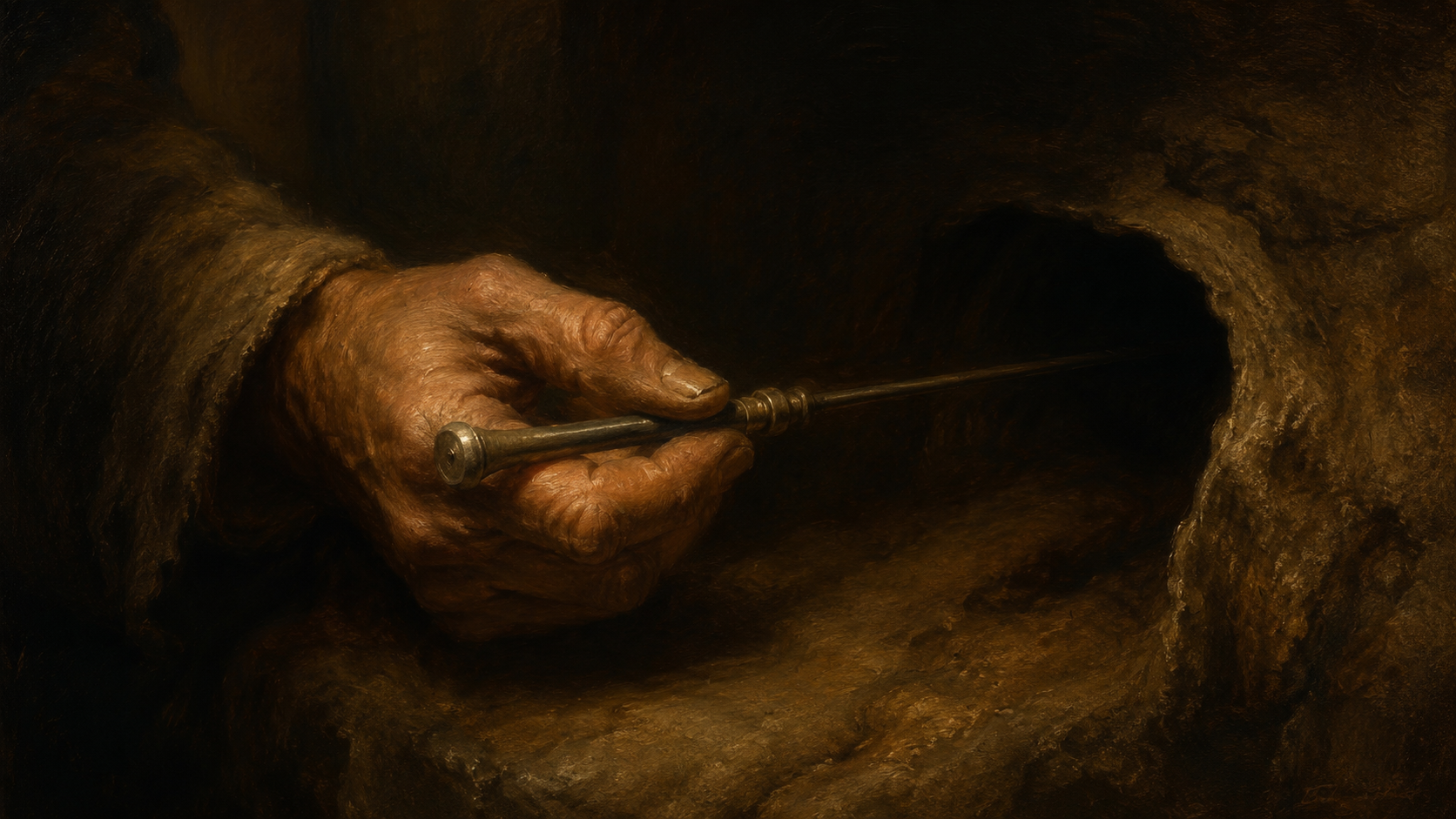
Newbigin borrows the sharper version from Polanyi. A doctor explores a body cavity with a probe. The skilled physician pays almost no attention to the instrument in his fingers. He attends to what the probe is telling him about the tissue at its far end. The probe has become, for the duration of the examination, an extension of his own hand, a part of the reaching self rather than an object he is examining. He feels the cavity, not the probe. And here is the detail that should stop you. The only person in the room who attends to the probe itself is the apprentice, the student whose hands are not yet skilled enough to forget it. Clumsiness is what it looks like to be focused on your tools. Competence is what it looks like to have forgotten them in favor of the world.
I have spent enough years with my hands inside broken systems to know this is exactly right. When a thing is working in me, when I actually understand the network or the failure I am chasing, I am not thinking about the commands or the concepts at all. They have gone transparent. I am thinking about the problem, and the tools have dissolved into the reaching. It is only when I am out of my depth that I become aware of the instrument in my hand, that I start fumbling with the syntax instead of seeing through it. The mark of mastery is that the tool disappears.
Now set that next to the Cartesian disaster from Part 1 and watch what happens.
Descartes' whole error was to turn and stare at the probe. He took the instruments of knowing, the mind, its ideas, its words and concepts and mathematics, and he made them the object of his attention instead of the means of it. He asked, can I trust this tool, can I be certain of these ideas, before I will let myself attend to anything beyond them. And the moment he did that, the moment he focused on the probe in his own hand rather than the world at its tip, he lost the nail. Of course he could not find the bridge back to reality. He had stopped reaching through the instrument and started inspecting it. The very act of demanding certainty about the means of knowing is the act that severs you from the thing known. Doubt is the apprentice's clumsiness raised to a philosophy.
This is the answer Part 1 was missing. We do not get back to the world by first proving our tools reliable and then cautiously using them. That order is impossible. It is the order that traps you in your own head forever, because you can never inspect the probe thoroughly enough to satisfy a doubt that has made inspection its only mode. We get back to the world by indwelling the tools, by relying on them without attending to them, by letting our awareness run through them to the reality they were always for. The bridge is not something you build after the audit. The bridge is what you are standing on while you conduct it.
And then Newbigin does something I did not expect. He names the whole collection of these tools. All of them together, the language we speak, the symbols we think with, the concepts and the mathematics and the inherited ways of seeing, the entire apparatus we reach through to touch the world. He calls it culture. The tools are not private equipment each of us forges alone in a sealed room, which was Descartes' fantasy of himself. They are given. We learn them young, before we could possibly evaluate them, absorbed from a community that was using them long before we arrived and handed them to us the way a trade is handed down. We indwell a culture the way the physician indwells the probe, and we reach through it to a reality none of us invented.
Which brings me to the one place I want to press on Newbigin, except that pressing on it turns out to strengthen him.
He describes our taking up of these tools as a commitment. He reaches for the image of an infant learning to focus its eyes and calls even that a kind of commitment to learning how to use them. When I first read it I wanted to push back. Commitment is too grand and too deliberate a word for what an infant does. No baby resolves to see. We do not decide to learn our mother tongue. The reaching for the tools is not chosen. It is instinctual, woven into us from the first, so deep that even the laziest person alive cannot stop himself from learning, if only new ways to be lazy. We are learning creatures the way we are breathing creatures. To call it commitment seemed to me to dress an instinct up in the clothes of a decision.
But I think the word is clumsy and the thing underneath it is exactly right, and once I saw what the thing was I had to give the point back to him with interest. Newbigin is not claiming the infant deliberates. He is making the anti-Cartesian point in its strongest form. You cannot first prove your faculties trustworthy and then elect to use them. You have to entrust yourself to them before you have any warrant at all, the way you trust language before you are able to so much as frame a doubt about it. That prior self-entrustment, made before proof and underneath choice, is what he is calling commitment. And here my instinct objection does not weaken his case. It hands him the strongest version of it. A commitment you chose, you could in principle reconsider. You could demand its credentials, second-guess it, put it on trial, which is precisely the move that locks the Cartesian in his room. But an entrustment that was woven into you before you could withhold it, that you were already enacting before you were capable of doubting anything, is bedrock the program of universal doubt can never get underneath. The doubt arrives too late. By the time you are able to question your tools, you have already been knowing through them for years. The instinct is the commitment, made for us before we were in any position to refuse it, and that is why no amount of subsequent doubting can dig beneath it. Newbigin reached for the word commitment and grabbed the weaker half of his own point. The instinct is the stronger half, and it was sitting right there.
So the picture that comes out of this chapter is the exact inverse of the one we started with. We began with a man alone in a room, refusing to trust anything he had not personally verified, and ending in exile. We end with a creature who was given its tools before it could ask for them, who reaches through them to a world it did not make, who knows by indwelling and trusting and attending past the instrument to the thing itself. The first man called his refusal reason and was proud of it. The second has nothing to be proud of and everything to be grateful for, which is the more honest position for a creature to be in.
And I cannot leave it at epistemology, because the more I sit with it the more it stops looking like a theory of knowledge and starts looking like a description of how we were made, and made on purpose. We are built to reach. The instinct goes down so deep that we cannot switch it off, that we go on learning even when we are trying not to, and we are equipped from infancy with tools we did not earn and a hunger to use them that we did not choose. That is not an accident of biology that faith later baptizes. That is the shape of a creature designed to find something. We were given the reaching and the instruments of the reaching by the same hand, and a gift that specific is not random. It is aimed.
Which tells me what all of this is finally for. The purpose was never the knowledge itself, never the catalog, never the closed fist around reality that the garden promised and could not deliver. The purpose is the One the reaching was always reaching toward. We were made to find Him, and the whole apparatus of knowing, the eyes and the words and the concepts and the inextinguishable itch to understand, is the equipment He gave us for the search. He wanted to be found, so He made finders.
And this is the part I find I cannot get over. It means there is no such thing as merely secular knowledge, no second tier of facts that have nothing to do with God because they were not stamped religious. The man bent over his equations, the scientist chasing his good problem, the technician with his hands in a broken system, the child learning that fire is hot, are all of them doing the one thing the creature was built to do. They are reaching through the given tools toward a reality they did not make, and every real thing they touch is His. All knowledge is of the same kind, because all of it is, whether the knower admits it or not, a way of feeling along the probe toward Him. To know anything truly is already to have begun, however blindly, to find Him.
There is no knowing without believing. There is no seeing without first, blindly and before all proof, trusting the eyes you were given to see with. And there is no reaching, of any kind, after anything at all, that is not finally a reaching for the One who made the creature to reach.


Comments