The book of Jonah is famous for the fish. Ask anyone, churched or not, what they remember about Jonah, and you'll get some version of the same answer: he got swallowed. Sunday school flannelgraphs, children's Bibles, the occasional sermon illustration. The fish has eaten the rest of the story.
Which is a shame, because the most theologically loaded moment in the first chapter isn't the fish at all. It's a single word in verse 4. In most English translations it's rendered "but," though the older versions sometimes have "however," and that's the one I want to sit with.
What verse 3 has just done
To feel the weight of verse 4, you have to notice what verse 3 has just accomplished. Read it slowly:
But Jonah rose to flee to Tarshish from the presence of the LORD. He went down to Joppa and found a ship going to Tarshish. So he paid the fare and went down into it, to go with them to Tarshish, away from the presence of the LORD.
The verse is a cage. It opens with "from the presence of the LORD" and closes with "from the presence of the LORD," and in between it stacks up motion verbs all pointing the wrong direction. Rose. Fled. Went down. Found. Paid. Went down. Two descents in a single sentence, which the Hebrew narrator is doing on purpose; Jonah's whole arc in chapter 1 is downward, and it will keep going down — into the hold of the ship, into sleep, into the sea, into the belly of the fish, eventually (in his own words) into the roots of the mountains.
And right in the middle of all that downward motion is a detail the narrator did not have to include: he paid the fare. Calvin noticed this and wouldn't let it go. Why does scripture bother to tell us about the receipt? Because disobedience is never free. Jonah is not stumbling away from God in a fog of weakness; he is making a transaction. He is signing a contract. He is investing resources in his own flight. Sin, the detail quietly insists, is something you spend money on. The fare is the moment passive reluctance becomes active rebellion, the point of no return, financially and narratively. He is all in.
By the end of verse 3, the cage is locked. Jonah has done everything a man can do to put distance between himself and the call of God. If the story ended there, the conclusion would be that he got away.
However
And then, verse 4:
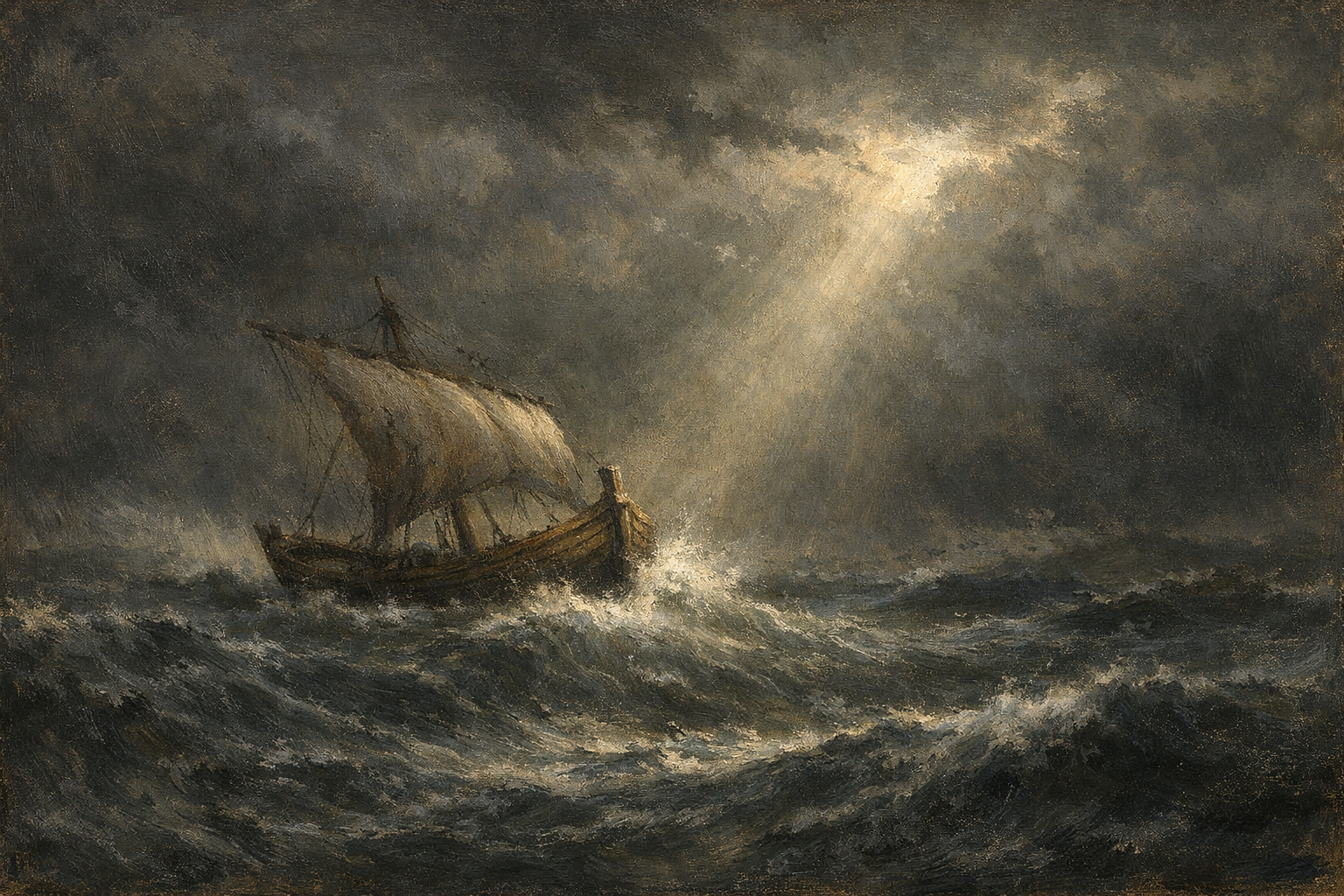
However, the LORD hurled a great wind upon the sea.
Everything pivots on that word. One conjunction, and the whole logic of verse 3 collapses. The cage was never a cage. The ship is on God's water. The wind is in God's hand. The "presence of the LORD" Jonah thought he was fleeing turns out to be — as Jonah himself will confess to the terrified sailors a few verses later — the presence of "the God of heaven, who made the sea and the dry land." There is no Tarshish far enough. The very medium of the escape belongs to the One being escaped.
What makes the however so striking is that it doesn't look like mercy at first. It looks like wrath. It looks like a storm. It looks like a God who refuses to be ignored and is willing to terrify a boatload of pagan sailors to make the point. And yet the entire book hinges on the recognition that this storm is grace — that being hunted down by God is the kindest thing that can happen to a man running toward his own destruction. If God had simply let Jonah go to Tarshish, that would have been the real judgment. The however is the refusal to abandon. It is Hosea's "How can I give you up, Ephraim?" rendered as weather. It is the shepherd leaving the ninety-nine, except the lost sheep has paid for a ferry.
There is a verb running through chapter 1 like a thread, and once you see it you can't unsee it. Hetil — to hurl. The LORD hurls the wind. The sailors hurl the cargo. Eventually they hurl Jonah himself. Every motion in the chapter is God's motion. Jonah thought he was the actor in verse 3; from the however onward we discover he never was. The whole scene has been directed from above all along.
An aside about flawed prophets
I love Jonah, and I think I love him for the same reason I love most of the compromised characters in scripture. They resonate, and they offer relief.
The Hebrew Bible has an almost stubborn refusal to clean up its heroes. Abraham lies about his wife — twice. Jacob is a con man who walks with a limp the rest of his life because he wrestled God and wouldn't let go. Moses kills a man and then spends forty years arguing with God about his own inadequacy. David, the man after God's own heart, commits adultery and arranges a murder to hide it. Elijah, fresh off Mount Carmel, collapses under a juniper tree and asks to die. Peter denies he ever knew Jesus, three times, by a fire.
Compare that to almost any other ancient religious literature and the contrast is vivid. The heroes of other traditions tend to grow more heroic over time, not less. Scripture moves the opposite direction. It keeps showing us the cracks, and then it keeps insisting that the cracks are exactly where the light comes through.
This is, I think, what the Reformed tradition has always wanted to protect when it talks about grace: that God's purposes are not contingent on the purity of our motives. If they were, none of us would survive a single morning. My failures are myriad, my motivations are never pure, and yet somehow, through grace, God draws his will out of them anyway. That's not a license for complacency. It's a relief. The pressure comes off. You don't have to be Elijah on Carmel to be useful to God. You can be Elijah under the juniper tree, or Jonah in the hold of the ship, and the however will still find you.
The book of Jonah is almost mischievous about this. God uses a runaway, sulking, half-repentant prophet to bring about what is arguably the most successful evangelistic mission in the entire Old Testament. An entire pagan city repents in sackcloth, livestock included, and the prophet responsible sits on a hill outside of town pouting because it worked. The mission succeeds through Jonah and despite him at the same time. His obedience, when it finally arrives, is grudging and minimal — eight Hebrew words of preaching, by some counts — and God honors it anyway.
The word that won't let us be the last word
Back to the hinge. What I find pastorally important about Jonah 1:4 is that the however is not a feature of Jonah's prophetic call alone. It is the shape of grace itself. It is the word God speaks at the moment we have most thoroughly convinced ourselves that we have gotten away — from a calling, from a conviction, from him.
The mercy is not that God lets us go. The mercy is that he doesn't.
The cage of verse 3 is the cage every one of us has built at one point or another, with our own hands, with our own money. Some of us are still inside one now. The good news of the book of Jonah, before any of the preaching or the repenting or the great fish, is the news that the cage doesn't hold. There is always a however. The wind is already on the way.
That is not a comfortable word, exactly. Storms aren't comfortable. But it is the kindest word in the chapter, and possibly in the whole book — the announcement that God has refused to let Jonah be the last word on Jonah. He refuses to let me be the last word on me. He refuses to let you be the last word on you.
And that refusal, dressed up as a storm, is the gospel in one conjunction.


Comments