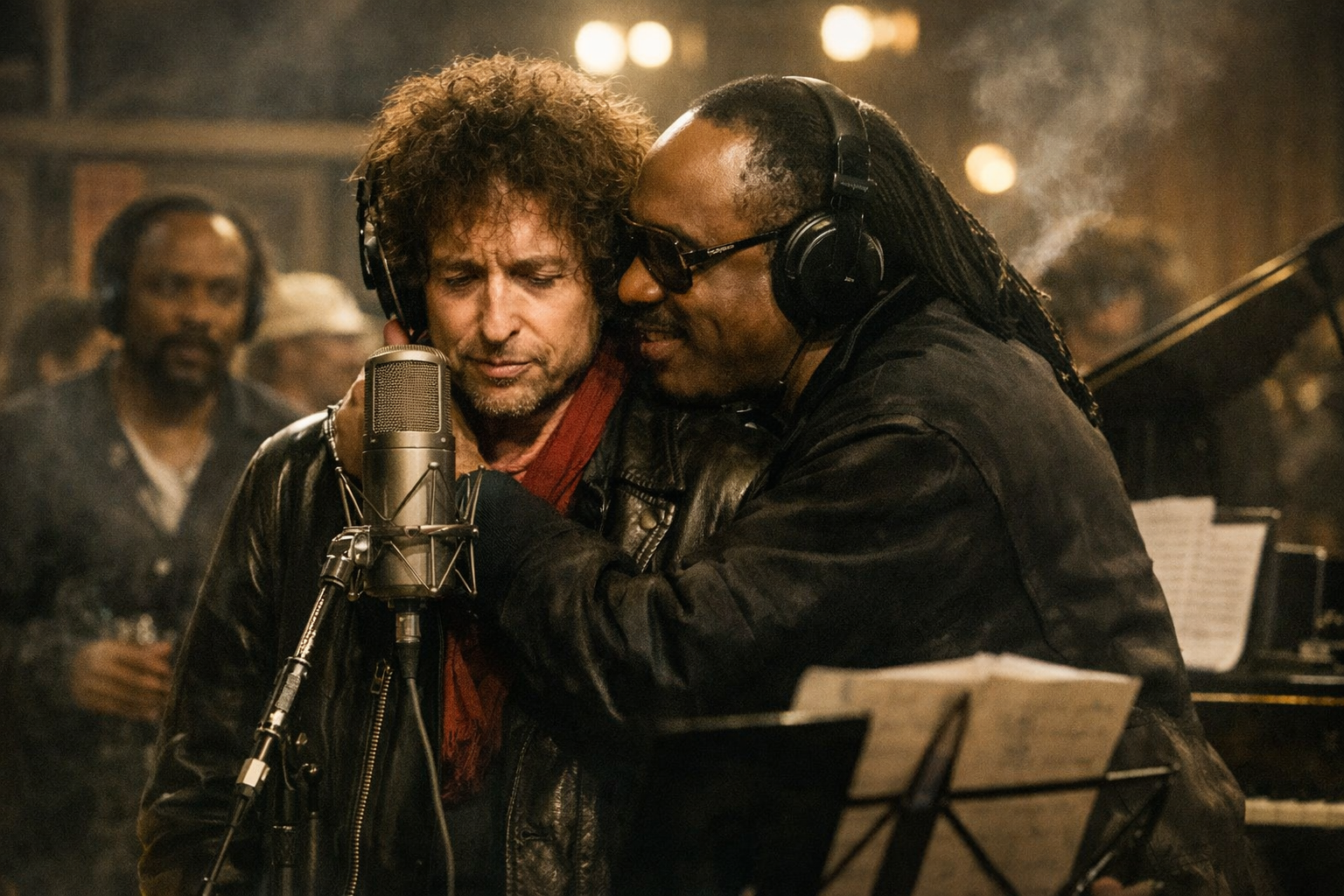
It's 5:30 in the morning at A&M Studios in Los Angeles. January 28, 1985. The biggest names in music have gathered to record "We Are the World," and most of them are exhausted, exhilarated, ready to call it a night. But Bob Dylan—the voice that shaped a generation, the poet laureate of rock and roll—is standing at the microphone, barely able to get through his four lines.
He's nervous. Uncertain. The man who once recorded fifteen songs in a single day for Blood on the Tracks cannot find his way into two simple sentences: "There's a choice we're making; we're saving our own lives."
Quincy Jones tries to help, tells him he can sing in a different key if he wants. It would actually be wonderful if he did—turning the mistake into a virtue. But Dylan is still stuck. The legend is exposed.
Then Stevie Wonder sits down at the piano. He doesn't lecture. He doesn't critique. He simply starts singing Dylan's part—as Dylan. The blind musician mirrors back the very voice that doesn't know how to use itself. And something breaks open. Dylan watches someone else become him, and through that strange gift, finds his way back to himself.
He nails the take.
What happens next is the part that stays with me. In the footage, after it's over, Stevie is close to him—an embrace, an intimate moment between two men who just shared something words can't quite hold. And you can hear Dylan, muffled but unmistakable, muttering the same phrase over and over: "You know, man. You know."
I think about what Dylan might have meant by that. Here is a man who revolutionized American music with a voice that—let's be honest—can't really sing. Not like Stevie can. Not like almost anyone in that room could. Dylan's genius was never technical. It was something else, something harder to name. And for twenty years, maybe there's been a whisper in the back of his mind: I've been getting away with something. I'm a one-trick pony. If anyone really looked closely, they'd see through it.
And now he's standing in a room full of people who can sing, and he can't find his way into four simple lines. The fear is confirmed. The hack is exposed.
Then Stevie sits down and imitates him. And this is the knife's edge of the moment: Is he mocking me? Is he showing me how easy it is to do what I do—how anyone with actual talent could replicate my "style" in thirty seconds?
But that's not what happens. Stevie's imitation isn't mockery. It's mirror. He's showing Dylan that the thing he thought was a limitation—the nasal, untrained, wholly unique voice—isn't a gimmick. It's irreplaceable. It's him. No one else in that room could have sung Dylan's part, because no one else is Dylan.
"You know, man."
You know I can't really sing. You know I've been faking it. You know I'm not like the rest of you.
And Stevie's answer, without words: Yes. I know. And the thing you thought disqualified you is exactly what makes you irreplaceable.
I've been sitting with Psalm 40 this week, and verse 9 arrested me:
I have proclaimed good news of righteousness in the great congregation;
Behold, I will not restrain my lips,
LORD, You know.
"LORD, You know." In Hebrew, Yahweh attah yadata. It's the same prayer Dylan was praying to Stevie Wonder in that studio. Not a boast. Not a defense. Just the raw acknowledgment of being fully seen.
The Psalm is messianic—Christ alone could stand before the Father and say these words with perfect confidence. He proclaimed righteousness without any gap between proclamation and practice. He alone could say "You know I did it right."
But what about the rest of us? What does "LORD, You know" mean for someone whose righteousness is, as Isaiah puts it, filthy rags?
Here's what I keep circling back to: the problem isn't just that I sin. It's that I can't even produce a clean motive. Why do I love? Partly for the pleasure it brings me. Why do I sacrifice? Partly to satisfy something in myself. The moment I try to purify my intentions, I find self-interest woven into the very act of trying. It's turtles all the way down.
Luther called us simul justus et peccator—simultaneously righteous and sinner. Not sequentially. Not "sinner becoming righteous." Both, at the same time, all the way to the root.
So when I pray "LORD, You know," I'm not saying "You know I got it right." I'm saying "You know I cannot. You know my righteousness is a tangled mess of genuine love and self-interest. You know the only clean thing in this entire transaction is what You've done."
The honesty itself becomes the offering. Not the purity of my motive, but the truthfulness of my confession that no purity exists in me.
Dylan at that microphone is all of us. The carefully constructed identity that works everywhere else suddenly failing in the moment that matters. The performance collapsing. The legend revealed as a man who can't find his way into a simple melody.
More than that—it's the terror that we've been getting away with something. That the thing people praised was never real. That we're about to be found out.
And there's Stevie—who cannot even see Dylan's face—meeting him in that exposed place. Not judging. Not exposing. Somehow saying, without words: the broken thing you thought disqualified you is exactly where I meet you.
That's the gospel. We come to God convinced we've been faking it, that if He really looked He'd see the hack behind whatever small reputation we've built. And He says: "I know. I've always known. And I'm not here to expose you—I'm here to tell you that your weakness was never the thing keeping us apart. It was always the place where I intended to meet you."
"You know, man."
Verse 6 of the Psalm whispers something crucial: "Sacrifice and offering You have not desired." The whole system of bringing something clean to God gets swept aside. What's left?
Verse 7: "Behold, I have come."
The only pure offering shows up in person. Not a lamb, not a ritual, not my best attempt at righteousness—but Christ himself, stepping into the place where I stand exposed and saying "I know. And I've got this."
So "LORD, You know" becomes something other than terror. It becomes relief. The exhausting project of self-justification can finally end. The performance can stop. Someone sees all of it—the tangled motives, the partial obedience, the love shot through with selfishness—and doesn't walk away.
You know, man.
You know.


Comments