2 Samuel 7:12–15 (NASB 2020)
**12 “**When your days are finished and you lie down with your fathers, I will raise up your descendant after you, who will come from you, and I will establish his kingdom. 13 He shall build a house for My name, and I will establish the throne of his kingdom forever. 14 I will be a father to him and he will be a son to Me; when he does wrong, I will discipline him with a rod of men and with strokes of sons of mankind, 15 but My favor shall not depart from him, as I took it away from Saul, whom I removed from you.”
This passage is widely recognized as messianic prophecy—until verse 14. When God says "when he does wrong," most interpreters assume the prophecy shifts from Messiah back to Solomon. Christ was sinless, so this clause must refer to someone else.
But this creates tension. If the entire passage prophesies about Christ, verse 14 confronts us with penal substitutionary atonement's central paradox: was the sin for which God poured out His wrath on Christ merely imputed, or did Christ bear it in a more substantial, personal sense?
The question sounds jarring. God incarnate with personal sin? Yet I propose a third option: imputed personal sin—sin that was credited to Christ and became His to bear, making Him the object of divine wrath. This distinction unlocks deeper appreciation for the atonement.
The Traditional Arguments
The case against applying verse 14 to Christ rests on three pillars:
First, the grammar suggests personal transgression. "When he does wrong" uses conditional language about the descendant's own sin. The Hebrew בְּהַעֲוֺתוֹ refers to active wrongdoing, not imputed guilt.
Second, Christ's sinlessness is non-negotiable. Hebrews 4:15 declares Him "without sin." 2 Corinthians 5:21 and 1 Peter 2:22 reinforce this. He bore our sins but never committed sin Himself.
Third, the historical fulfillment fits Solomon. Solomon sinned through idolatry with foreign wives (1 Kings 11). God disciplined him through adversaries and kingdom division. Yet God maintained the Davidic line, unlike with Saul—exactly as verse 15 promises.
Traditional interpretation sees partial fulfillment: the eternal kingdom points to Christ (v. 13), but the discipline for wrongdoing applies only to Solomon and the Davidic dynasty (v. 14). Not every prophetic detail must apply to the ultimate fulfillment.
But this creates a problem for substitutionary atonement.
If Christ remained personally sinless while bearing imputed sin, what justified God's wrath? God is just—He would never punish an innocent person. Yet Christ experienced God's wrath on the cross. Something substantial must have happened at imputation to make that wrath just.
A Possible Middle Ground
The Levitical sacrificial system illuminates this paradox.
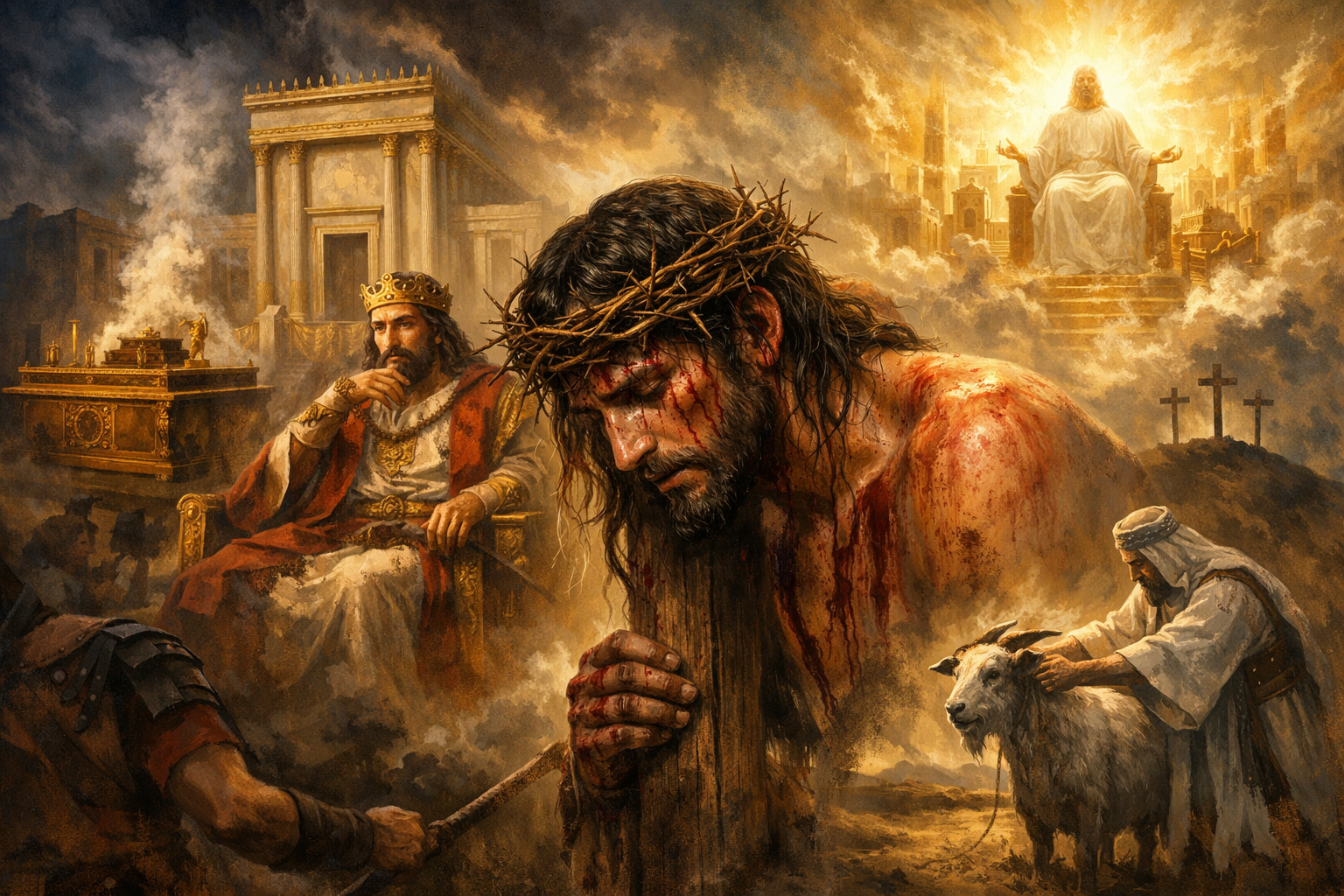
In Leviticus 16:21-22, the high priest lays hands on the scapegoat's head, confessing Israel's sins over it. The text says he "shall place them on the head of the goat"—actual transfer, not symbolic gesture. The goat then carries those sins away.
Crucially, the animal must be unblemished before imputation. After imputation, it bears real sin. No one worried whether the goat "remained sinless" after the ceremony. The requirement was that it start unblemished.
This sequence matters:
- Before imputation—the victim is pure, unblemished, acceptable
- At imputation—sin transfers from offerer to victim
- After imputation—the victim bears the sin and receives judgment
Christ follows this pattern perfectly. He was unblemished before the cross—His pre-imputation sinlessness qualified Him as acceptable sacrifice. But at the cross, our sin was placed on Him. Not merely credited to a ledger, but transferred in the way the scapegoat bore Israel's sin.
The strong biblical language supports this:
- "He made Him who knew no sin to be sin" (2 Corinthians 5:21)
- "Having become a curse for us" (Galatians 3:13)
- "The LORD was pleased to crush Him" (Isaiah 53:10)
These aren't metaphors for legal fiction. They describe real identification with sin. Christ became what we are so we could become what He is.
This resolves the justice problem. God didn't punish an innocent bystander. He punished real sin—sin that was really on Christ through imputation. The wrath was just because it fell on actual guilt, even though Christ never personally transgressed.
Verse 14 can prophetically describe this mystery:
- "When he does wrong"—when imputed sin is placed on Him
- "I will discipline him"—God's wrath poured out
- "With the rod of men and the strokes of the sons of mankind"—Roman crucifixion through human agents
Solomon's actual sins provided typological foreshadowing. Christ bore imputed sin. Both were disciplined. Both remained in the covenant. The prophecy carries dual fulfillment at different levels.
What This Means For Our Understanding Of The Atonement
This interpretation deepens rather than diminishes the atonement's power.
First, it honors the reality of imputation. Weak theories that make imputation merely legal bookkeeping cheapen Christ's sacrifice. If God's wrath fell on Christ, the sin must have been substantially present. The Levitical system shows that imputation means real transfer.
Second, it explains Christ's experience of forsakenness. "My God, My God, why have You forsaken Me?" (Matthew 27:46) makes more sense if Christ bore real sin that caused real separation from the Father. Legal fiction doesn't break fellowship. Sin does.
Third, it maintains Christ's qualification as perfect sacrifice. The traditional objection—"if Christ became sinful, He can't save us"—conflates two categories:
- Personal commission of sin (which Christ never did)
- Bearing imputed sin (which He did, as the sacrifice required)
Christ never transgressed. But He was so identified with our sin that God treated Him as the guilty party. The sacrifice works precisely because the unblemished one voluntarily took sin upon Himself.
Fourth, it magnifies the cost of redemption. Christ didn't merely stand near sin. He became sin. He didn't just pay a fine from a distance. He entered fully into our condemnation, experiencing the full weight of divine wrath against sin.
Pause here. Consider what happened at the cross. The Holy One—dwelling in unapproachable light, before whom seraphim cover their faces—took sin into Himself. God, who is righteousness, justice, purity, and light, became identified with everything opposite to His nature. Corruption touched incorruption. Darkness enveloped the Light of the World. The chasm between holiness and sin is infinite, yet God crossed it. Language fails. We can only stand silent before this mystery.
The resurrection proves sin didn't ultimately corrupt Him. He carried it away like the scapegoat into the wilderness, defeated it, and rose vindicated. More than that—He became "the firstfruits of those who have fallen asleep" (1 Corinthians 15:20). The pattern is set. What was true of Him will be true of us. Sin bore down on Christ with its full corrupting weight, yet He rose incorruptible. We who are in Him will follow. Sin will not ultimately corrupt the believer either. The firstfruits guarantees the harvest.
Finally, it reveals the Trinity's love. This wasn't injustice—it was voluntary substitution planned before creation. The Father and Son agreed. Christ willingly laid down His life (John 10:18). The innocent one volunteered to become the guilty one so the guilty could become innocent.
The cost wasn't merely physical death. It was the Holy One becoming sin. God experiencing what is most alien, most abhorrent, most opposite to His nature. For us.
The cross remains foolishness to those who are perishing (1 Corinthians 1:23). How can the sinless bear sin? How can the innocent receive wrath? The answer lies not in making imputation less real, but in recognizing its terrible, wonderful reality.
Christ didn't just stand in our place. He became us—taking our sin as His own—so we could become Him, receiving His righteousness as ours.
This is the double imputation at the heart of the gospel. And 2 Samuel 7:14, read as messianic prophecy in full, may describe it more precisely than we've dared to believe.
So What Now?
This passage came from an Advent reading. Advent—when we prepare for Christmas, celebrate the incarnation, remember God taking on flesh.
But if this reading teaches us anything, it's that incarnation was only the beginning. God didn't just become human. He became sin. The baby in the manger was born to bear what no one else could. The eternal kingdom promised in verse 13 required the discipline described in verse 14.
So as you light Advent candles and celebrate Christ's coming, remember what He came to do. Two responses follow:
Stop cheapening it. Casual sin mocks what cost God everything. When you minimize transgression or rationalize disobedience, you're treating lightly what required the Holy One to become sin. The gravity of the cross measures the gravity of sin.
Stop doubting it. If imputation was real enough for God to crush His Son under its weight, it's real enough to cover you completely. Your sin—past, present, future—was placed on Christ as thoroughly as Israel's sins were placed on the scapegoat. He carried it away. It's gone.
The same transfer that made Christ guilty makes you righteous. If you believe the first half, believe the second. Completely.



Comments