The Question No One Wants to Answer
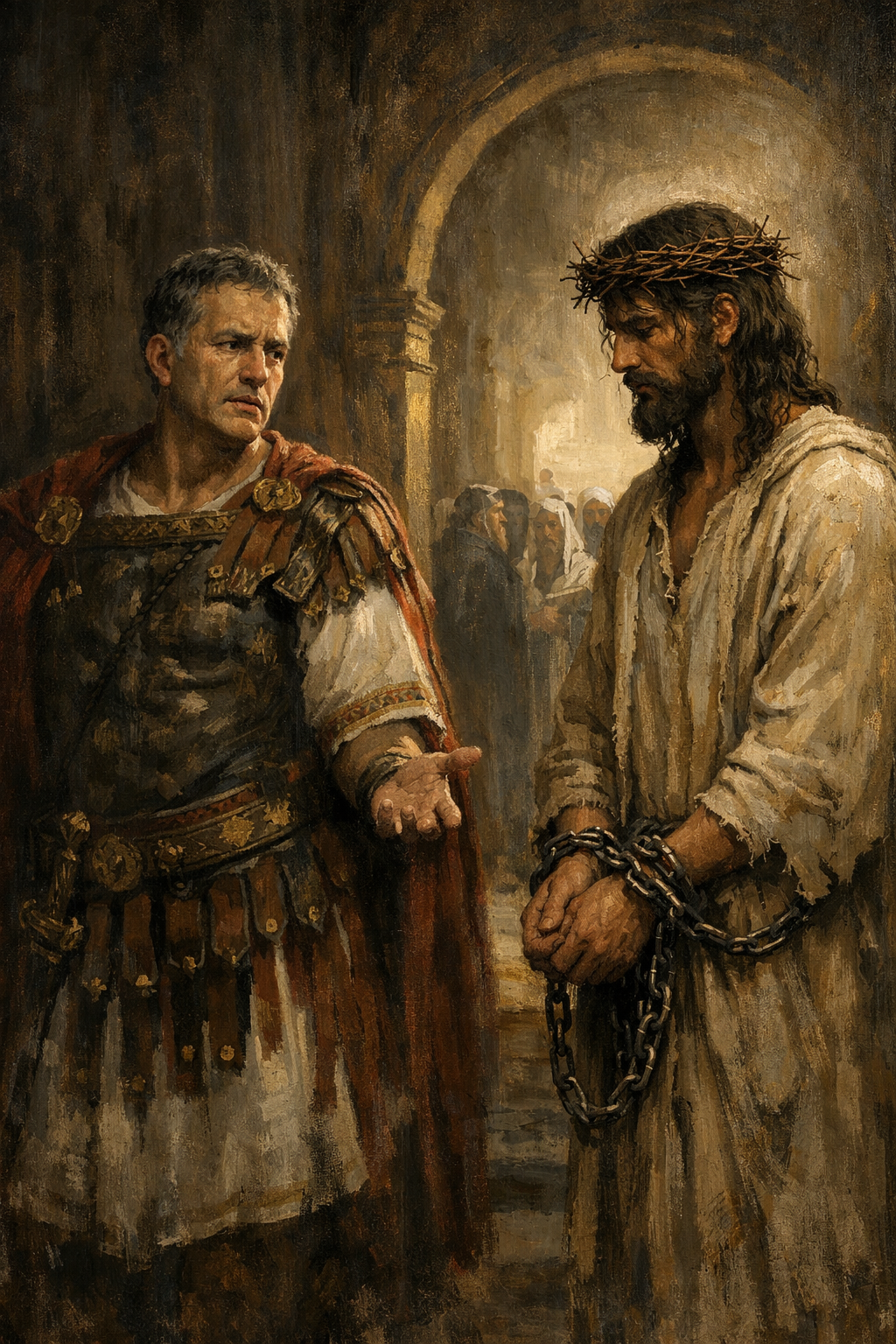
Pilate asks the question while standing in front of the answer.
Jesus has just told him, "Everyone who is of the truth hears my voice." Pilate responds, "What is truth?" — and then walks away without waiting for an answer.
It's tempting to read this as cynicism, the jaded Roman bureaucrat dismissing the very idea of truth. But I don't think that's what's happening. Pilate sounds exhausted. He's a man caught between competing power structures — religious and political — trying to navigate an impossible situation with a real human being standing in front of him. He's watched the Pharisees manipulate the system all morning. He's seen their religious posturing, their careful choreography of outrage. And now he's face to face with someone who claims to embody truth itself, but who stands before him in chains, powerless, making no effort to defend himself.
What is truth? It's not philosophy. It's almost a sigh.
Meanwhile, outside the Praetorium, the Pharisees wait. They won't come inside because entering a Gentile building would make them ceremonially unclean for Passover. Think about that. They're orchestrating an execution — pressuring a Roman governor to kill a man they know is innocent — but they're scrupulous about ritual purity. They won't risk contamination while demanding blood.
Religion performing itself. Righteousness as theater.
What Does God Actually Require?
Seven centuries before Pilate's question, the prophet Micah asked a similar one: What is good?
The context matters. Israel had come to God with a kind of anxious bargaining. What do you want from us? Burnt offerings? Thousands of rams? Rivers of oil? Should we sacrifice our firstborn children? They're reaching for the most extreme religious gestures they can imagine, escalating the performance, hoping something will finally satisfy.
God's answer sweeps all of it aside:
He has told you, mortal one, what is good: to do justice, to love kindness, and to walk humbly with your God.
No temple activities. No sacrificial system. No elaborate religious machinery. Justice, kindness, humility — these are relational. They only make sense in contact with other people, out in the world, in the mess of actual life.
The prophet is dismantling religion from within the tradition itself.
When Religion Becomes Machinery
Here's what strikes me: Micah's audience wasn't irreligious. They had plenty of religion. They had the temple, the priesthood, the sacrificial calendar, the feast days, the whole apparatus. What they lacked was the heart of it.
The Hebrew word for justice here is mishpat. We tend to hear that as courtroom language — fair rulings, legal process, the scales balanced. And it includes that. But in this context, Micah seems to be using it more broadly. He's just finished listing burnt offerings, rams, rivers of oil — the currency of ritualized religion. When he pivots to mishpat, he's not moving from liturgy to law. He's contrasting the whole system of religious performance with something else entirely.
Israel had built an elaborate structure of requirements. They knew exactly what to sacrifice and when, exactly how to approach God, exactly which rituals rendered them clean. But the structure had become the point. The machinery of religion had replaced relationship with God. They had mishpat in the sense of a system — ordered, codified, rigidly maintained — but they had lost mishpat in the sense of actually doing right by God and neighbor.
It's the difference between religion as performance and faith as presence.
The Word That Changes Everything
The next word is the one that changes everything: chesed.
Most translations render it "kindness" or "mercy," but neither captures it fully. Chesed is covenantal language. It describes loyal love — the kind of committed faithfulness that flows from relationship. When God shows chesed, it's not arbitrary compassion. It's his covenant promise in action. And when Micah tells Israel to love chesed, he's calling them to embody that same posture toward others.
Here's what's interesting: chesed is actually embedded in the biblical concept of justice itself. In the Hebrew mind, justice wasn't purely judicial. It included mercy, compassion, restoration. These weren't in tension the way we frame "justice vs. mercy" in Western thinking. They were facets of the same reality — reflecting God's character and his desire for shalom, the wholeness and flourishing of creation.
So why does Micah name chesed separately? If mercy is already part of justice, why pull it out and give it its own line?
Because Israel had stripped it away.
They still had the religious system — the rituals, the sacrifices, the formal structures. They still had a version of mishpat — legalistic, codified, carefully maintained. But they had divorced it from chesed. The covenantal loyalty and relational faithfulness that was supposed to animate everything had been hollowed out. What remained was rigid, transactional, self-serving. Religion without heart. Law without love.
Micah isn't adding something new. He's calling them back to what was always supposed to be there. And he's not just telling them to practice chesed — he's telling them to love it. To make covenant faithfulness central, not peripheral. To stop treating mercy as an optional add-on and recognize it as the heartbeat of everything God requires.
Justice Without Mercy
This is where Pilate comes back in.
Pilate ultimately makes a pure mishpat decision — if we define mishpat the way Israel had corrupted it. He follows procedure. He finds no fault in Jesus, says so publicly, then defers to the system. He washes his hands — literally separating himself from the moral weight of what he's authorizing — and lets the execution proceed.
He administers "justice" emptied of chesed. He maintains order. He keeps the peace. And in doing so, he participates in the greatest injustice in history.
The Pharisees do the same thing from the religious side. They have their system — the purity codes, the Passover requirements, the carefully maintained boundaries of clean and unclean. They follow every rule. They won't even enter the Praetorium. But their religion has become machinery. It runs smoothly while they orchestrate a murder.
The question Micah asked — What is good? — and the question Pilate asked — What is truth? — turn out to be the same question. And both are asked by people standing in front of the answer, unable or unwilling to see it.
How We Bend God's Commands Into Our Own
We do this too. Maybe not as dramatically, but the pattern is the same.
There are two ways God's commands get bent into commandments of men.
The first is interpretive distortion — subtle reframing, nuanced shifts that seem minor but change the essence of what God desires. Sometimes they present themselves as fresh insight, a new angle that unlocks something hidden in the text. But a thousand small turns and you're facing the opposite direction without realizing how you got there.
The second is selective emphasis — amplifying what suits us while quietly ignoring what doesn't. Not rejecting God's word, but putting all the weight on one part and letting the other fade into the background.
Jesus called out the Pharisees for exactly this: "You tithe mint and dill and cumin, but you have neglected the weightier matters of the law — justice, mercy, and faithfulness." They didn't reject the law. They were meticulous about the parts that made them look righteous. They just ignored the parts that would cost them something.
A Contemporary Illustration
This same fracture showed up in my reading this week.
House Speaker Mike Johnson and Pope Leo XIV have been sparring publicly over immigration policy. Johnson's argument runs like this: "Sovereign borders are biblical and good and right... We should love our neighbors ourselves as individuals, but as a civil authority, the government has to maintain the law." He draws a sharp line between private charity and public duty. Mercy is personal. Justice is governmental. The two operate in separate spheres.
Pope Leo counters that how you administer justice matters — that treating people humanely, with dignity, is itself part of what makes justice just. He's not denying the legal framework. He's insisting that chesed can't be stripped out of mishpat and relegated to private life.
I'm not interested in adjudicating the policy debate. What strikes me is how cleanly the exchange maps onto Micah's critique. One position separates justice from mercy and assigns them to different domains. The other insists they can't be separated — that justice without compassion isn't the justice God requires.
Micah already answered this question. The call to love kindness means making covenant faithfulness constitutive of justice itself, not a private addendum to it. You don't get to wash your hands.
The Clay Playing Potter
Isaiah saw the same inversion and named it directly: "You turn things around! Shall the potter be considered as equal with the clay?"
The Hebrew root is haphak — to overturn, to reverse. It's the same word used for the destruction of Sodom. There's a sense of perversion in it, of turning reality upside down.
Isaiah's accusation is that they've flipped the proper order. They're treating themselves as the potter and God as the clay — as if they can shape their own destiny apart from God, as if they get to define what's required, as if God doesn't see or understand what they're doing.
That's the move. Not rejecting God outright, but subtly assuming we're the ones in control. The clay telling the potter, "I'll decide what I'm for."
Pilate did it when he washed his hands — as if he could shape the outcome without moral consequence, as if the Potter wasn't watching.
The Pharisees did it when they built a religious system that let them orchestrate murder while staying ritually clean.
We do it every time we construct a version of faith that conveniently emphasizes what costs us nothing and quietly sets aside what would demand everything.
The Subtle Drift
Jesus quotes Isaiah when he confronts the religious leaders: "This people honors me with their lips, but their heart is far away from me. In vain do they worship me, teaching as doctrines the commandments of men."
The drift is always subtle. Seemingly minor changes. A slightly different emphasis. An interpretation that feels fresh but bends toward self-interest. And before long, the whole essence of what God desires has been replaced by something else — something that looks like faithfulness but is actually the commandments of men.
So what does good look like outside the religious system we've constructed?
I think it looks like what Jesus kept doing. Healing on the Sabbath. Eating with sinners. Touching the unclean. All things the religious machinery had layered over with prohibition, but which embodied the actual heart of God — chesed-infused justice, mercy over sacrifice, presence with the broken.
The religious system kept asking, "Is this permitted?"
Jesus kept asking, "Is this loving?"
Presence
What if what God desires is simply presence in the world? To live with love toward God and man?
Not a system. Not a performance. Not a checklist of doctrines or cultural markers that signal belonging. Just presence — being fully here, in the world God made, loving God and loving the people in front of you.
Justice, mercy, humility. None of these are temple activities. They only happen in contact with other people, in the mess of actual life. It's what Bonhoeffer meant by religionless Christianity — not the absence of faith, but faith that doesn't retreat into a sacred sphere while the world burns outside.
The religious system keeps trying to add things. More requirements. More boundaries. More markers of who's in and who's out. But what if God just wants us here? Present. Attentive. Loving.
"Love the Lord your God with all your heart, soul, mind, and strength. Love your neighbor as yourself." Jesus said all the Law and Prophets hang on those two things. Everything else is commentary.
And too often, the commentary becomes the commandments of men that obscure the simple heart of it.
What Is Good?
What is good? What is truth?
The answers aren't hidden. They've been told to us — by the law, by the prophets, by the accumulated witness of Scripture, by Christ himself standing in front of Pilate.
The question isn't whether we know. The question is whether we're willing to act on what we already know — or whether we'll wash our hands and defer to the system we've built.
Presence. Love. That's טוֹב.
That's what God requires.


Comments