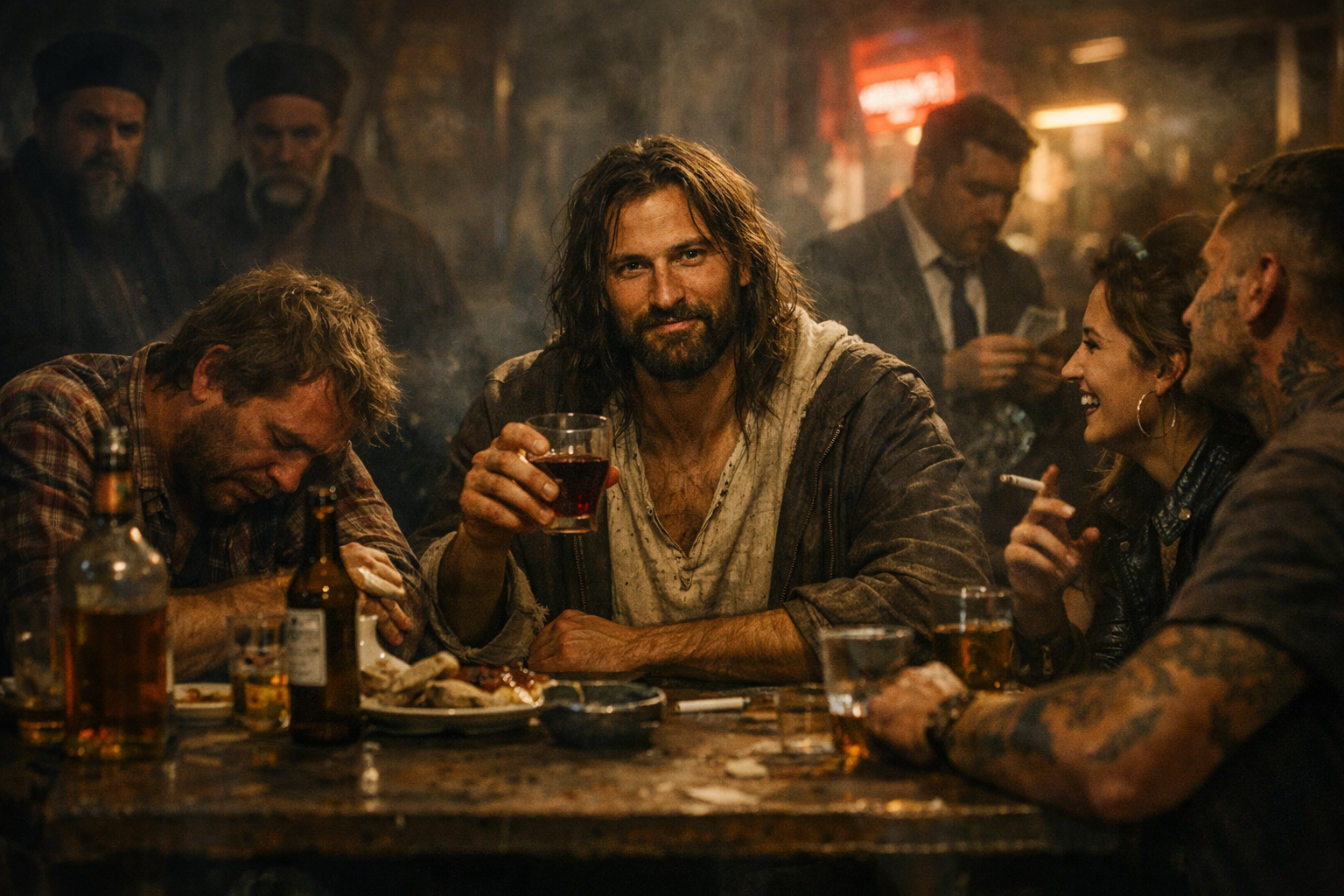
"The Son of Man came eating and drinking, and they say, 'Look at him! A glutton and a drunkard, a friend of tax collectors and sinners!'" —Matthew 11:19
The Accusation
There is an accusation lodged against Jesus in the Gospels that we tend to sanitize. We read past it, spiritualize it, treat it as obvious slander from enemies who didn't understand who they were dealing with. But the accusation only works if it had some grounding in observable behavior.
They called him a drunkard.
Not "he once attended a party where wine was served." Not "he was seen in the vicinity of people who drink." They called him a drunkard—a word that implies pattern, habit, visible behavior. The religious leaders didn't pull this accusation from nowhere. Something about how Jesus conducted himself at meals, at celebrations, in the company he kept, led them to this conclusion.
And they called him a friend of tax collectors and sinners. Again, not "he occasionally ministered to such people" or "he tolerated their presence for evangelistic purposes." A friend. Someone whose company was sought and enjoyed. Someone who belonged with them.
The tax collectors and prostitutes were drawing near to hear him, Luke tells us, while the Pharisees grumbled (Luke 15:1-2). Notice the dynamic: the sinners were attracted; the religious were repelled. Whatever Jesus was doing, it made the broken feel welcomed and the pious feel scandalized.
This should unsettle us more than it does.
The Recognition Problem
Here is a question worth sitting with: Why couldn't the Pharisees recognize God in their midst?
These were not casual believers. They had memorized Scripture. They tithed precisely. They had built their entire lives around preparing for the Messiah. They were, by any external measure, the most religiously serious people in Israel.
And when God showed up, they called him demon-possessed.
"He was in the world, and the world was made through him, yet the world did not know him. He came to his own, and his own people did not receive him" (John 1:10-11). His own people. The religious. The prepared. The ones who should have known.
The problem was not a lack of information. The problem was that Jesus didn't match their template. They had constructed an image of what holiness looked like—and it looked like them. It looked like separation, visible purity, careful boundary maintenance. It did not look like a man who stayed late at parties with sinners, who touched lepers, who let prostitutes wash his feet with their hair.
Their theology had become a blindfold.
The Template We've Built
I fear we have done the same thing.
The American evangelical church has constructed a template of what faithfulness looks like, and it bears more resemblance to the Pharisees than to Christ. We have built what I have called in previous writing "the compound"—a hermetically sealed subculture designed to ensure we never have to encounter the world as it actually is.
We have Christian radio so we never hear secular music. Christian bookstores so we never browse alongside unbelievers. Christian schools, Christian gyms, Christian business directories, Christian social media. An entire parallel economy designed to minimize contact with the very people Christ came to save.
And within this compound, we have developed an elaborate performance culture. We know the right words, the right testimony arc (struggle, then victory, always victory), the right posture of cheerful confidence. We know which doubts can be voiced and which ones mark you as spiritually suspect. We know how to signal seriousness—who leads prayer, who gets asked to share, who occupies the inner ring. We know the circumstances, people, and places to avoid lest we be seen as sinful.
This is not discipleship. This is theater.
I have written previously about what it means to be the ekklēsia—the called-forth ones—and how we have abandoned our calling by building a territory of our own. The Levitical priests had no land inheritance precisely so they could be distributed among the people, present in their cities, sharing their lives. We have done the opposite. We have carved out an inheritance that was never meant to be ours and called it holiness.
And I have written about the scattering—how the disciples' failure in Gethsemane was not an interruption of their faith but the revelation of its true texture. Peter's denial wasn't a detour on the road to maturity; it was the discovery that he would never graduate from needing grace. The scattering is not behind us. It is the permanent condition of creatureliness this side of glory.
These two realities—our calling to presence in the world and our ongoing need for grace—converge here. The compound is an attempt to escape both. It removes us from the world we were called to inhabit, and it constructs an environment where we can pretend we have arrived, where struggle must be spoken of in the past tense, where the scattering is something that happened to Peter two thousand years ago rather than something happening to us this morning.
And the tragedy is that we have become so formed by this theater that we can no longer recognize genuine faith when we see it. The believer who doesn't perform the expected signals—who hasn't mastered the vocabulary, who admits ongoing struggle without the requisite resolution, who is simply present in the world without the buffer system, who has friends and associations that would raise eyebrows—this person becomes invisible to us. Or worse, suspect.
Meanwhile, we trust the performer. The business with the ichthus in the logo, the cross on the yard sign—these are secret signals to believers that say we are one of you, do business with us. And we do, because the symbol tells us they belong to the compound. Whether they are honest, whether they do good work, whether they treat their employees with dignity—these questions become secondary to the tribal marker. The fish on the business card has replaced the fruit of the Spirit as our test of authenticity.
We have become the Pharisees, unable to recognize God's work because it doesn't match our template.
The Inversion
Jesus said something stunning to the religious leaders of his day: "Truly I tell you, the tax collectors and the prostitutes are entering the kingdom of God ahead of you" (Matthew 21:31).
Ahead of you. Not "they might eventually catch up if they get their act together." Ahead. The sinners who knew they were sinners were closer to the kingdom than the righteous who had constructed elaborate systems to maintain their righteousness.
This is an inversion that should terrify the religious.
The Pharisee in Luke 18 went to the temple and prayed: "God, I thank you that I am not like other men—extortioners, unjust, adulterers, or even like this tax collector. I fast twice a week; I give tithes of all that I get." The tax collector, standing far off, couldn't even lift his eyes to heaven, but beat his breast saying, "God, be merciful to me, a sinner."
Jesus says the tax collector went home justified, not the Pharisee.
The performance was flawless. The theology was arguably correct—he wasn't an extortioner; he did tithe. And it meant nothing. The man who knew he was empty went home full. The man who thought he was full went home empty.
Dee Dee
My grandfather—we called him Dee Dee—was an evangelical Christian. He was not a bad man. He shared what he had. He shared his joy of working in the refrigeration industry, spending time with me in ways that shaped my life. I became a refrigeration mechanic because of him. That's incarnational presence—sharing life, letting someone into your world.
But the compound had formed him too.
In the late 1980s, when I was maybe twelve, Dee Dee came to visit for Christmas. We grew up poor, and having a VCR was not on our list of luxuries. The closest we ever came was renting one from the grocery store for a night. That year, my sisters pooled their money—no small expense—and bought my parents a VCR. They rented Planes, Trains and Automobiles for us to watch together.
All of us, including my grandfather, piled into our small TV room on Christmas Day. And there's a scene in that movie where Steve Martin's character, utterly exasperated, unleashes a string of profanity.
My grandfather got up and walked out. He said he wasn't going to listen to that filth.
It basically ruined the day. It overshadowed the generous gift from my sisters. And it made a statement about what mattered most: his visible purity, his performed separation from the unclean.
Maybe he disagreed with the language. Fine. But silence and patience—staying present so as not to wound the people around him—would have cost him nothing and preserved something precious. Instead, he chose the demonstration of piety. The compound told him that's what faithfulness looked like.
Years later, after he had a stroke, the entire family gathered to celebrate a milestone birthday. In slurred speech, he made a plea for us to follow the Lord.
It fell on deaf ears.
By then, he was known as someone you hid things from—living with a significant other, struggles, doubts. There was no relationship, no reality, no sense that he knew us or accepted us. He had spent decades walking out of rooms, and now he wanted to be heard in one.
The door that closed in that small TV room never really reopened.
This is what the compound produces. Not villains. Good men who sacrifice relationship on the altar of visible purity and call it faithfulness. Men who want to gather at the end but have spent a lifetime scattering.
What Christ Actually Did
Consider the contrast.
Jesus didn't walk out of rooms. He walked into them—rooms where sinners were eating, drinking, celebrating. He stayed. He was present. He was so present, so genuinely with the people around him, that the religious could plausibly call him a drunkard.
You don't get that accusation by sipping water at the edge of the party looking disapproving. You get it by being in it—laughing at their jokes, staying late, being someone they actually wanted around.
The tax collectors and prostitutes didn't experience Jesus as someone doing outreach. They experienced him as a friend. Not someone tolerating them until they cleaned up enough to really belong. A friend.
And here's what matters: that friendship is what made the gospel land. When Jesus spoke hard truths—and he did, the call to repentance was radical—it came from someone who hadn't pre-rejected them by his very demeanor. The words had weight because the relationship was real.
The woman at Simon's house washed Jesus' feet with her tears and dried them with her hair. Simon the Pharisee was scandalized—if Jesus were really a prophet, he would know what kind of woman this was. But Jesus knew exactly what kind of woman she was. He also knew what kind of man Simon was. And the sinful woman went away forgiven, while Simon got a rebuke.
She recognized something in Jesus that Simon couldn't see. The same dynamic plays out across the Gospels: sinners see, the religious are blind.
"In But Not Of"
At this point, the familiar refrain arises: "We're called to be in the world but not of the world."
This phrase has done more damage than almost any other misapplied text in American evangelicalism.
The phrase itself isn't even in Scripture. It's a conflation of John 17:14-16, where Jesus says his disciples are "not of the world" just as he is "not of the world." But look at the context. In the very same prayer, Jesus says: "I do not ask that you take them out of the world, but that you keep them from the evil one... As you sent me into the world, so I have sent them into the world" (John 17:15, 18).
"Not of the world" is a statement about origin and ultimate allegiance—not about behavioral separation or cultural quarantine. Jesus himself was "not of the world" in the fullest possible sense; he was literally from outside creation. And yet his behavior was so enmeshed with sinners that the religious called him a drunkard.
If "not of the world" meant maintaining visible distinction through behavioral separation, Jesus failed spectacularly.
The way the compound deploys this phrase inverts its meaning entirely. It becomes a mandate for exactly what Jesus said he wasn't asking for: removal from the world, quarantine, a sealed-off existence where contamination is impossible because contact never occurs.
And here's the tragic irony: the compound produces people who are actually neither in nor not-of. They're not genuinely in the world because they've constructed elaborate buffers. And they're not genuinely "not of" it either—they've just created a Christian-branded version of the same status games, the same image management, the same performance anxiety that drives the world. They've replicated worldliness inside the walls and called it holiness.
The Pharisee Problem
I want to be careful here. I am not saying everyone in the evangelical church is a Pharisee. I am saying the structures we've built, the culture we've created, forms people in a Pharisaic direction—often without their awareness, often despite genuine faith underneath.
The Pharisees weren't evil. They were serious about God. They wanted to be faithful. They constructed their system of separation because they genuinely believed it honored God. And that system blinded them to God when he stood in front of them.
Jesus reserved his harshest words for them—not because they were worse sinners than the tax collectors, but because their religious confidence had become impenetrable. "If you were blind, you would have no guilt; but now that you say, 'We see,' your guilt remains" (John 9:41).
The tax collector who knew he was far from God was closer than the Pharisee who was certain he was near.
This is the danger of the compound. It produces a kind of certainty that cannot be interrupted. Everyone inside confirms everyone else's righteousness. The feedback loop is closed. And when someone from outside—or someone from inside who has started to see—names what's happening, they become the problem. They're bitter, they're backslidden, they're compromising.
The system protects itself.
What Faithfulness Actually Looks Like
So what is the alternative?
It is not accommodation. It is not "anything goes" or cheap grace or indifference to holiness. The call to follow Christ is radical and costly.
But the cost is not cultural isolation. The cost is presence.
Christ was present with sinners in a way that cost him his reputation with the religious. He was "a friend of tax collectors and sinners"—and that friendship was not a strategy. It was genuine. He genuinely enjoyed their company. He stayed in the room.
This is the incarnational pattern. The Word became flesh and dwelt among us. The Greek word is eskēnōsen—he pitched his tent, he tabernacled, he moved into the neighborhood. Not a beachhead of purity from which to conduct operations. Full entry into the mess of human existence.
Faithfulness that looks like Jesus will be misunderstood by the religious. It will be accused of worldliness, compromise, taking advantage of grace. If you are present with sinners the way Jesus was present, you will be suspect.
That's not a bug. That's the pattern.
The Door That Stayed Open
Jesus could speak radical truth to sinners because he had first given them radical presence. He earned the right to call people to repentance by being someone they trusted, someone who hadn't pre-rejected them.
My grandfather inverted the order. He led with judgment—walking out of the room—and then wondered why the gospel felt like more of the same. The plea at his birthday party wasn't heard because there was no relational ground for it to land on. He had spent decades communicating what he thought of us, and words at the end couldn't undo it.
Christ's way keeps the door open. It stays in the room. It is present in the mess, not above it. And from that presence, everything else becomes possible.
The sinners recognized something in Jesus that the Pharisees couldn't see. They saw someone real. And that realness—not performance, not separation, not visible purity—was the condition for hearing anything he had to say.
A Word to the Reader
If you have read this and felt recognition—if you have sensed the suffocation of the compound, the exhaustion of performance, the loneliness of having to hide your real self even among believers—know that you are not alone.
And know that the uneasiness you feel may not be a sign of weak faith. It may be discernment. It may be the Spirit's quiet resistance to a system that has substituted theater for truth.
Christ is not looking for performers. He is looking for people who will be present—with him, and with the world he came to save. Present in the mess. Present in the uncertainty. Present with sinners who need to see that following Jesus doesn't require first passing an audition.
The tax collectors and prostitutes recognized him. The religious missed him entirely.
May we have eyes to see.



Comments