I caught myself doing it again last week. The details do not matter much, a small exchange, the kind that happens a dozen times in any working day. Someone needed something from me, and before I had even decided how to answer I had already arranged my face and my words to keep a certain advantage. Not a lie. Nothing you could point to. Just a quiet positioning, a way of holding the conversation so that I came out of it standing where I wanted to stand. I told myself it was prudence. I was protecting something legitimate, my time, my judgment, the shape of the thing I am responsible for.
It was only afterward, turning it over, that I saw the other person had become a variable in my own arithmetic. I had not been relating to them. I had been managing them. And the thing that unsettled me was not that it was cruel, because it was not cruel. It was that it was so practiced, so smooth, so easily mistaken for virtue. I have done it ten thousand times and called it being responsible.
I do not think I am unusual in this. I think it is the most ordinary thing in the world, and I have started to notice it everywhere, in business dealings and in friendships and in the small negotiations of a marriage and a family. We are all, all the time, maintaining our standing over one another. We do it gently, mostly. We do it without quite admitting it. But it is there, this constant low-grade effort to come out on top, or at least not to come out underneath. And I have begun to suspect that it is not a flaw in my personality or yours. It is the oldest thing in us.
The oldest thing in us
The serpent did not, in the end, sell Eve on a piece of fruit. The fruit was the occasion. The offer was something else entirely: you will be like God. That is the hook the whole thing hangs on. Not knowledge for its own sake, not pleasure, but elevation. The chance to stop being a creature under authority and become an authority unto oneself. To shake off, finally, the unbearable condition of having someone above us.
Augustine had a name for what that desire becomes once it is loose in the world. He called it the libido dominandi, the lust to dominate, and he built his whole reading of human history on it. Two cities, he said, made by two loves. One built on the love of God carried even to the contempt of self, the other on the love of self carried even to the contempt of God. And because we cannot actually climb up onto God's throne, the love of self that wants to be God has to find somewhere else to go. It goes sideways. The reach for the vertical place we can never have becomes the grasp for the horizontal place we can. If I cannot be over God, I can at least be over you.
What makes this so difficult to see, and so much harder to repent of, is that it almost never arrives dressed as cruelty. Cruelty announces itself. You can feel cruelty in your hand as you do it. But the management of standing comes dressed as something respectable. It comes as prudence, as stewardship, as keeping order, as not letting yourself be taken advantage of. It wears the clothes of duty. That is the genius of it. The same impulse that drove the first grasp in the garden now hides inside my sense of being a responsible man, and I can go years calling it the one thing while it is quietly the other.
A room full of it
There is a scene where you can watch this drive operate in the open, in several people at once, and it is the scene at the center of everything we believe.
It is late, after a supper and a garden and an arrest. They have taken him first to the house of the high priest, and now, before the sun is fully up, they march him across to the Roman governor, because the thing they want done is a thing only Rome can do. A crowd has gathered in the cold. The religious court has already decided; the governor has not yet been made to. And so for a few hours this one bound and silent man stands at the center of a room full of people who all have something to lose by him.
Bring him into that room and watch who is protecting what. The religious leaders are protecting their authority, the standing of the temple and the office and the whole apparatus of their place in the world. Pilate is protecting his record, his position with Rome, the one thing a provincial governor cannot afford to lose, which is the appearance of control. The crowd is protecting its own peace, its sense of a settled world that this man keeps disturbing. Three different people, three different uniforms, and underneath all of it the same single motive. Each one is guarding a place. And each one, crucially, is dressing the defense of that place as the defense of something holier, the temple, the law, the nation, the peace.
Caiaphas says it without the costume, in a moment of terrible clarity. If we let him go on like this, the Romans will come and take away both our place and our nation. There it is, naked. Our place. The verdict is rendered on those grounds before any trial begins, and only afterward is the religious charge assembled to cover it. This is the pattern, and once you have seen it you cannot stop seeing it: the accusation always tracks power while wearing the costume of purity. Whenever an institution describes the defense of its own position as the defense of God, it is worth asking very quietly whose place is actually being protected, and who is going to pay for it.
It is not a new pattern
It would be comfortable to think this was a single bad Friday, an aberration, the worst day rather than the truest one. But it is not new. The prophets walked into this same machinery again and again.
Jeremiah stood in the temple court and said the unsayable thing, that the building itself was not permanent, that the house of God could become a ruin if the people did not turn. And the priests and the prophets seized him and said, you shall surely die. The charge was that he had spoken against the city. The wound was to their place. It is the identical structure, the identical recruitment of the wider crowd and the civil officials to do what the religious leadership wanted done.
But Jeremiah lived, and the way he lived is the thing worth sitting with. In the assembly that day there were officials who were willing to say, out loud, that this man does not deserve death. And one man in particular, Ahikam son of Shaphan, threw his own protection over the prophet, and Jeremiah was spared. There was still enough daylight in that room, enough fear of God in the people with power, that a single voice could stand up and stop the machine.
That is what makes the later scene so much darker. It is the same trial with the deliverer removed. No Ahikam stands up. The crowd that might have asked for a release asks for Barabbas instead. The officials who might have said this man does not deserve death have become a priesthood that says we have no king but Caesar, which is the most astonishing sentence in the whole account, the men whose entire vocation rests on the kingship of God renouncing it out loud to be rid of him. The same room, the same charge, the same drive. Only this time nothing in it fears God enough to stop.
What was actually in that room
Here is what I keep coming back to. Every person in that room was playing the game of standing. The priests, the governor, the crowd, every one of them grasping, positioning, protecting a place. And there was exactly one person in the room who was not.
He being in the form of God did not count equality with God a thing to be grasped, but emptied himself, taking the form of a servant. That is the whole counter-motion of the gospel stated in a single breath, and it is the precise inversion of the garden. In Eden a man who was not God grasped at being God. Here is God himself, holding in his hands the one place that actually is his by right, and he will not close his fingers around it. He lets it go. He descends.
So the cross is the collision of those two motions. It is a room full of the oldest thing in us, every soul in it reaching upward to secure a place, converging on the one man who came down on purpose and would not reach. The lust to dominate, distributed across the priest and the governor and the mob, finally runs all the way to its end, and its end turns out to be the killing of God, because God would not play the game. He would not grasp, so they crucified the only one in the room with clean hands.
This is why I cannot read the Passion as a story about other people, about bad men long ago. It is a mirror. The thing that nailed him is the thing I caught myself doing last week in a conversation so small I almost did not notice it. Not a different sin, scaled down. The same one. The same exact motive, the protection of my place at the quiet expense of someone made in the image of God, is the motive that put him on the cross. When I learned to see that, I could not pretend I was standing with the disciples at a safe distance. I was in the crowd.
The ones who never said a word
There is a turn in this that I have been slow to make, and it is the hardest one, so let me make it plainly.
Jeremiah and Jesus both came with a message, and the message is what threatened the place. That is the version of the story I find easiest to admire from a distance, the brave prophet, the truth-teller punished for the truth. But the pattern does not actually require a message. Go back further, to the beginning of the same Gospel that ends at the cross. When the wise men frighten Herod with word of a child born to be king, Herod cannot find the one child, so he kills them all, every boy in Bethlehem under two. Those children prophesied nothing. They threatened no one's theology. They had no message and no movement. They died because the throne could not tell which of them was the danger, so it destroyed the whole category. Matthew, telling it, reaches back and borrows Jeremiah's own words, Rachel weeping for her children, because the thread is already there in the prophets: the powerless destroyed by a throne protecting itself.
That is the thing I have to sit with, because it widens the circle in a direction I would rather not look. The threat does not have to do anything. It does not have to say anything. It only has to be the kind of thing that, to a frightened power, looks like it could ruin the good arrangement. And once you have built a wall to keep the world out, everything on the other side of the wall starts to look like that. The prophet with a message and the bystander just trying to keep her head down get flattened into the same category, danger, the thing that might breach the compound, and the wall cannot tell them apart and does not try.
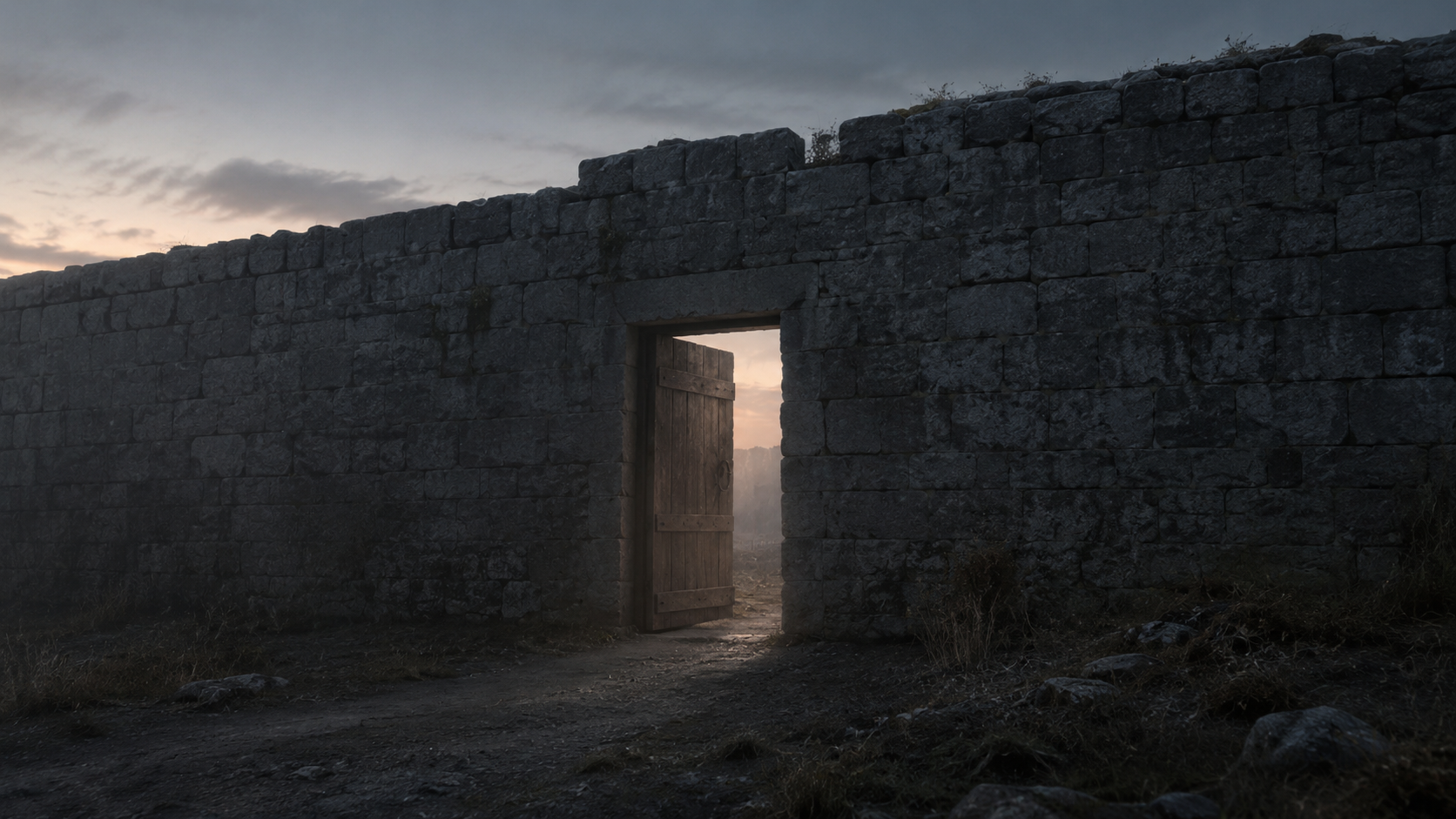
I write the word compound on purpose, because I think it is what gets built, and I know the inside of it. I grew up there. My father preached in it, and I spent my early years moving through its rooms, the charismatic ones and the Pentecostal ones and the ones that just called themselves Bible-believing, and then as a man I passed through other rooms further down the hall, the Methodist and the Lutheran and the megachurch, until I found myself standing outside the building altogether, which is where I am now. So when I describe the wall I am not pointing at strangers. I am describing a structure I was taught to tend, a way of seeing I lived by for a long time before I could see it at all. The compound walls itself off from a world it finds threatening, and everything outside the wall, the counterculture, the stranger, the immigrant, the one whose life does not fit the arrangement, comes to read as a danger to the good thing inside. Some of those people are speaking. Most are just living. It does not matter. The wall teaches you to see a threat before you see a face, and I know it teaches that because it taught me.
And here is the part that should stop any of us cold, inside the wall or out. The whole gospel is the story of a wall coming down from the inside. The incarnation is God leaving the one compound that was ever actually safe, ever actually holy, ever actually his, and walking out into the company of exactly the people the wall was built to exclude. He did not fortify. He emptied. So when we build the wall and then read everyone beyond it as a threat to be managed or removed, it is not a small political mistake. It is the garden's logic run in reverse of the manger's. It is rebuilding, brick by anxious brick, the very thing he tore down, and standing ready to crucify whoever we imagine might get over it.
I have to say one more thing here or the whole passage curdles into something I do not mean. I can see this folly now because I once lived inside it, and that is exactly the reason I cannot say it from above. The man who has left one fog does not thereby stand in clear air. He has almost certainly walked into another he cannot see yet, and I am sure I have. I can name the blindness of the house I came from because it was my blindness, and I have no doubt that wherever I am standing now has its own walls I have not noticed, its own faces I am failing to see. So this is not the report of a man who got clear. It is the confession of a man who traded one set of blind spots for another and is trying, slowly, to be honest about the kind of creature who builds walls at all. I am that creature. I just happen, for the moment, to be able to see this particular wall.
The only way down
That recognition could crush a person, and maybe it should, for a moment. But it is not the end of the thing, and to leave it there would be to miss the mercy by an inch.
Because the one I am implicated in killing is the very one who came to set me free from the compulsion that does the killing. He did not descend by accident. He came down precisely to break the thing in us that always has to climb. And the freedom he offers is not the freedom I keep reaching for, the freedom of finally being on top, secure, unbothered, with my place nailed down at last. It is the stranger freedom of not needing the place at all.
I want to be careful here, because there is a counterfeit that loves to wear this language. The answer to the lust for standing is not a great show of having no self, the performed smallness that is really just one more move in the same game, a way of dominating a room by being conspicuously the humblest one in it. False humility is the libido dominandi's favorite hiding place. That is not it.
The real thing is quieter and much harder. It is the freedom to descend. To hold my place loosely enough that I can actually let it go, to stop extracting my standing from the people around me, because my standing was never theirs to give in the first place. It is already settled. It is held by God, securely, whether or not I win the small exchange, whether or not I come out on top of the conversation. The man who knows whose he is does not need to stand over anyone to feel that he is real.
I am a long way from that. I caught myself last week, after all, and I will catch myself again tomorrow, probably before I have finished my coffee. But I have come to think that the catching is not nothing. The catching is the first foot set on the way down. He went all the way to the bottom, and it turns out the bottom is the only solid ground there is. The least I can do is start in that direction.


Comments