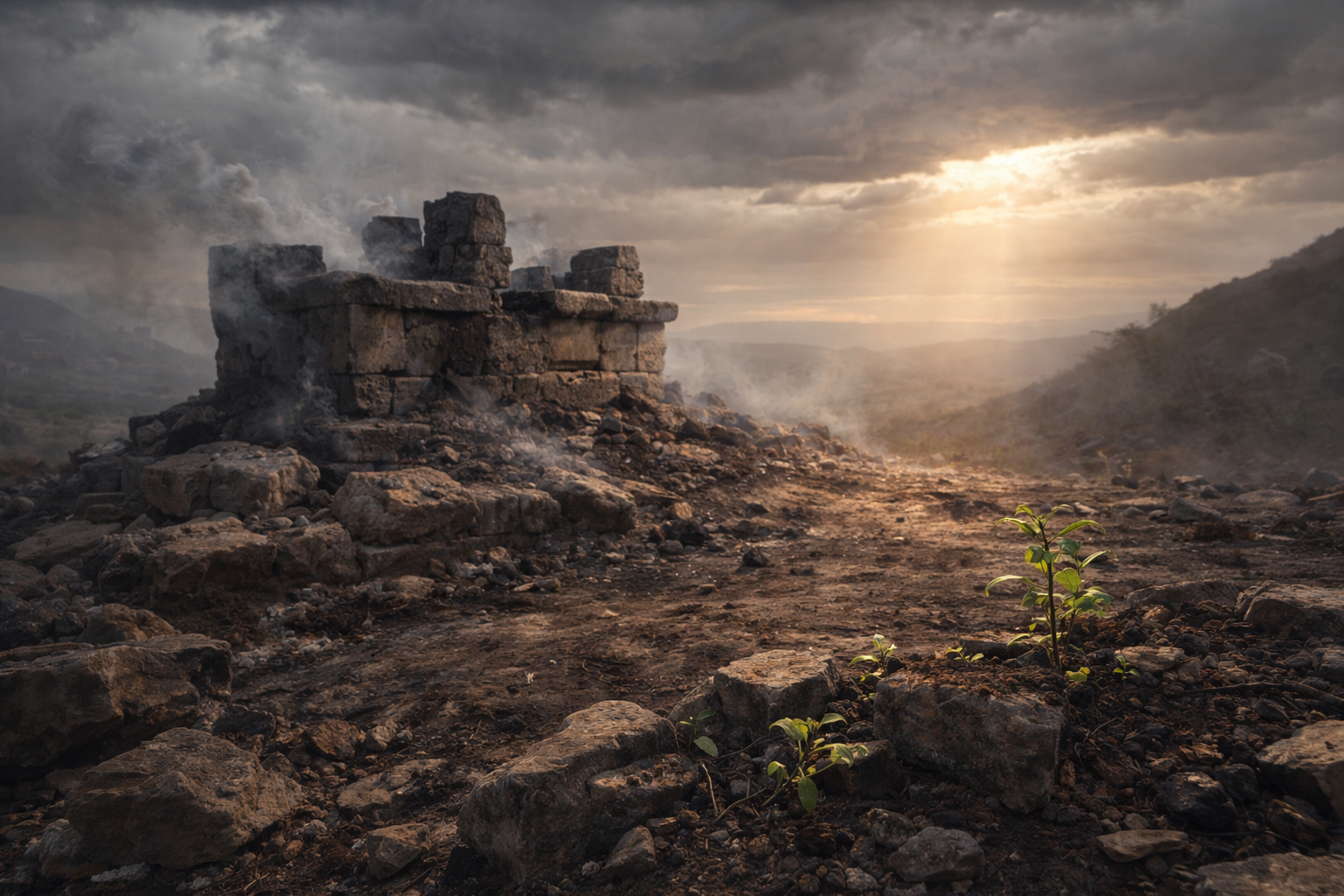
There's a moment in Ezekiel 36 that catches me every time I read it. God is speaking to the mountains of Israel. Not to the people. Not to the priests. To the mountains. And He says this remarkable thing: "I am for you, and I will turn to you, and you will be cultivated and sown."
It's a strange address. Mountains don't need encouragement. They don't respond to promises. They don't bear fruit because someone told them to. So who is He actually talking to?
To feel the weight of this, you have to go back to Ezekiel 6, where the same mountains receive a very different word. There, God pronounces judgment on them. The mountains of Israel are the high places, the sites where Israel built its altars to other gods. And the high places weren't just geography. They weren't just hills with bad things happening on top of them. They were the religious apparatus itself. The whole scaffolding of worship. The priests, the altars, the rituals, the systems of mediation between the people and whatever it was they were actually worshiping. The mountains represented something deeper than terrain. They represented the people who formed the structure that the broader community relied upon for its spiritual life. The religious infrastructure. The thing everyone leaned on.
And it was rotten.
So God spoke against it in chapter 6. Pronounced judgment on the very system that was supposed to be pointing people toward Him but had instead become the primary vehicle for leading them away.
Now, thirty chapters later, God speaks to those same mountains again. Not new mountains. Not a replacement range. The same ones that carried the idols. And He says, "You will grow your branches and bear fruit for My people Israel." The entity that bore the curse now receives the promise. The infrastructure of false worship becomes the infrastructure of restoration.
But here's the thing I cannot get past, the thing that changes the whole shape of this passage: between Ezekiel 6 and Ezekiel 36, there is Babylon.
There is exile. There is silence. There is a long, disorienting emptiness.
The movement in Ezekiel is not a simple pivot from bad to good. It is not: yesterday you were doing something wrong, and today you will be doing something right. The actual sequence is idolatry, then exile, then silence, then restoration. And that middle section, the exile and the silence, is not incidental to the story. It is not a parenthetical that God inserted while He got the restoration ready. It is the necessary precondition for everything that follows.
The exile is formative, not merely punitive. In Babylon, the temple is rubble. The land is gone. The priesthood has no altar. The entire system that allowed Israel to feel like they were maintaining their relationship with God through ritual performance has been dismantled. Not reformed. Not corrected. Dismantled. And in that silence, in that terrifying absence of all the religious infrastructure they had depended on, Israel was forced to confront a question they had never been forced to answer while the system was running: Is God actually here, or was it always just the building?
This is what exile does. It strips away the apparatus and leaves you alone with the question of whether God exists apart from the structures you built to contain Him. And one of two things happens in that space: you discover a God who is present without your performance, or you discover nothing at all. That is the gift and the terror of Babylon. The old religious imagination has to die. Israel could not simply swap out the Baals for Yahweh on the same high places with the same posture and the same assumptions. The whole framework had to come apart.
And importantly, the high places were not reformed. They were torn down. When Josiah enacted his reforms, he did not put better altars on the high places. He did not hire better priests. He destroyed them. Because the problem was not that the worship was being done poorly. The problem was that the infrastructure itself had become so thoroughly identified with the idol that the two were inseparable. The form was the false god. At a certain point, you cannot repurpose a system that has been entirely co-opted by something other than God. You can only raze it and start from the ground.
I need to name something here, because the rest of this won't make sense without it.
The idolatry that Ezekiel is identifying is not the obvious kind. It is not golden calves. It is not Israelites bowing down to statues and knowing full well they are betraying Yahweh. It is far subtler and far more devastating than that.
The idolatry on the high places was the construction of a God who is impressed by what we bring Him. A God whose favor operates on a transactional basis. A God who looks at the sacrifices we offer, at the purity we maintain, at the religious seriousness we perform, and responds with approval. "Look what I gave up for you. Look at my faithfulness. Look at my devotion." The God on the high places is a God who values perceived sacrifice. And the worshiper's real devotion is not to God at all but to the system that allows them to feel like they are earning His attention.
Hosea saw this with devastating clarity: "I desire mercy, not sacrifice." But mercy is messy. Mercy requires you to enter into the pain of another person without any guarantee that your effort will be rewarded or even noticed. Sacrifice, on the other hand, sacrifice you can control. Sacrifice you can measure. Sacrifice gives you a receipt.
This is the idolatry that is hardest to see, because it wears the right clothes. It uses the right vocabulary. It can quote scripture. But the God at the center of it is a projection, a deity who exists primarily to validate the worshiper's self-image. A theological mirror that reflects back the image of someone who is doing it right.
The evangelical church in America has perfected this.
I want to be careful here, because I am not making a political argument, and I am not making a cultural argument. I am making a theological one. The evangelical project, broadly speaking, has constructed a religious culture organized around a God who rewards transcendence. A God who is pleased when you successfully separate yourself from the contamination of ordinary human life. The rallying cry is "in the world but not of it," but the way that phrase gets operationalized is not as a call to incarnational presence. It is read as permission to build a parallel civilization. A clean one. A controlled one. One where the mess of actual human existence is someone else's problem.
This is not Christianity. This is gnosticism wearing a worship band t-shirt.
The gnostic impulse, the desire to escape the material, to rise above the body, to float free of the dirt and ambiguity and suffering of embodied existence, that heresy did not die in the second century. It found a new host. And it thrives in any church that treats holiness as the successful avoidance of mess, that measures spiritual maturity by how effectively someone has insulated themselves from the brokenness of the world, that presents the Christian life as an upward trajectory away from the human condition rather than a deeper entry into it.
I want to sit with that phrase for a moment: evangelical gnosticism. Because I think it names something that a lot of people sense but struggle to articulate. The gnostics believed that the material world was a prison and that salvation meant escaping it. The body was a cage. Spirit was the real thing, and the goal of the spiritual life was to shed the physical and ascend to something purer. The early church rejected this decisively. The incarnation was the refutation. God did not send a message from above. He came down. He took on flesh. He entered the cage.
But the evangelical church, for all its orthodoxy on paper, has functionally rebuilt the gnostic framework. The language is different. Nobody talks about the demiurge or the pleroma. But the underlying logic is the same: the world is contamination, holiness is separation, and the spiritual life is an upward movement away from the dirt. Purity culture is gnostic. The prosperity gospel is gnostic. The political project of building a "Christian nation" insulated from the mess of pluralism is gnostic. All of it shares the same basic conviction: that God is found by rising above, not by entering in.
But there is something even more insidious operating underneath the transcendence project, and it needs to be named directly: the real engine driving all of it is self-righteousness.
The transcendence is not really for God. It is for the worshiper. The more thoroughly you separate yourself from the world, the more righteous you feel. The more completely you construct a parallel existence, with its own schools, its own businesses, its own economy, its own political allies, its own music, its own social circles, the more at peace you are. Not the peace of God, which scripture says surpasses understanding. This is a peace that is entirely understandable. It is the peace of self-approval. It is the satisfaction of looking at the life you have built and concluding that you are doing it right. That you are one of the good ones. That God must be pleased with you, because look at how much of the world you have successfully excluded.
This is the high place in its most refined and most dangerous form. The idol is not a statue. The idol is not even a false theology, exactly. The idol is the feeling of righteousness itself. The warm assurance that you have made the right sacrifices, drawn the right boundaries, kept yourself sufficiently unstained. The God being worshiped in this framework is not really God at all. He is the guarantor of the worshiper's self-image. He exists to confirm that the life of separation was worth it. And the worshiper's devotion, which is sincere, which is often costly in real ways, is ultimately directed not at the living God but at the internal experience of having pleased Him. The receipt, not the relationship.
This is what makes evangelical gnosticism so resistant to correction. You cannot argue someone out of a posture that feels like peace. You cannot present an alternative theology to someone whose current theology is producing the exact emotional result they are looking for. The system works. It delivers what it promises. It just doesn't deliver God.
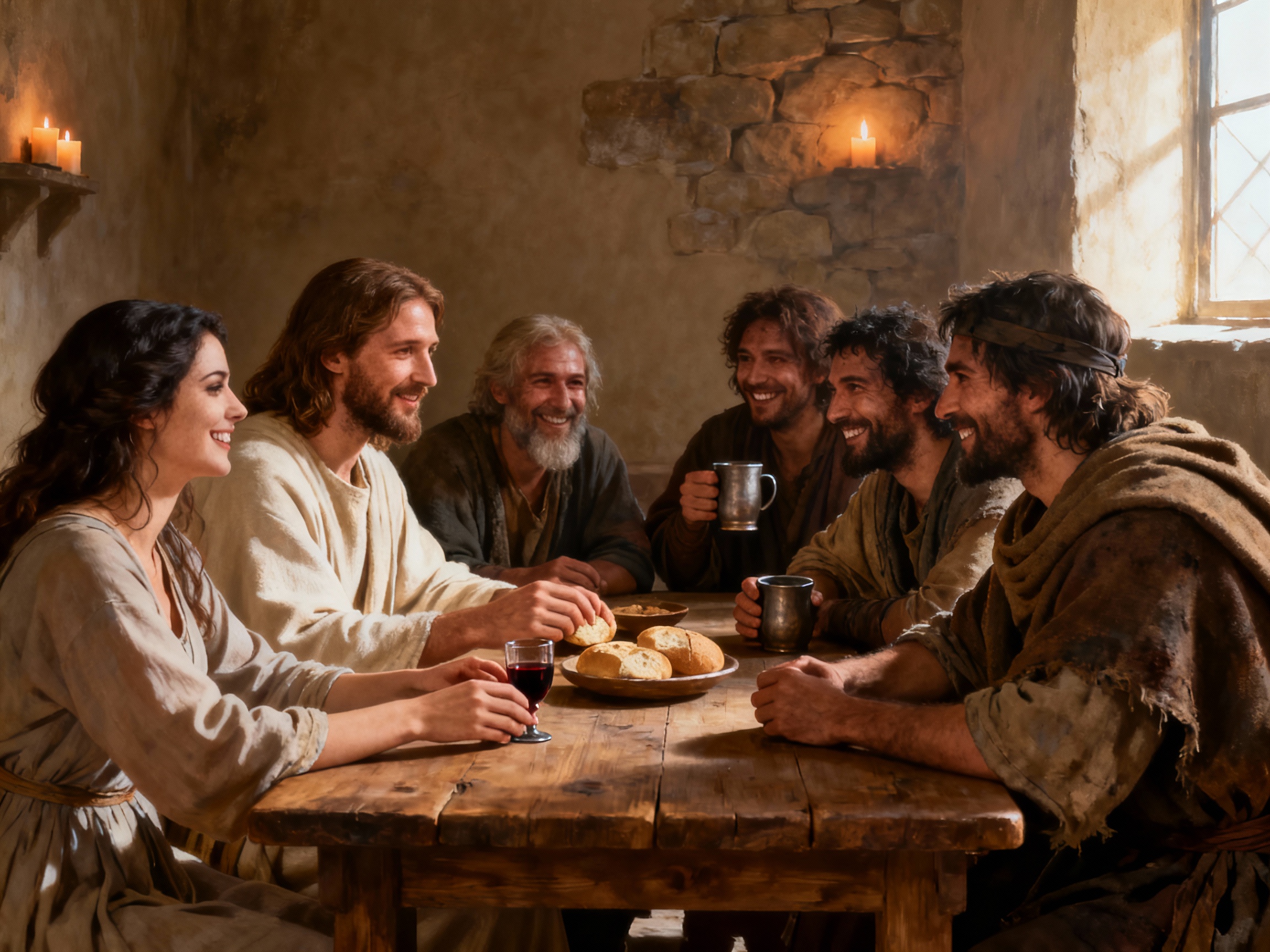
And here is the thing that the incarnation tells us, the thing that evangelical gnosticism cannot tolerate: God moved toward flesh. Not away from it. Toward it. Toward suffering. Toward the tax collectors and the lepers and the sinners and the dirt. The incarnation is God entering the mess, not escaping it. It is God taking on a body that gets tired and hungry and bleeds. It is God sitting at tables with people that the religious establishment had written off. It is God submitting to death, real death, physical death, on public execution equipment, in full view of the people who were supposed to be His own.
Any religious apparatus that presents godliness as the avoidance of mess is working against the grain of what God actually did. Any church whose primary product is the feeling of having risen above is building a high place. And the God being worshiped on that high place, however sincerely, however enthusiastically, is not the God of the incarnation. It is the God of the worshiper's aspiration. It is an idol.
I haven't been to church since 2019.
Not because I stopped believing. Not because I lost interest in the faith or decided I didn't need community or got lazy on a few too many Sunday mornings. I stopped going because the dissonance became unbearable. I take the incarnation seriously. I believe that the central claim of the Christian faith is that God entered flesh, entered limitation, entered proximity with the broken and the ordinary, and that this entry was not a temporary measure or a rescue mission but a revelation of God's own character. And I could not sit in a room where the operative theology ran in the opposite direction. Where godliness meant transcendence. Where the project was to rise above the world rather than be present in it. Where the implicit message, week after week, was that the Christian life is about becoming less human rather than more fully so.
It is an unsettling thing, to sit in a place that is supposed to be your support network and feel that it is antithetical to the core of your theology. To sing songs about a God you recognize and then listen to a sermon about a God you don't. To be surrounded by sincere people, genuinely kind people, people who love God as best they know how, and to feel that the version of God they are loving is not the one who showed up in Bethlehem.
And I want to be clear about something, because the rest of this will sound like an indictment, and I need to say who it is not aimed at: those sincere people in the pews are not the architects of this. They are the casualties. Most of them inherited this framework. They were born into it, or they came to faith inside it, and it is the only version of Christianity they have ever been offered. They were taught that transcendence was holiness. They were taught that separation was obedience. They were taught that the feeling of self-approval that comes from maintaining the right boundaries was the peace of God. And they believed it, because why wouldn't they? The people they trusted told them so. The system shaped them, formed their instincts, trained their reflexes, and they participated in it not out of malice or arrogance but because it was the only game in town.
When I say the institution must be razed, I am not saying the people inside it are the enemy. They are the ones most harmed by it, precisely because they are the ones most invested in it. The person who has built their entire spiritual identity around the gnostic project is not going to experience the collapse of that project as liberation. They are going to experience it as devastation. And that matters. It should give us pause. It should make us speak carefully, even when speaking bluntly. The critique is of the system, the framework, the theology that produces the wrong fruit. It is not of the people who ate what the mountains gave them and called it nourishment because no one ever told them there was anything else.
I say this not as someone who has always stood at a distance. I traveled in those circles. Years ago, I was inside the project. I strove to transcend the world the way the system taught me to. I tried to build the right boundaries, consume the right media, associate with the right people, think the right thoughts. I tried to rise above. And the more I did it, the more I succeeded at it by the system's own standards, the more hollow I felt. It was not satisfying. It was not the peace that the project promised. It was unsettling in a way I could not name at the time, and it left me anxious in a way that felt like a betrayal, because the whole point of the exercise was supposed to be peace.
What I understand now, and could not have articulated then, is that the hollowness was the incarnation making its case at the level of the body. The anxiety was not a failure of faith. It was the signal that something was fundamentally wrong with the direction I was moving. Because you cannot transcend your way to a God who descended. You cannot rise above the world to reach a God who entered it. The entire trajectory of the gnostic project runs in the opposite direction from the God it claims to be pursuing. And when you pursue God in the wrong direction long enough, what you feel is not arrival. It is absence. Not because God has abandoned you, but because you have been walking away from the place where He actually is, which is down here, in the dirt, in the flesh, in the mess you were trying so hard to escape.
The self-righteousness felt good for a while. The feeling of being set apart, of being serious about holiness, of having sacrificed worldly comforts for something higher. But the shelf life of self-righteousness is short when you are honest with yourself. Because underneath the feeling of having pleased God, there is always the nagging question: Is this actually God, or is this just me, pleased with myself? And once that question surfaces, the whole structure starts to tremble. Because if the peace you are experiencing is self-generated rather than God-given, then what you have built is not a life of faith. It is a very elaborate monument to your own religious performance. And you are the only one worshiping there.
I know I am not alone in this. There is a familiar refrain among a certain kind of believer, people who are serious about their faith, who value the incarnation, who read their Bibles with care and think hard about what they find there, and the refrain is this: I don't have a church home.
This is not consumer dissatisfaction. It is not the complaint of someone who hasn't found the right worship style or the right small group or the right coffee in the lobby. It is something closer to exile. It is the experience of caring deeply about the thing the church is supposed to be and finding yourself unable to participate in what it actually is. The mountains are still there. The religious infrastructure is standing. People are going. Songs are being sung. But what is being worshiped on those mountains is not the God who showed up in a borrowed manger and died on a Roman cross.
And the cruel irony is that the people who feel this most acutely are not the people who have drifted away from the faith. They are the people most committed to it. The gap between the incarnational God they encounter in scripture and the gnostic project they encounter on Sunday mornings has become too wide to sit in quietly. So they leave. Not because they are faithless, but because they remember what God actually looks like.
The Ezekiel pattern suggests that these people are not the problem. The people who could not worship on the high places were not the ones who had lost their way. They were the ones who had kept it. And their exile, their displacement from the center of the religious community, was not a sign that they were wrong about God. It was a sign that the mountains had been given over to something else.
I read a book once, written in the 1960s by a social gospel pastor, in which the author made an observation that has stayed with me for years. He said the church was in mid-season. It was either spring or fall. Either tending toward renewal and life, or sliding toward the death of winter. And at that moment, he said, one could not tell which.
I think we are beginning to tell.
The evangelical church in America is not collapsing under the weight of external persecution. It is hollowing out from the inside. Its credibility crisis is not a marketing problem that better outreach can solve. It is not a leadership crisis that the right charismatic pastor can fix. It is not even a cultural crisis that a more relevant worship style can address. It is a theological crisis, and it runs all the way down to the foundation.
When the institution becomes so thoroughly identified with political power, with cultural triumphalism, with a God who looks suspiciously like the aspirations of its most vocal members, the watching world does not see a flawed institution that means well. They see the thing itself as the lie. And here is the part that is hardest for people inside the church to hear: the watching world is not entirely wrong. Not because the gospel is a lie. The gospel is the truest thing there is. But what is being presented as the gospel in much of American evangelicalism is a lie. It is a God of transaction and transcendence, a God of political convenience and moral performance, and the people outside the church can see it even when the people inside cannot. The packaging has become the product. And the product bears no resemblance to the God who washed feet and ate with sinners and let a woman with a reputation pour perfume on His head while the disciples muttered about waste.
I said once, hyperbolically but not dishonestly, that I wished the churches in this nation would empty out and be razed to the ground. I want to explain what I mean by that, because I do not mean it flippantly, and I do not mean it with contempt.
What I mean is this: the religious institution known as the evangelical church has become so marred, so thoroughly co-opted by something other than the incarnational God of scripture, and so profoundly an anathema to the very people it claims to want to reach, that I do not believe its credibility can be rehabilitated. The form has become the idol. The infrastructure is so fused with the false worship that separation is no longer possible. You cannot put a better altar on a high place and expect different results. You cannot renovate a system whose foundations are built on a God who does not exist.
You can only tear it down.
This is the Ezekiel logic, carried to its conclusion. The high places were not reformed. They were destroyed. Not because mountains are evil. Not because religious infrastructure is inherently corrupt. But because what had been built on those mountains was so thoroughly identified with the idol that the only path to restoration ran through demolition. Josiah did not renovate. He razed. And it was counted as faithfulness.
I believe the religious institution known as the church, as we currently know it in America, is going to die. And I do not say that with triumph or with satisfaction. I say it with the grief of someone who loves the church as a concept, who believes in the necessity of Christian community, who feels the absence of it every Sunday morning, and who has come to believe that the thing we are calling church is no longer the thing that Christ established. It is something else wearing the same name. And it has to go.
But here is the hope, and it matters, and I want to end here because without it the rest is just despair.
The mountains in Ezekiel 36 are not removed. They are transformed. "You will grow your branches and bear your fruit." The structure remains, but what it produces changes entirely. The mountains are still mountains. The religious infrastructure, the community, the scaffolding of shared worship and mutual support, these things are not abolished by the restoration. They are necessary. People need something to stand on. They need structure. They need each other. God does not leave the mountains empty forever.
But the fruit is different. Branches and fruit. Organic, tangible, earthly things that feed actual people. Not transcendence. Not escape. Not a feeling of having risen above the mess. The redeemed religious apparatus does not elevate people out of their humanity. It nourishes them within it. The mountains bear fruit not by reaching higher but by being rooted in the ground and producing something real for the people who are hungry.
The exile forced Israel into the very posture that the incarnation would later reveal as God's own. Not above the mess, but in it. Not floating free of human limitation, but fully present within it. Not performing for a transactional God, but discovering a God who had been present all along, even in the silence, even in the absence, even in the rubble of the temple they thought they needed in order to find Him.
And maybe that is where we are now. In the in-between. In the silence after the high places and before the fruit. The exile that is necessary but not yet complete. Living in a faith that does not have a building to go to on Sunday morning, and discovering, slowly and painfully, that the God who razed the high places is the same God who spoke to the empty mountains and said, "I am for you."
I do not know what the restoration will look like. I do not know whether it will be new communities forming outside the institutional structure, or the existing institutions breaking down enough to be rebuilt on different foundations, or something else entirely that none of us can see yet. What I do know is that the exile itself, for now, may be the most faithful posture available. The willingness to sit in the absence rather than pretend the high places are the temple. The refusal to worship a God of transcendence when the God of the incarnation is the one who actually showed up.
Maybe the most incarnational thing a believer can do right now is stay in the dirt. Stay in the mess. Stay in the exile. And trust that the God who entered flesh is not afraid of the silence between the demolition and the restoration.
God in Christ did not find a home in the religious establishment of His day either. And the fruit that came from that displacement changed the entire world.


Comments