By the time you read this, the dust will have settled on Super Bowl LX — or more accurately, on the debate around it. Bad Bunny headlined the halftime show, performing largely in Spanish on the biggest stage in American entertainment, and predictably, the country split right down the middle. The President called it a slap in the face. Turning Point USA staged a rival halftime show with Kid Rock. Pundits debated whether a Spanish-language performance belonged at an American institution. It was, as these things always are, less about the music and more about the lines we draw.
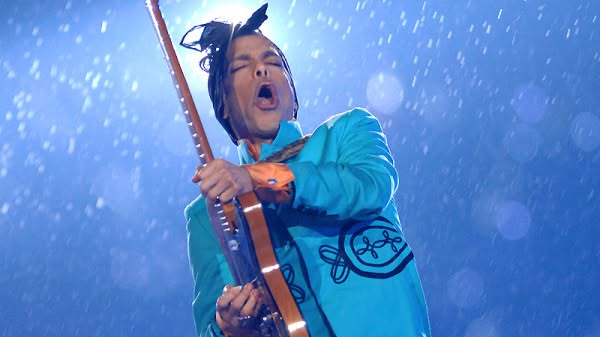
But the halftime show I keep thinking about isn't this year's. It's the one from Super Bowl XLI in 2007. Prince.
If you remember it, you remember the rain. It had been threatening all evening in Miami, and by halftime, it was pouring. The production team panicked and asked Prince if they should adjust. His response, now legendary: "Can you make it rain harder?" And then he played "Purple Rain" — in the rain. The sky opened, the lights caught every falling drop, and for twelve minutes, a hundred million people watched something that transcended entertainment. It was one of those rare moments where the world seemed to hold its breath.
For believers watching, there was a choice to make about what that moment meant. And many made it quickly.
Some saw God's hand in it — how could you not? Rain falling during "Purple Rain" felt too poetic, too perfectly orchestrated to be random. But then the theological sorting began. Prince was a secular artist. His catalog was filled with sexual innuendo, androgynous imagery, and content that would never pass muster in a church bookstore. So the rain couldn't be God's blessing, could it? At best, it was coincidence. At worst, it was judgment — God showing His disapproval of a sinful life played out on a global stage.
This is the interpretive move that believers make constantly, almost reflexively: the world is divided into sacred and secular, clean and unclean, approved and condemned. And our job, we assume, is to sort everything we encounter into the correct category. If a Christian artist had been up there performing a worship song when the heavens opened, we'd have called it a sign from God without hesitation. But because it was Prince? We hedged. We qualified. We looked for a way to explain it away.
I think this interpretation misses something enormous about the nature of God.
Consider the logic we operate under as believers. When we feel like we're living right — reading our Bibles, serving others, keeping our behavior in check — we feel acceptable to God. Approved. Worthy. And when we stumble, when we fall into patterns of sin or selfishness, we feel the opposite. Unacceptable. Distant. Disqualified.
But this framework has a fatal flaw, and Scripture itself exposes it. Isaiah 64:6 tells us that all our righteous acts are like filthy rags before God. Not our sins — our righteousnesses. The very best we bring to the table, the moments when we think we're getting it right, are still marred and insufficient before a holy God.
This changes everything.
If God accepted me in my perceived goodness — when, in reality, even that goodness was stained and incomplete — then on what basis would He reject me in my obvious sinfulness? The truth is that I am sinful all the time. Not just when I'm behaving badly, but when I'm behaving well. Lived sinfulness is the condition of our existence. It is the water we swim in, every moment of every day, and it is precisely into this condition that grace was poured. God did not wait for us to clean up. He came while we were yet sinners (Romans 5:8). That's the whole scandal of the gospel.
Now apply this back to Prince standing in the rain.
If the standard for God's presence and beauty is human moral performance, then nobody qualifies. Not Prince, but also not the worship leader at your church on Sunday morning. Not the missionary, not the theologian, not you, not me. The ground is perfectly level. So either God is free to display His glory through whomever and wherever He chooses — or He's bound by a merit system that His own Word dismantles from Genesis to Revelation.
And here is where I think we need to let this truth reshape not just our theology but our posture toward the world.
If God can make a secular moment sacred — if He can pour rain on a halftime show and create something breathtaking and transcendent through an artist who would never be booked for a church conference — then why can't we extend the same grace? Why can't we look at the world around us, in all its mess and complexity and beauty, and see God at work in it?
The instinct to partition everything into sacred and secular, approved and condemned, is deeply human. But it isn't deeply biblical. The God who sends rain on the just and the unjust (Matthew 5:45) is not a God constrained by our sorting mechanisms. He spoke through Balaam's donkey. He called the pagan king Cyrus His anointed. He chose to enter the world not through a palace but through a barn, not among the religious elite but among shepherds and tax collectors and women of questionable reputation.
This God is not interested in our categories.
And yet we persist in maintaining them. We look at the halftime show and decide who belongs and who doesn't. We look at our neighbors, our coworkers, the strangers in the grocery store, and we sort. We evaluate. We determine who is in and who is out, who is worthy of grace and who has disqualified themselves.
But if we have received grace that we did not earn — grace that came to us while our best efforts were still filthy rags — then the only honest response is to extend that same unearned, unconditioned grace to everyone we encounter. Not tolerance in some bland, secular sense, but genuine acceptance rooted in the recognition that God is at work in all of His creation, not just the parts we've labeled "Christian."
The talent Prince had — that jaw-dropping, once-in-a-generation musicianship — did not originate in Prince. It was given. And when it was exercised at its highest level, in the rain, on the biggest stage in the world, it reflected something of the Giver whether anyone on that stage intended it to or not. The beauty was real. The transcendence was real. And a God who is big enough to orchestrate the universe is certainly big enough to show up in a Miami rainstorm during a halftime show.
The question for us is whether we have eyes to see it.
The incarnation itself is the ultimate rejection of the sacred-secular divide. God did not send a memo from heaven. He moved into the neighborhood. He ate with sinners. He touched lepers. He entered fully into the mess of human existence — not to escape it or condemn it, but to redeem it from the inside out. And if He is at work in all of it, then our calling is not to build walls between the holy and the worldly. Our calling is to live — fully, with open eyes and open hands — in the world God made and loves.
It rained during "Purple Rain." And it was beautiful. Let that be enough.


Comments