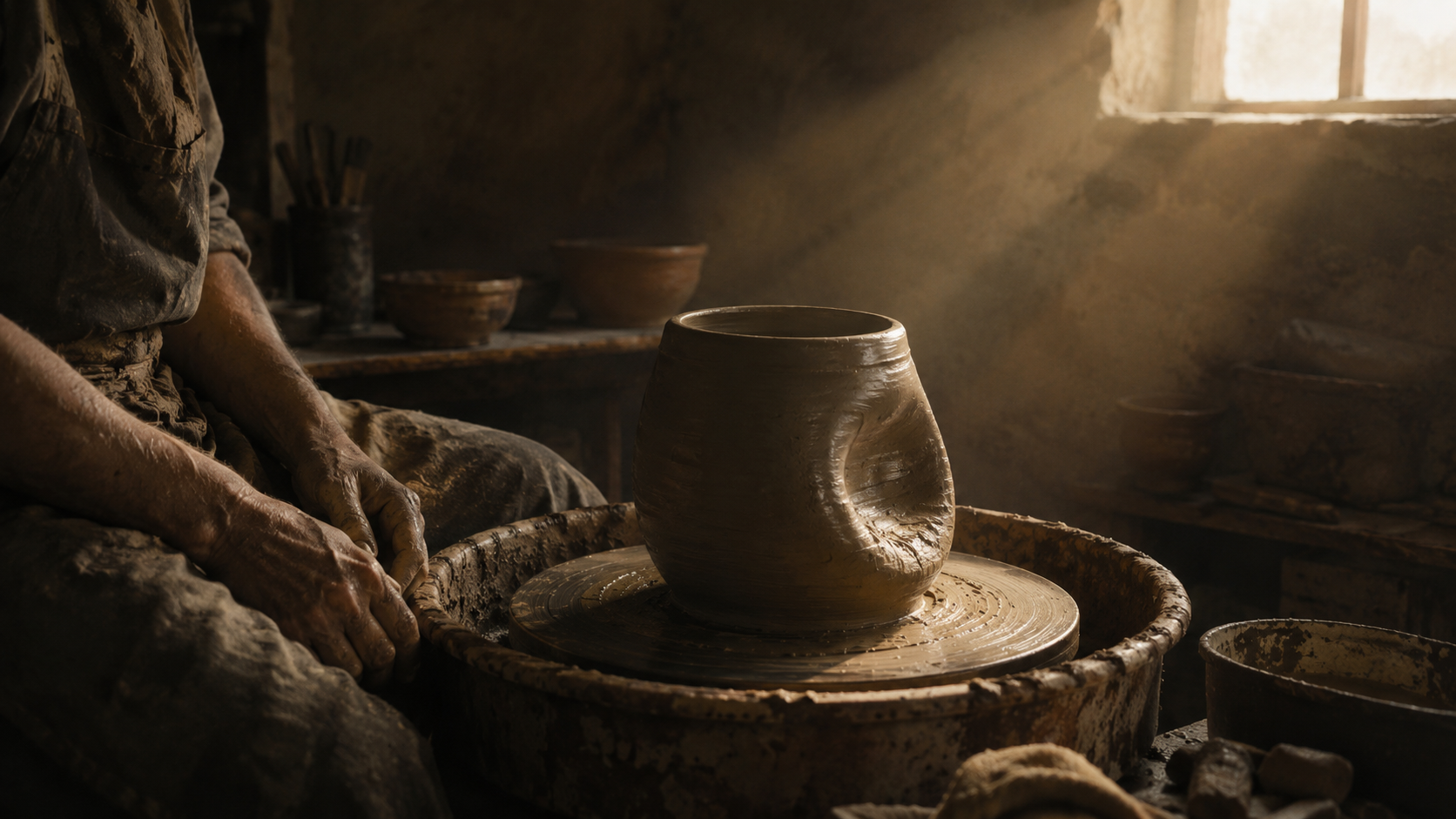
I went down to the potter's house this week, or at least to Jeremiah's account of it. The prophet is told to go watch a craftsman at work, which on its face seems like an odd errand for a man carrying the weight of a coming judgment. But God has a habit of teaching through the ordinary, the field, the almond branch, the boiling pot, and this time it is a wheel spinning in a workshop. "So I went down to the potter's house, and there he was, making something on the wheel. But the vessel that he was making of clay was spoiled in the hand of the potter; so he remade it into another vessel, as it pleased the potter to make" (Jer 18:3-4).
The word that stopped me was "spoiled." In English it carries a sense of intrinsic degradation, something that goes bad on its own, the way meat left out too long loses its value through no fault but its own chemistry. Spoiled meat did not resist anyone. It simply decayed, passively, according to its own nature, under conditions no one controlled. If that is the right sense of the word, the passage reads the way most of us have always heard it preached: God shapes, the clay is acted upon, end of story, any imperfection in the vessel is either the potter's deliberate choice or an accident of technique, never anything the clay itself contributed. But when we actually picture clay deforming under a potter's hands, that is not usually how we read the scene. We don't blame the clay. We look to the potter. How could inert material have any bearing on what it becomes?
That instinct is worth pausing on, because the Hebrew behind this text may not carry quite the weight the English translation does here. The word is closer to being marred or ruined in the process, without the built-in implication that the ruining happened through the clay's own passive decay. It is a smaller gap than it might first appear, but it is enough to loosen the passage from the reading we default to. And that gap is worth sitting in, because it opens up a question most devotional treatments of this text skip past entirely: what if the clay is not entirely inert? What if the marring in verse 4 is not simply a flaw the potter discovers and corrects, but something the material itself had some hand in, resistance, unevenness, a grain that did not yield the way it should have? The text does not spell this out. But it leaves the door open, and once it is open, the whole passage starts asking a different question than the one we usually bring to it.
The passive reading, and why it's cheap
Most serious believers already hold that the events of our lives are, in some final sense, God ordained. Success, failure, everything in between, worked together for our good, forming us into what He has called us to be. That process is sanctification, and it should give us pause: this is the hand of God, doing His most sacred work, in us, specifically. Every circumstance becomes a place where we meet the Creator. There is real comfort here, and it is not a false comfort. Nothing that happens to us is finally wasted or outside His purposes, and that conviction has carried believers through losses that would otherwise have no bottom to them.
But there's a way to hold that same truth that curdles into something passive, even cowardly, and the trouble is that it is very hard to tell the two apart from the inside. If everything is God's doing, the reasoning goes, then my job is simply to endure. Let the wave of circumstance wash over you, respond with whatever comes out first, which for most of us is our worst self, irritation, self-pity, the short answer instead of the patient one, and call it submission to providence. It feels like humility because it asks nothing of you. It even sounds theologically careful, since it seems to guard God's sovereignty by keeping human effort as far from the process as possible. But watch what it actually produces over time. A man who treats every hardship as something to simply survive does not usually come out the other side more like Christ. He comes out more brittle, more reactive, no more patient than he was before the hardship arrived, because nothing in the passive posture required patience to be practiced. The wave came and went, and he was still standing, but he was not shaped. He was only wet.
Dietrich Bonhoeffer had a name for this move in a different context. He called it cheap grace, grace treated as a doctrine to be accepted rather than a person to be followed, forgiveness without discipleship, the cross without the cost. For Bonhoeffer, the cost was never optional extra credit tacked onto salvation. It was the shape salvation actually takes in a human life: concrete obedience, the specific and often costly following of Christ into whatever the moment demands. Grace without that following is not grace received, it is grace admired from a safe distance.
I think the same evasion shows up in how we handle sanctification, and it is worth being precise about what the cost actually is, or the parallel stays a slogan instead of becoming useful. The cost is not suffering itself. Circumstance supplies the suffering, or the success, or the interruption, without our help. The cost is the labor that comes after: the attention it takes to ask what a given circumstance is actually doing to you and in you, the discernment to tell the difference between the reaction that comes first, which is usually reflexive and usually your worst, and the response that is actually formed by the moment rather than merely triggered by it. It is the discipline of naming what you are feeling before you act on it. It is choosing, deliberately and often against the grain of what feels natural, to let a specific hardship teach you something rather than simply survive it. None of that happens automatically. Receiving the forming without doing that work is cheap grace applied to the potter's wheel. It sounds humble, since it looks like surrender. It is actually a refusal, since surrender to the potter was never meant to mean going limp.
The vocation underneath the passivity
Refusing to extract value from circumstance isn't neutral. It's a denial of the vocation we were given at the very beginning.
Genesis 1:28 hands humanity a mandate: be fruitful, multiply, fill the earth, subdue it, have dominion. That is not a one-time errand. It is a delegation of creative agency, an invitation into the ongoing work of ordering what God made "very good" but left, deliberately, open for cultivation. Humanity is given the vocation of continuing what God set in motion at creation.
Notice what kind of work that mandate actually describes. Subduing and having dominion is not manufacturing something from nothing, that capacity belongs to God alone. It is taking raw material that already exists, that God already made and called good, and ordering it, naming it, cultivating it toward its fullest use. Adam names the animals rather than creating them. The garden is planted by God but tended by man. Dominion, in other words, is always exercised on given material. It is a derivative, responsive kind of making, working with what has already been provided rather than conjuring something apart from it.
That is exactly the shape of the work under discussion here, just turned inward. Circumstance is the raw material. It arrives already provided, already, in the final sense, ordained. We do not choose the clay any more than Adam chose which animals existed to be named. But the same capacity that was given for ordering the external world, the same derivative, cultivating agency, is the capacity we are meant to exercise on the material of our own lives. To extract value from a hardship, to let attention and discernment and deliberate response do their work on a circumstance rather than letting it simply wash over you, is dominion exercised inward. It is the same vocation Genesis 1:28 names, aimed at the self instead of the soil.
I think this also reframes something important about how we picture God's sovereignty. We tend to imagine it as constant, moment-to-moment intervention, God's hand physically repositioning every event as it happens. But a great deal of what God ordained, He ordained at creation, in setting the terms, establishing the mandate, writing the covenant into the structure of things. He is not less sovereign for working this way. He is sovereign enough to bring forth His desires through what He has already set in motion, including through the cultivating work He assigned to us. That is not deism. He remains present, upholding, sustaining, and He is the one who supplies the clay in the first place. But it does relocate where the action is happening. A great deal of it is happening through the vessel's own cultivating response, not around it.
This is why the worship of the Old Testament, foreshadowing what God would do fully in the incarnation, was participatory. God did not simply act while man watched. Man brought something to the altar, an offering cultivated from what God had already given, grain that had been grown, an animal that had been raised. In the New Testament we no longer bring a symbol of what we have; we bring ourselves, willing, offering what is actually in our person, the self as the raw material now, cultivated and handed over rather than grown in a field and handed over. Paul will later call this being God's fellow workers. It is the same logic Bonhoeffer points to when he writes of the Christian being formed into Christ's shape, little Christs, not by imitation from a distance but by costly, concrete participation, the daily labor of naming, discerning, and offering rather than merely enduring.
Why the participation is safe
Here is the question that has to be answered before any of this becomes presumption: if the clay has real agency, real capacity to resist or yield, what stops the whole project from collapsing into human self-determination? If the vessel can genuinely mar itself, what guarantees the potter ever finishes the work at all? This is not a minor loose end. It is the place where a theology of participation either holds together or quietly turns into a theology of God doing His best with uncooperative material and hoping for the best outcome. That second picture is not the God of Scripture, and the answer to how the two truths hold together does not lie in carefully balancing sovereignty against freedom. It lies somewhere else entirely: in God's own character as the kind of God who keeps His word regardless of what it costs Him.
The answer is that we cannot act against God except what God allows, and what God allows is bounded by a covenant He made with man at the very start and has never broken, not because the terms were easy to keep but because He is not the kind of God who breaks terms. Scripture is emphatic on this point in a way that goes beyond a general assurance of reliability. Numbers 23:19 puts it almost bluntly: God is not man, that He should lie, nor a son of man, that He should change His mind, has He said, and will He not do it. Psalm 15 goes further and names faithfulness to covenant, specifically the willingness to swear to one's own hurt and not change, as the very definition of righteousness, which means this is not a peripheral trait in God but the pattern His own righteousness takes. Genesis 15 makes the same point in narrative form, and it is worth slowing down on. In the ancient covenant ceremony described there, both parties would normally walk together between the divided halves of sacrificed animals, each side effectively saying, may what happened to these animals happen to me if I break this covenant. But in Genesis 15, Abraham falls into a deep sleep, and only a smoking firepot and a flaming torch, representing God alone, pass between the pieces. God binds Himself unilaterally. Abraham does not even have to walk the path. And Hosea takes the same commitment and stretches it across an entire book, a marriage to an unfaithful wife as the sustained image of a God who remains bound to a covenant partner who keeps breaking her end of it, absorbing the cost of that infidelity rather than walking away from the relationship it was always his right to end.
And ultimately, the cross is where this logic reaches its full weight, the place all of these threads were always pointing. God upholds His covenant even to His own hurt, and the potter does not discard the spoiled vessel and start fresh with different clay. He remakes this one, at infinite cost to Himself, in the person of the Son, who bears the very marring the clay itself introduced. That is the guarantee underneath everything said above about human participation. Our agency is not a threat to God's purposes because His commitment to finishing the work was never contingent on the clay behaving perfectly in the first place. He built the covenant to absorb our resistance, not to be defeated by it. Which means the participation this whole reflection has been arguing for is not a risk God is taking on us. It is a capacity He built into the relationship, already covered, already accounted for, before the wheel ever started turning.
The imperative
So the two truths have to be held together, not balanced against each other like weights on a scale but rooted in one another like a trunk and its branches. God ordained the shape of our lives at creation and continues to bring it to pass, largely through what He has already set in motion, including through the cultivating, dominion-bearing work He assigned to us at the very start. And we are called, as little creators bearing the image of the Creator, as little Christs formed through obedience rather than autonomy, to bring ourselves willingly to the wheel rather than merely enduring it. None of this is safe to attempt on our own initiative, which is exactly why it was never left to our own initiative. The covenant was in place before the first circumstance ever arrived, and the potter's commitment to finishing the vessel does not waver when the vessel resists. That is not a license for the resistance. It is the reason the resistance does not have the last word.
To ride the wave of circumstance passively, to let it wash over you and call that faith, is not humility. It is a denial of the vocation stamped into you at Genesis 1:28, the same vocation that was there before the fall, before the wheel started spinning, before there was anything to endure at all. The clay does not choose its own shape, and it never will. But it was never meant to lie there inert either, waiting to be acted upon like something already dead. It was formed from the dust with breath in it, given hands, given the capacity to name and tend and cultivate, and then handed a life full of circumstances that are themselves the raw material for exactly that same capacity, turned inward now, aimed at the self instead of the soil. The potter is still forming the vessel. But the vessel, if it is willing, is forming something too.


Comments