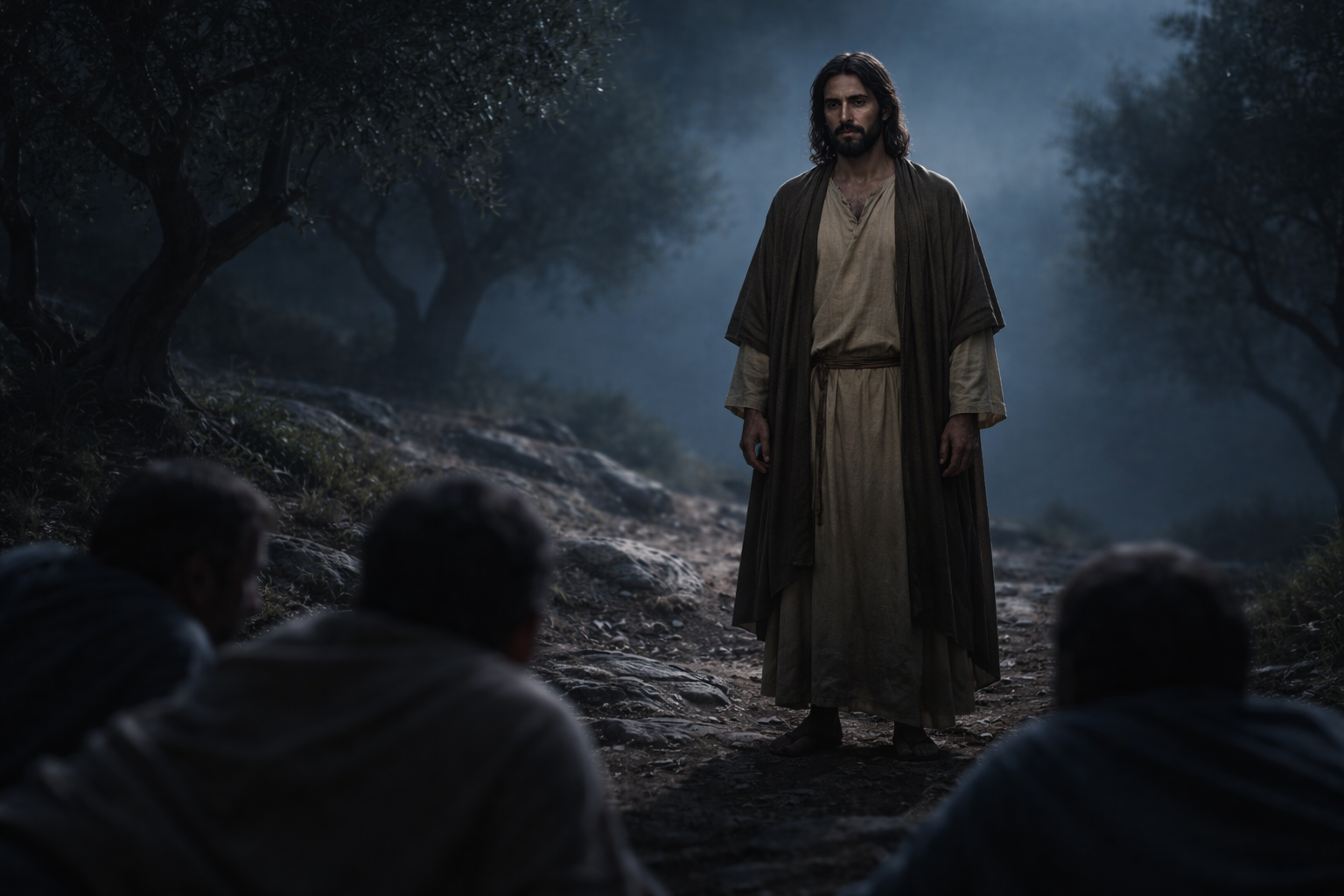
Today is Transfiguration Sunday, the day the church calendar sets aside to remember one of the most extraordinary moments in the Gospels. Jesus takes Peter, James, and John up a high mountain, and there He is transformed before their eyes. His face shines like the sun. His clothes become dazzling white. Moses and Elijah appear and speak with Him. The veil between heaven and earth grows thin, and for a brief moment, the disciples see something of who Jesus truly is.
I've read this passage more times than I can count. But this morning, something clicked that I had never seen before: something about who is on that mountain, what happens to them, and what it tells us about how God has chosen to speak.
It starts, as so many revelations do, with Peter getting it wrong.
Peter, James, and John are standing in the middle of this heavenly scene, Jesus glorified, Moses and Elijah beside Him, and Peter, being Peter, responds the way any of us might: Let me build something.
"Lord, it is good that we are here. If You want, I will make three tabernacles here: one for You, one for Moses, and one for Elijah." (Matthew 17:4)
Three tabernacles. Three equal shelters. One for each. It's a perfectly reasonable, perfectly human response. Peter is doing what religious people have always done. He's categorizing. He's placing Jesus alongside Moses and Elijah as co-equals: the Law, the Prophets, and now this new teacher. Three pillars of the faith, three voices worth preserving. Let me build a framework around this.
He doesn't even get to finish the sentence.
While he was still speaking, a bright cloud overshadowed them, and behold, a voice from the cloud said, "This is My beloved Son, with whom I am well pleased; listen to Him!" (Matthew 17:5)
Not them. Him.
God interrupts Peter mid-word to make a singular, unmistakable declaration. This is not one voice among many. This is not a new addition to the pantheon of Israel's great figures. This is the beloved Son. Listen to Him.
The Law and the Prophets Step Aside
What strikes me now (what I somehow missed for years) is the symbolism of who is standing on that mountain and what happens next.
Moses represents the Law. The commandments, the strict requirements, the entire system of obligation and sacrifice that defined Israel's relationship with God for centuries. Elijah represents the Prophets. The warnings, the calls to repentance, the tales of judgment that thundered through Israel's history.
They appear alongside Jesus. And then they're gone.
Matthew 17:8 gives us one of the most quietly powerful verses in Scripture: "And lifting up their eyes, they saw no one except Jesus Himself alone."
The Law recedes. The Prophets recede. And what remains is just a man. Standing on a hillside. Looking at them.
This is God.
No System, Just a Person
Peter's instinct to build tabernacles is really the instinct to institutionalize. Pin the moment down. Create a structure. Manage it. And that instinct runs deep in us. We want a system we can navigate, a checklist we can complete, categories that tell us who's in and who's out.
Legalism needs that. It needs clean and unclean, sacred and profane, righteous and sinner. It needs rules with strict requirements. It needs prophetic warnings to enforce those rules. The whole machinery of religious obligation depends on it.
But God says no. You don't get a system. You get a person.
And that's what makes grace so disorienting. You can't reduce a person to a checklist. You can't codify a relationship. You can only stand in front of someone and be known by them. When the disciples looked up and saw Jesus alone, that's exactly what they were being invited into: not a new and improved religious program, but a living relationship with God in human skin.
I AM
This is not a small thing. It cannot be understated. Throughout the entire arc of Scripture, God has been communicating who He is, and the means of that communication has changed everything.
In times past, God communicated who He was through the Law. Through commandments carved in stone on a mountain not unlike this one. Through requirements and rituals and the meticulous ordering of life. I AM holy, and here is the code by which you will know it.
Then He communicated who He was through the Prophets. Through Elijah calling down fire. Through Isaiah's visions and Jeremiah's tears and Ezekiel's strange and terrible imagery. I AM just, and here is the judgment that proves it.
But now, on this mountain, in this moment, God communicates who He is in an entirely different way. Not through a system. Not through a warning. Through a person. This is My beloved Son. Listen to Him.
Jesus is the I AM. Not a new chapter in the same book, but the living Word that the whole book was always pointing toward.
The Scandal of Simplicity
What gets me is the ordinariness of the final image. All the dramatic apparatus (the dazzling light, the heavenly voice, Moses and Elijah, the bright cloud) falls away. The spectacle ends. And there's just Jesus.
No angels. No thundering trumpets. No tablets of stone. Just a man, probably reaching down to help them up off the ground.
This is the incarnation in miniature. This is how God chose to speak His final word: not through more laws, not through more warnings of judgment, but by being here. Emmanuel. The Word made flesh. Not a message, but a presence.
The Transfiguration turns every human instinct toward religious categorization on its head. We want to sort and rank and systematize. We want to build tabernacles, neat structures that keep everything in its proper place. But God interrupts us mid-sentence and says: Stop building. Start listening. My Son is enough.
When you look up, there is just Jesus alone. And that is more than enough.



Comments