41 May Your favor also come to me, Lord,
Your salvation according to Your word;
42 So that I will have an answer for the one who taunts me,
For I trust in Your word.
Psalm 119:41-42
An answer for the one who taunts me. What answer could the psalmist possibly have in mind? Just like the physicist with the axioms of physics, any serious believer cannot prove that God exists, and therefore cannot truly prove his salvation after death. If one could show that God exists, the reality of salvation would be far easier to demonstrate. But all of it lies beyond the boundary no living man can pass, that of death, and that is simply where every believer stands.
So what could the psalmist be referring to? It cannot be the evidence of a life that finally "works out" once one aligns oneself with God, and every serious believer will agree with me here. Bad things still happen to the faithful, sometimes horrible things. The taunt in the Psalms is rarely a philosophical one anyway; it is usually some version of "where is your God?" thrown at someone whose life looks no better than anyone else's. And the taunter has a point. The only thing preventing the believer from being overtaken by the fall is the same thing protecting the non-believer, common grace. That is no salvation at all, since it is a natural corollary of God's mercy and patience toward all of creation, extended to the just and the unjust alike.
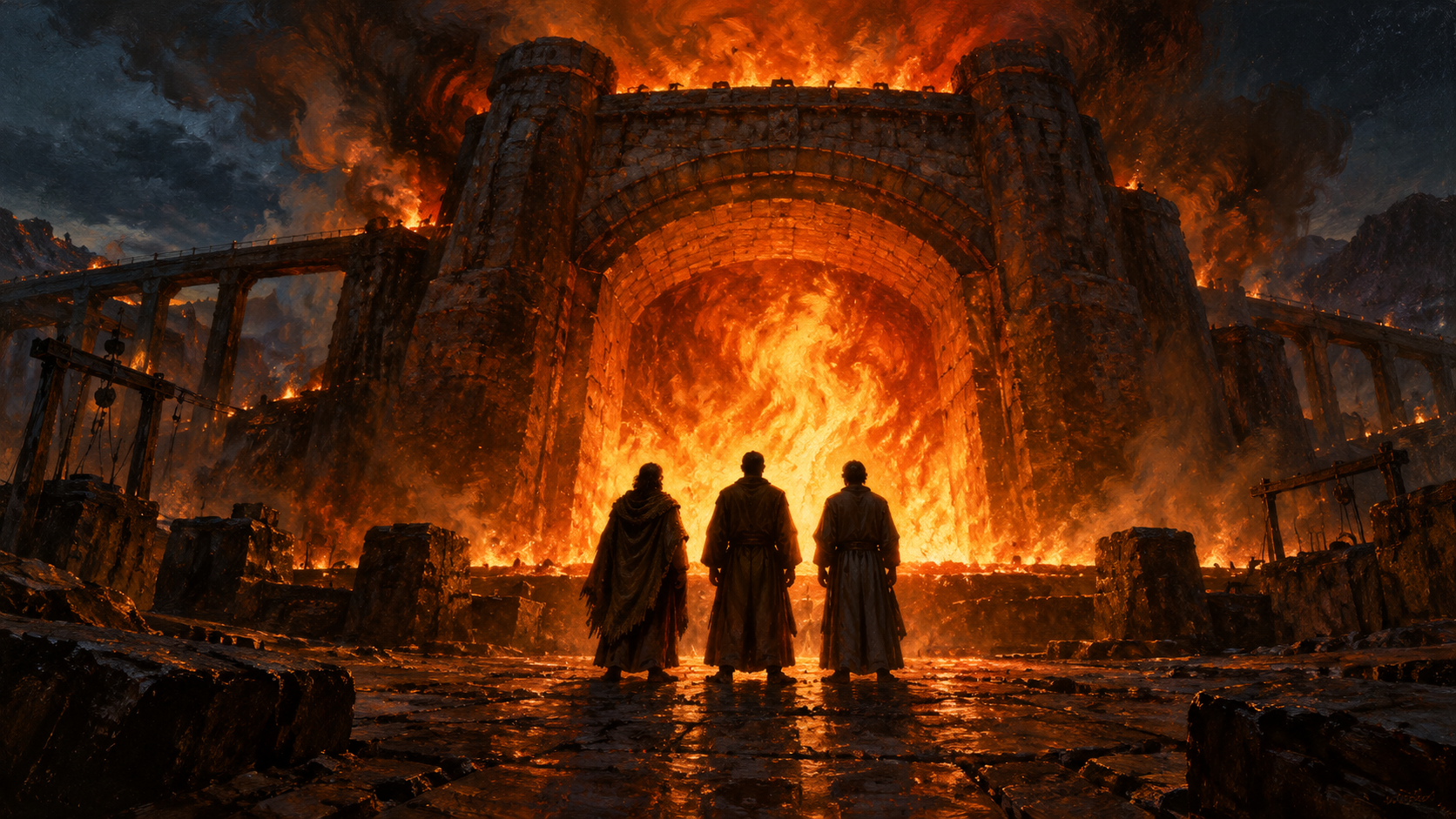
This is where I find myself thinking about Shadrach, Meshach, and Abednego. Anyone with a basic understanding of the story can point to what is commonly understood as God's salvation, their preservation in the midst of the flames. But I am captivated by the words they speak before they are thrown into the furnace. Their answer to the king is essentially this: our God is able to deliver us, and maybe He will, but even if He does not, we will not bow to any other god. In my mind that is the demonstrated salvation, not the rescue from the fire. The rescue was God's to give or withhold; the devotion was already there before the furnace was ever lit.
What they had was clarity. Since the fall, the vision of mankind has been blurred. We see dimly, not entirely grasping God, not really grasping who we are, and not fully understanding the knowledge of good and evil, the very thing Adam reached for when he took the fruit. As believers we understand that on the day of salvation we shall see Him clearly, not as in a dim mirror but face to face, as He is in all of His glory. It is in that clarity that all knowledge will become complete, where man will finally find his completion as creature, receiving all from his Creator. That is what salvation will look like when it has come to fruition, and the three men in Babylon had a measure of it already. They were not confused about who the one true God was or from whom they receive. They did not need any other god, because they had the only one who could provide.
I believe that is what salvation looks like in this life: knowing and seeing God with some measure of clarity. Not that it makes us any better than the lost, but because it clarifies the relationship between Giver and receiver. The evidence of this salvation is devotion. Not perfection, not some visible difference that sets us apart, but simply being devoted to the Creator, whether the fire comes or not.
Notice another feature of the text. There is no requirement that the answer make sense to the one taunting, nor that it be a convincing or persuasive argument. The psalmist's answer is simply "I trust in Your word," and that is the whole of it. Shadrach, Meshach, and Abednego did not defend God, launch into apologetics, or reach for rhetoric of any kind; they said, in effect, we have our answer and it is enough for us. This model turns the evangelical motion of evangelism on its head. We are taught from a young age to always be ready to give an answer, in season and out of season, and that is taken very seriously, so much so that there are monolithic programs with myriad methods and techniques to convince "the lost" to choose Christ. Even Peter's call to be ready with an answer assumes someone has first asked about the hope they already see in us, and it was written to people who were suffering.
In the last few decades the movement has become so pervasive that our ordinary day-to-day lives are now treated as if we were walking around wearing sandwich boards advertising the gospel as the way to a better life. In that environment there is no room for smudged boards, for marketing material that is plainly marked by sin. In reality, that means there is no room for any of us, and that is painfully clear to everyone on the outside. They can see the smudges even when we pretend they are not there, and the pretending is what they find so hard to stomach.
So, as Watchman Nee asked, borrowing Peter's question about John, "what shall this man do?" Jesus' answer to Peter was simple: what is that to you? You follow Me. It really boils down to understanding who the gospel and salvation are for, and the answer is simply oneself. The moment we assume it is for others and lose sight of the fact that it is for us is the moment we put the sandwich board back on. Preaching the gospel, then, is a life that has been visibly met by God's steadfast love, with a few honest words attached to explain what people are looking at. Not nothing said, but the saying is the caption, not the picture. That is the heart of evangelism, and that is the motion. At all times, preach the gospel, and if necessary, use words.



Comments