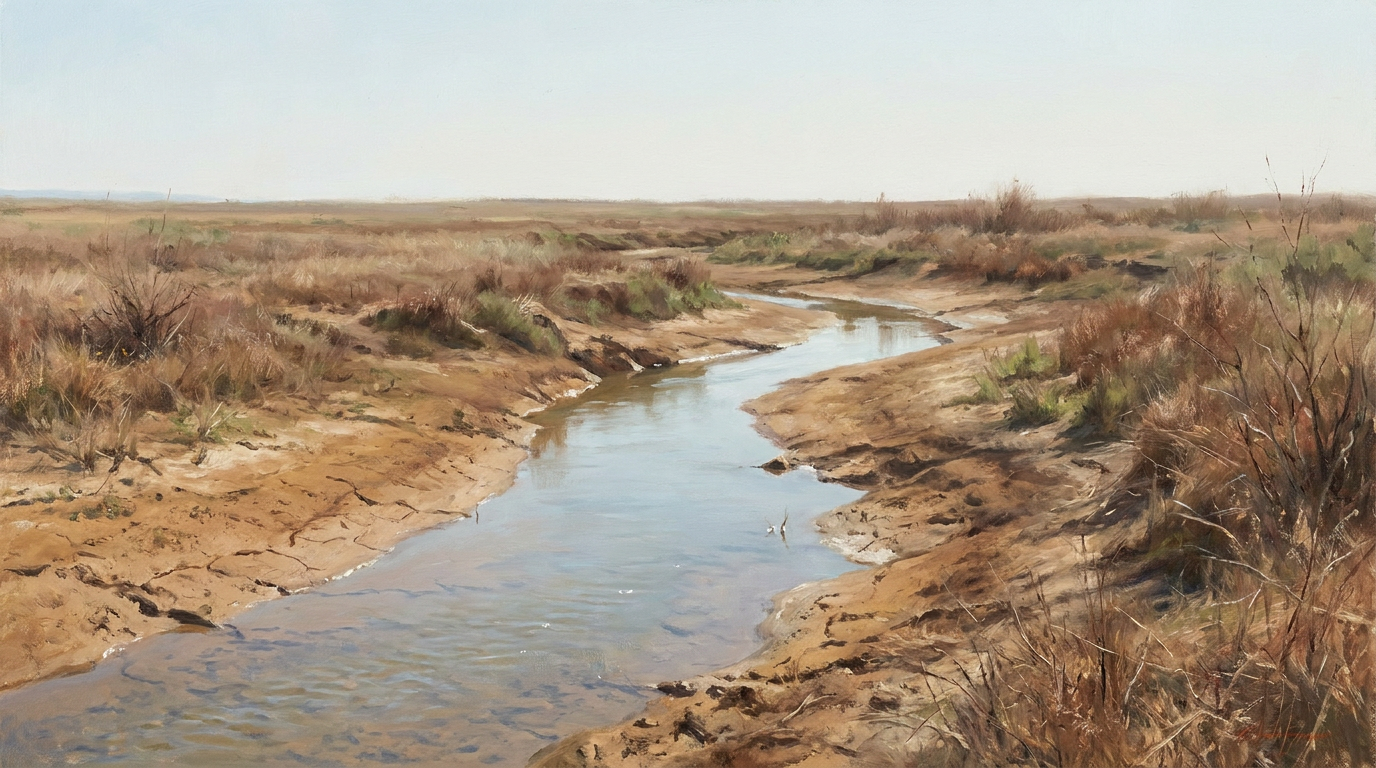
Picture a creek in the third week of a drought. The grass on its banks has browned off. The mud along the edges has cracked into plates. Everything visible about the place says the water should be gone.
The creek is running.
Ask where the water is coming from and the honest answer is, its complicated, because it is coming from rain that fell a very long time ago. Not last week. In some fraction of it, not in this century.
Here is what actually happens when rain hits the ground. Some of it never soaks in at all. If the rain comes faster than the soil can take it, or the ground is already saturated or frozen or paved, the water sheets across the surface and runs straight into the channel. That is runoff, and it moves in minutes to hours. It is what produces flood peaks and muddy water and the general impression that rain and creeks are closely and immediately related.
Some of it soaks into the topsoil, hits a less permeable layer underneath, and slides laterally downhill through the soil without ever joining the deep water. That is interflow. Hours to days.
And some of it keeps going down. It percolates through the unsaturated zone, past the reach of any root, and joins the water table. Then it moves, very slowly, through the aquifer, and eventually it seeps back out through the bed and banks of the stream. Not through some dramatic spring. Just up through the streambed, along the whole length of the channel, so gradually that you would never see it happening if you stood in the water and watched.
The residence time on that last pathway is measured in decades and centuries.
So the creek in August is not running on anything recent. It is running on rain that fell before anyone standing on the bank was born. The visible drought is real. The creek does not care. It is drawing on a reserve that was filled by ten thousand rainfalls nobody remembers, and it will keep running until that reserve is gone, and the reserve is not gone.
That is a strange fact to sit with, and it is stranger still that a prophet described it three thousand years before anyone could have explained it.
**The Text
For as the rain and the snow come down from heaven, and do not return there without watering the earth and making it produce and sprout, and providing seed to the sower and bread to the eater; so will My word be which goes out of My mouth; it will not return to Me empty, without accomplishing what I desire, and without succeeding in the purpose for which I sent it. (Isaiah 55:10-11)
Isaiah knew nothing about aquifers. He had no concept of a water table, no way to measure residence time, no reason to suspect that the water in front of him had a hidden history. And it does not matter in the slightest, because he was not making a hydrological claim. He was making a claim about the reliability of a process whose interior he could not see.
Look at what he actually gives you. The rain goes down. The bread comes up. Between those two points, nothing. He names the sprout, the seed, the sower, the eater, and he says not one word about the mechanism, because there was no mechanism available to him and because the mechanism was never the point. The point was the yield. He is telling a people who cannot trace the process that the process does not fail.
The hydrology does not add a meaning Isaiah missed. It gives us a more vivid picture of the exact opacity he was preaching into.
And it sharpens one thing considerably. Notice he does not say the rain returns to heaven. He says it does not return empty. There is a return. It is simply a return laden with accomplishment, and the accomplishment happens somewhere you cannot watch.
The rain enters the earth
The verb matters here. The rain does not fall upon the earth in this passage as though the earth were a surface. It comes down and waters it, saturates it, goes in.
And the earth in view is not scenery. It is adamah. The ground Adam was taken from. The ground God formed a man from and breathed into. The ground the Lord God planted a garden in. When Isaiah says the rain enters the earth and makes it sprout, the Hebrew imagination is not primarily reaching for agriculture as a decorative metaphor for the human soul. It is thinking about the ground, and man is the ground, and those are not two thoughts.
We are dust. What falls on us goes in.
Which means the timescale is not incidental. A word spoken into a man can sit in him for forty years, doing nothing anyone can measure, producing no sprout, generating no evidence, and then surface as a spring in a drought. It can surface after he is dead, in his son. Isaiah says the word accomplishes what God desires. He does not say it accomplishes what the speaker desires, and he does not say it does so on the speaker's calendar.
That cuts two ways and both of them are worth having. It relieves you of the burden of visible yield, which is a burden most of us are carrying without admitting it. And it forbids you from ever calling a word wasted, which is a permission most of us have quietly given ourselves.
Repentance is not an episode
The chapter is explicit about what the sprouting actually is. This is Isaiah 55, and the verses just before ours are the ones everybody knows: let the wicked forsake his way, and the unrighteous man his thoughts, and let him return to the Lord. The fruit in view is repentance and return.
The temptation is to read that as a single decisive turn. The prodigal comes to himself in the pigpen, gets up, and goes home, once, and the story is over. Rain fell on a man, he repented, and the water cycle in question completed.
But that is not the life any of us are actually living, and it is not the anthropology Scripture gives us. We are fallen. Luther put it in the very first of the ninety-five theses, and it is not an incidental observation: when our Lord and Master Jesus Christ said repent, he willed the entire life of believers to be one of repentance. Not an entrance rite. Not a door you pass through once and then stand on the far side of, finished. A mode of existence. Simul iustus et peccator does not describe two populations of people. It describes one man, and it means that repentance is not the beginning of the Christian life but its ongoing shape.
And here is what struck me: the hydrology fits that reading better than it fits the other one. Which is generally a good sign that the reading is the true one.
Rain is not an event. It is a pattern. It falls, and it falls again, and the ground that was watered last spring needs watering again this spring. Not because the last rain failed. Because the ground is ground. That is what being ground is. The plant does not drink once and then stand there hydrated for the rest of its life. It drinks continuously or it dies, and the continuous drinking is not evidence of a defect in the plant. It is what a plant is.
The aquifer under that creek is full because it has been recharged ten thousand times. Go looking for the single rainfall that made the spring run and you will not find it, because there isn't one. There is only the accumulated, repeated, unglamorous soaking of a century.
So the sinner is not watered once, does not repent once, does not stand up finished. He is watered and repents, watered and repents, and the sprouts and the bread are not a monument to a moment. They are the ongoing fruits of repentance, borne from the Word, evidence of a ground that keeps receiving. Isaiah's own image insists on this if you let it. The bread to the eater is daily bread. It was never a single loaf.
What holds it
Push on any of this and eventually you arrive at the question of who is doing the work.
The passage answers before you finish asking. The rain comes down from heaven. It is not summoned. There is no suggestion anywhere in the image that the ground called for it, earned it, or contributed to its arrival. And when Isaiah turns from the rain to the word, he says the word goes out of God's mouth and succeeds in the purpose for which He sent it. He supplies the seed to the sower. He supplies the bread to the eater. He supplies the word to the hearer, and He supplies the accomplishing. Both ends of the circuit are His own act.
The rain is not tribute owed to heaven. Heaven sends it down out of sheer sufficiency, and what returns adds nothing at all to the sender.
This is where continual repentance turns out to protect something important. If repentance were a single decisive act, one could quietly locate the efficacy in the act. It would be a small move, easy to make without noticing, and the whole accounting would shift. Make repentance continual and that move becomes impossible. Every turn requires a fresh word. The word is always sent, never summoned. A man cannot repent his way into having recharged himself. He is dust that only ever holds what fell on him.
The return runs through the bread
There is a second return path, and it is the one Isaiah is actually describing.
Not all of the water goes downhill. In a temperate place, roughly half of what falls goes back up, and almost none of that goes up by evaporating off the surface. It goes up through the plant.
Here is how. Water enters at the root. It moves up through the xylem, column by column, all the way to the leaf. And at the leaf there are stomata, pores in the surface, and they open. They have to open. The plant cannot photosynthesize without carbon dioxide, and there is no way to get carbon dioxide into a leaf except by opening the leaf to the air. But an open pore leaks. The moment the stomata open to take carbon in, water escapes out. It cannot be prevented, and it is not a defect. It is the unavoidable cost of the aperture.
Now follow what that means. Photosynthesis is what makes the sugar. The sugar is what fills the grain. The grain is what becomes the bread. And the water going back to heaven is going back through the very opening the plant had to make in order to produce the bread at all.
The return and the yield are not two separate things happening in the same plant. They are one event. The water cannot get back up except by passing through the machinery of production. There is no bypass. There is no route home for the water that does not run straight through the making of the loaf.
Which means Isaiah's line is more nearly literal than he could have known. The rain does not return empty. Not because emptiness would be disappointing, and not because God has arranged a happy correlation between watering and yield. Because in this system emptiness is impossible. The only door out is the door that makes bread.
Read the sentence again with that in view. It does not return there without watering the earth and making it produce and sprout, and providing seed to the sower and bread to the eater. That is not a list of nice outcomes attached to the water's journey. That is the journey. The producing and the sprouting and the seed and the bread are the water's road back.
And so with the word.
It does not get back to God by some route that runs around the hearer. There is no such route. It gets back by having gone through him, and the going-through is the bearing of fruit. The two cannot be separated, which means no one who receives the word gets to hand it back unaltered and unfruitful, and it also means no one has to. The word's return to God is not a debt the hearer is asked to pay. It is what happens to a man the word has passed through.
He is dust with an opening in him. The word goes in at the root, and it comes out at the leaf, and it cannot come out without having made something on the way.
The certainty of the harvest
There is one more thing, and it is the thing that makes this a comfort rather than merely an observation about persistence.
These verses sit at the very end of Isaiah 55. Read what precedes them. My thoughts are not your thoughts, neither are your ways my ways. Let the wicked forsake his way. Return to the Lord, and He will have compassion, and He will abundantly pardon.
The word that will not return empty is a word of pardon. It is issued to people who have every reason to believe God is finished with them, and it is issued with a guarantee attached, and the guarantee is not about their capacity to receive it well. The guarantee is about the sender.
The certainty of the harvest is the certainty of mercy.
What we do not get to know
I have been trying to identify the oldest word still bearing fruit in me, and I cannot do it, and I have come to think that the failure is not a failure of memory.
Some of what is working in me now was put there by people who did not know they were putting it there. Some of it went in before I had the equipment to evaluate it, which is exactly what made it go deep rather than run off. A word you receive at seven, that you do not weigh, do not choose, could not have argued with if you had wanted to, does not sit on the surface. It goes into the water table. And whatever I have since built with any conscious effort is sitting on top of a reserve I did not fill.
I do not know which sentences did it. It may not even be sentences. And the honest thing to say is that I never will know, that the tracing cannot be done, and that this is precisely what the passage told me to expect. Isaiah gives you the rain and the bread and nothing in between. The interior is hidden. That hiddenness is not a gap in the promise. It is the promise.
The creek is running in August. Nobody standing on the bank can tell you why.
You are not asked to trace it. You are asked to be ground.


Comments