“Go up on a high mountain, Zion, messenger of good news,
Raise your voice forcefully, Jerusalem, messenger of good news;
Raise it up, do not fear.
Say to the cities of Judah, ‘Here is your God!’”
— Isaiah 40:9 (NASB 2020)
“…among you stands One whom you do not know.
It is He who comes after me, of whom I am not worthy even to untie the strap of His sandal.”
— John 1:26–27 (NASB 2020)
“Here is your God!”
Those four words from Isaiah are thunderous. They summon images of blazing holiness: a throne high and lifted up, seraphim crying “Holy, holy, holy,” a God clothed in unapproachable light. You can almost hear the roar of heaven and feel the ground tremble at the announcement.
If you were in Judah hearing Isaiah, you would expect spectacle. You would expect a visitation that matches the One being announced: the God who spoke galaxies into existence, who split seas with a word, who shakes nations as easily as we shake dust from our shoes.
“Here is your God” should mean fire, smoke, cherubim, and a glory so weighty that no one can stand.
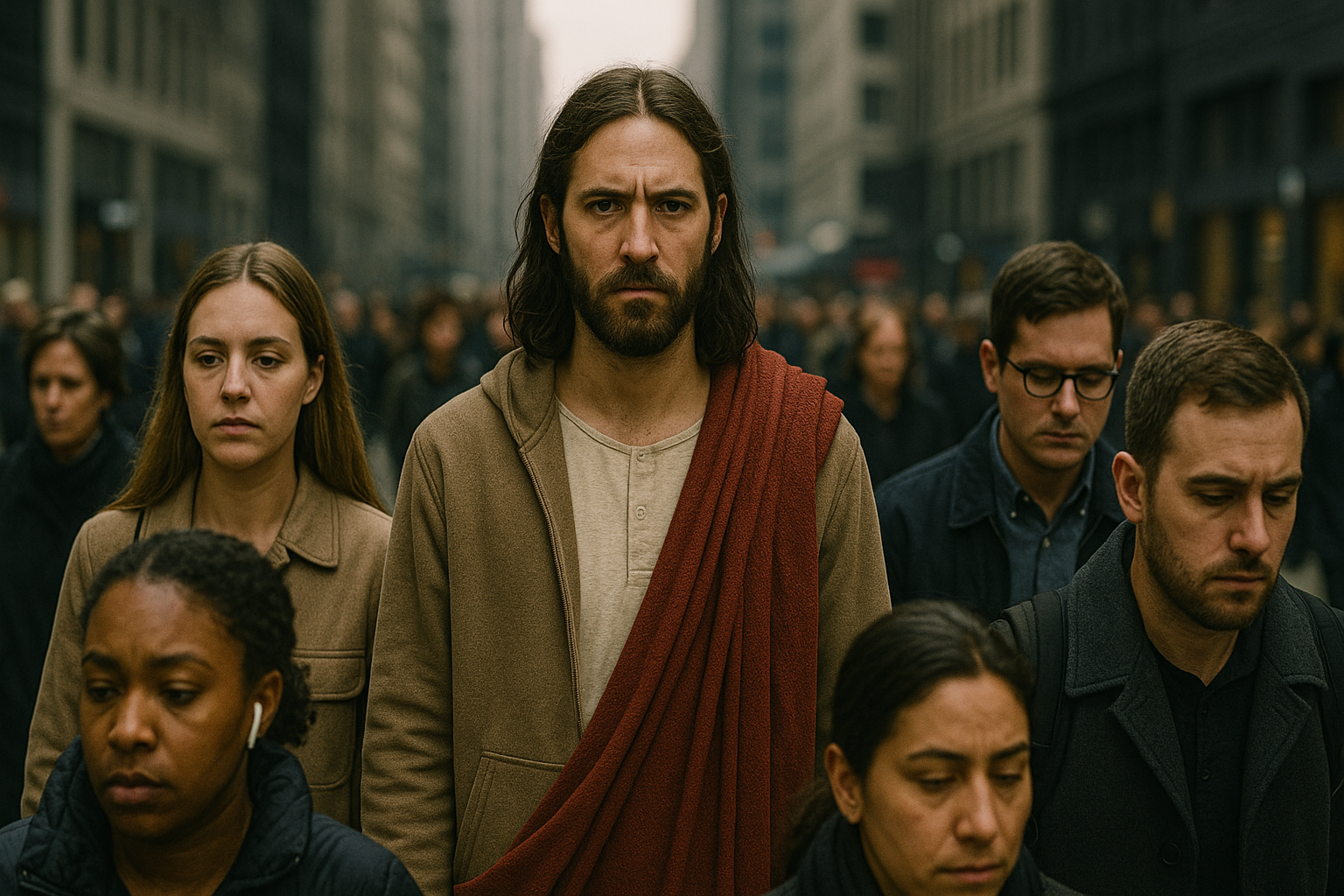
And yet, when that very same God comes, John can point at Him in a crowd and say, in effect, “He is here among you … and you do not recognize Him.”
The blazing God of Isaiah stands unnoticed in the dust of Galilee.
The One before whom angels cover their faces is now so ordinary that people ask, “Is this not the carpenter’s son?”
This is the staggering contrast at the heart of the incarnation: the infinite God, truly here, in a way so lowly that many simply walk past.
The God Who Comes Down
Isaiah invites us to lift our eyes to the heights: “Go up on a high mountain … raise your voice … say to the cities of Judah, ‘Here is your God!’”
John shows us that this high and holy God has gone in the opposite direction.
He comes down.
The eternal Word through whom all things were made steps into His own creation and willingly breathes its dusty air. The Lord of glory takes on real human weakness, hunger, fatigue, vulnerability. The One whose eyes are too pure to look upon evil walks into the very streets and homes where sin has soaked everything.
He does not float above humanity in a sanitized bubble. He does not only appear in the temple, wrapped in incense and ritual. He comes as a man who can be touched, misunderstood, interrupted, and ignored.
This is what makes His condescension so shocking: it is not just that He becomes human. It is the kind of human life He embraces.
- He is born into an obscure family in an occupied land.
- He grows up in a town that people mock.
- He works an ordinary job.
- He surrounds Himself not with the wise and powerful but with fishermen, tax collectors, and sinners.
The High and Lofty One comes all the way down into our low places.
The God Who Stands Among Sinners
John’s words are telling: “among you stands One whom you do not know.”
God does not shout salvation from a safe distance. He stands among us.
Among our broken families.
Among our bitter arguments.
Among our unclean thoughts and unspoken resentments.
Among people who, by nature, do not want Him to rule their lives.
By rights, humanity exists for His glory. By practice, we live as if He exists for ours. Our default posture is not humble worship but quiet rebellion. We grasp at His place, His rights, His throne. Sin is not just “breaking rules.” It is attempting to rewrite the story so that we sit at the center instead of Him.
And this is the world He steps into.
He comes not as a distant critic but as a present Redeemer.
He eats with sinners.
He lets the unclean touch Him.
He draws near to those everyone else pushes away.
But His condescension goes deeper still.
From Standing Among Us to Suffering for Us
It would already be an act of astonishing humility for God simply to live among us.
But in Christ, God does more than share our neighborhood. He bears our sentence.
The One whose laws we have broken takes responsibility for the punishment our rebellion deserves. The judge steps down from the bench and stands in the dock in our place.
Here is the true depth of divine condescension:
- The Holy One treated as unholy.
- The Righteous One numbered with transgressors.
- The Author of life killed by the people whose every breath He upholds.
The very creatures who try to usurp His place now hammer the nails that pierce His hands.
The ones who owe Him everything curse Him to His face.
And He endures it willingly.
He is not dragged to the cross against His will.
He walks there, eyes fixed, out of love.
He takes the wrath we earned.
He absorbs judgment we cannot survive.
He drains the cup dry, so that for all who are in Him there is no condemnation left.
The condescension of God is not sentimental softness. It is holy love that stoops low enough to lift us from death to life.
An Awesome God Worthy of Our Awe
When we speak of the “awesomeness of God,” we are not reaching for a slogan. We are staring at a reality that should leave us quiet and undone.
God’s greatness is not reduced by His humility. It is displayed by it.
- The One who needs nothing chooses to need food and sleep.
- The One who is all-powerful chooses to embrace weakness.
- The One who is eternally worshiped chooses to be despised and rejected.
What kind of God does this?
Not a God fabricated by human imagination. We create gods that are strong on our terms, distant on our terms, manageable on our terms. The true God refuses to play by our expectations. He is both infinitely high and shockingly near.
His holiness does not keep Him from us; it drives Him toward us in redeeming love.
His justice does not crush us; it is satisfied in Christ so He can welcome us.
His majesty is not threatened by our smallness; it makes His kindness all the more stunning.
To behold this Christ is to have your categories shattered.
To really see Him is to ask, with John, “Who am I that I am not even worthy to untie His sandal?” and yet to hear Him call your name and invite you to follow.
Called to Share His Posture
If this is our God, it changes how we live in the world. We cannot cling to our own grandeur when we follow a Savior who laid His aside.
We are children of the King, but that does not give us the right to hover above the “muck and mire” of the world and look down in disgust. If anything, our adoption into His family invites us into His posture.
We do not stand at a distance from sinners. We remember that we are sinners. The difference between us and the world is not moral superiority but sheer grace.
So what does it mean to imitate this condescending Christ?
We go low instead of climbing high.
We do not chase importance, platform, or reputation as if that were the goal of the Christian life. We look for ways to serve without being seen, to lay down our rights for the good of others, because that is what our Lord did.
We enter messy places instead of avoiding them.
We do not build Christian bubbles and hope the world stays outside. We walk into hard conversations, confusing situations, broken relationships, trusting that the God who stood among sinners is with us still.
We speak as fellow sinners, not as distant judges.
When we share the gospel, we do so with the posture, “I am just as needy as you are.” We are not salespeople peddling spiritual improvement; we are beggars telling other beggars where we found bread.
We embrace the cost of love.
True love will cost us time, comfort, reputation, even safety. If our Savior’s love cost Him everything, we should not be surprised when following Him feels like death to our pride and preferences.
This is not optional extras for especially serious Christians. This is what it means to walk in the way of the crucified and risen Lord.
“Here Is Your God”: A Call to See and Respond
The invitation of Isaiah still stands: “Here is your God.”
The warning of John still lingers: “Among you stands One whom you do not know.”
The question is not whether Christ is present and active.
The question is whether we recognize Him and respond.
So let this be a humble call to action in three parts.
Look again at Christ.
Slow down. Read the Gospels with fresh eyes. Ask God to show you the real Jesus, not the tame version you might carry in your mind. Linger over His humility, His courage, His tears, His willingness to be interrupted, His mercy toward the guilty. Let His condescension lead you into deeper awe.
Repent of false grandeur.
Where have you wanted to be seen as important more than to be faithful? Where have you avoided hard people or hard places to protect your comfort? Bring that into the light. Confess it. Receive the cleansing that comes from the One who died for precisely such sins.
Walk into the world as He did.
Ask the Lord for one concrete step.
Who is one person you can move toward this week instead of avoiding?
What is one situation you can enter as a servant instead of as a critic?
Where can you quietly bear another’s burden, at cost to yourself, in the name of the One who bore yours?
“Here is your God” is not just an announcement to overhear. It is a summons to worship, to trust, and to follow.
The God who dwells in unapproachable light has stepped into our darkness.
The God whose glory fills the heavens has walked our dusty roads.
The God against whom we have sinned has borne our sins in His own body on the tree.
Stand in awe of Him.
Then, in His strength, go and reflect His humble, world-upending love to the very people who need Him most.



Comments