On Whims, Messes, and the Unremarkable Thresholds of Calling
Author's Note: This essay draws together threads from two earlier pieces—"The Divine Simplicity of Ignorance" and "The Wasteful Worship"—and weaves them into what I hope is a more complete articulation of an idea that has been forming over months of writing and reflection. Readers familiar with those essays will recognize passages and arguments here; rather than rehashing for content's sake, my aim is to show how these separate meditations belong to a single theological vision. What began as scattered observations about Luke's prologue and the woman in Bethany has matured, I think, into something more coherent: a theology of action over calculation that runs as a consistent thread through Scripture and through the life of faith. Consider this a capstone rather than a repetition.
"Go back, for what have I done to you?"
— Elijah to Elisha, 1 Kings 19:20
The Unremarkable Threshold
We wait for burning bushes. We expect Damascus road experiences—blinding light, the audible voice of God, unmistakable clarity about the path ahead. We imagine that the great turning points of our lives will announce themselves with appropriate fanfare, that we will know when we are standing at the threshold of something significant.
But this is not the testimony of Scripture. Nor is it the testimony of lived experience.
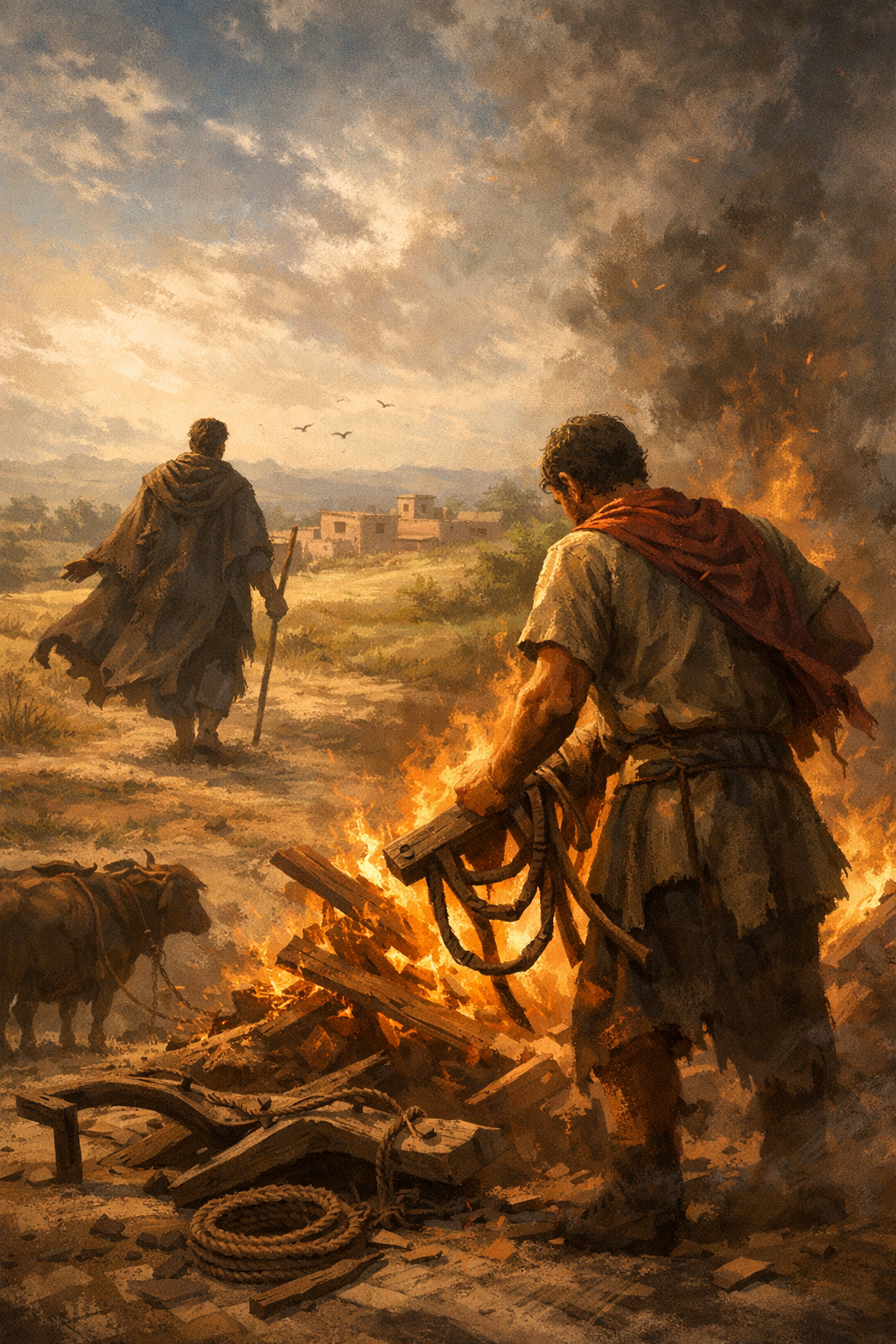
Consider Elisha, plowing a field with twelve yoke of oxen. Elijah passes by and throws his cloak over the younger man's shoulders—a symbolic act, yes, but hardly a theophany. Elisha asks permission to say goodbye to his parents. And Elijah's response is startlingly dismissive: "Go back, for what have I done to you?" It is almost a shrug. We haven't really begun anything yet. Do what you need to do.
From this unremarkable exchange—a cloak thrown in passing, an enigmatic permission granted—one of the most significant prophetic successions in Israel's history emerges. Elisha slaughters his oxen, burns his farming implements, and follows Elijah into a ministry that will span decades and reshape a nation. The moment that initiated it all could be described, in Elijah's own words, as nothing much at all.
This pattern—the unremarkable threshold, the seemingly innocuous moment that in retrospect changes everything—runs throughout Scripture and throughout the lives of those who follow Christ. It suggests a theology that stands in tension with much of what we have been taught about discerning God's will: a theology of action over calculation, of faithful response over strategic analysis, of trusting God with the mess that results from actually doing something.
It Seemed Good to Me
Luke opens his Gospel with words that should arrest us: "It seemed fitting to me" (Luke 1:3). Other translations render this "it seemed good to me." Here is a physician and careful historian, about to pen one of the four canonical Gospels—a text that would shape Christian theology, inspire countless believers, and endure for two millennia. And his stated motivation is remarkably ordinary. It simply seemed like a good idea at the time.
There was no burning bush. No angelic visitation commanding him to write. No tablets received on a mountain. Luke investigated the accounts carefully, thought to himself that this seemed worthwhile, and decided to write it down for Theophilus. From that modest impulse, one of Scripture's most detailed and beautifully crafted accounts of Jesus' life emerged.
Some might interpret Luke's understated introduction as profound humility—a deliberate downplaying of his role in God's redemptive plan. But this interpretation may actually give Luke too much credit, ironically undermining the very humility it seeks to highlight. True humility in this sense would require Luke to have known or suspected the monumental significance his Gospel would achieve, then consciously chosen to minimize his role.
The more likely reality is simpler and, in its own way, more profound: Luke genuinely didn't know. He couldn't have foreseen that his careful account would be read by billions across centuries, translated into thousands of languages, preached from countless pulpits, and recognized as divinely inspired Scripture. He was simply doing what seemed good—documenting the story of Jesus for a friend named Theophilus and perhaps a wider audience of Gentile believers.
This is not unique to Luke. It is the common condition of humanity. We are, by design or limitation, largely ignorant of the grand scheme of things. We cannot see the full ramifications of our actions as they ripple through history and eternity. We don't understand how our small obediences or simple decisions fit into God's cosmic narrative. We live, as it were, with severely limited visibility, making our way forward with incomplete information and partial understanding.
Far from being a burden, this state of unknowing is actually a gift—a source of profound relief and unexpected freedom. God knows our frame; He remembers that we are dust. He understands our cognitive limitations, our inability to grasp the eternal implications of our temporal choices. And perhaps this is by divine design.
Consider what would happen if we could see the full significance of our actions. If Luke had known his Gospel would become Scripture, would he have been paralyzed by the weight of that responsibility? Would pride have crept in, corrupting the purity of his work? As Paul warned, knowledge can puff up, and revelation of our own importance might inflate us beyond what is healthy or holy.
Our ignorance, then, becomes a kind of protection—a safeguard against the pride that comes from knowing our place in God's story. It keeps us dependent, humble, and free to act without the crushing burden of fully understanding the eternal stakes of every decision.
The Freedom of Sacred Ignorance
This sacred ignorance grants us remarkable freedom: the freedom to act, to try, to step out in faith without needing absolute certainty about outcomes. We can do "what seems good to us" without bearing the full weight of accountability for results we cannot foresee or control. This doesn't eliminate personal responsibility—we remain accountable for the immediate, foreseeable impacts of our choices on others, for acting with integrity, wisdom, and love. But it does release us from the impossible burden of trying to orchestrate outcomes that are ultimately in God's hands.
We can, in a sense, pursue the interests, callings, and opportunities that resonate with our hearts—trusting that God is weaving even our spontaneous decisions into His larger tapestry. We become, in the most liberating sense, unwitting actors in a divinely orchestrated plan.
When we embrace this reality—that we are small players in a story far larger than we can comprehend—several things happen.
First, anxiety diminishes. We don't need to have everything figured out. We don't need to see ten steps ahead or guarantee outcomes. We can take the next right step, do what seems good, and trust God with the results.
Second, creativity flourishes. Released from the pressure of needing to ensure "significant" outcomes, we're free to experiment, to try, to follow interests and passions that might seem small or insignificant but could be exactly what God wants to use.
Third, genuine humility emerges. Not the false humility that comes from knowing we're important and trying to appear modest, but the authentic humility of recognizing we truly don't know—and don't need to know—how significant our role might be. We can serve faithfully in obscurity, write for an audience of one, or invest in work that seems small, trusting that God sees what we cannot.
Fourth, gratitude deepens. When we look back and see how God has worked through our simple, often unremarkable decisions, we're filled with wonder. We can't take credit for outcomes we didn't orchestrate or foresee. We can only marvel at a God who takes our "it seemed good to me" moments and weaves them into His eternal purposes.
Where No Oxen Are
There is a proverb that cuts against our instinct for tidiness: "Where no oxen are, the manger is clean, but much revenue comes by the strength of the ox" (Proverbs 14:4).
The empty manger is tidy, orderly, risk-free—and barren. The working farm is chaotic, smells like livestock, requires constant maintenance, and produces something. The proverb is almost sardonically practical: you want a clean barn? Don't have oxen. You want a harvest? Accept the mess.
This reframes failure and disorder not as evidence that we've stepped outside God's will, but as the natural byproduct of faithfully working. The mess isn't the opposite of fruitfulness—it's often the precondition for it. Elisha slaughtering his oxen and burning his equipment was messy, final, a bit dramatic. But it was the necessary severance that enabled his prophetic ministry.
There is a strain of Christian teaching that implicitly promises a kind of frictionless obedience—if you're truly in God's will, doors will open smoothly, peace will reign, circumstances will align. But that's not the testimony of Scripture or of lived experience. Paul's letters are full of obstacles, setbacks, abandoned plans, relationships gone sideways. The mess wasn't evidence he'd missed his calling; it was evidence he was actually doing something.
The theology of action over calculation gives permission to act without requiring certainty—and permission to fail without requiring that failure mean you were wrong to try. The whim that goes nowhere is still the oxen in the stall. Some of them pull the plow that yields the harvest. Some of them just eat and produce manure. You can't always tell which is which until later. And that's acceptable. That's the nature of faithful work in a world we don't control.
The Paralysis of Calculation
There is another way to live, of course. It is the way of calculation—the careful measuring of every decision, the strategic analysis of every opportunity, the attempt to maximize value and minimize waste in all things.
This approach has a certain surface-level piety to it. It speaks the language of stewardship, of being wise with resources, of maximizing kingdom impact. But underneath it often lies the same fear as the one-talent servant in Jesus's parable: fear of waste, fear of mess, fear of being wrong. And that fear can become its own form of paralysis dressed up as discernment.
The one-talent servant buried his talent precisely because he was risk-averse and wanted to preserve what he had without loss. The master's rebuke wasn't "you should have done more analysis." It was essentially "you should have done something, even something as minimal as putting it with the bankers." The servant's calculation—his careful assessment that the safest course was inaction—was itself the failure.
The calculating Christian avoids certain mistakes but may also avoid the very action that would have borne fruit. They keep the manger clean. And at the end, they have a clean manger.
There is an implicit assumption in the maximizing approach that if you just think hard enough, pray long enough, gather enough data, you can engineer an outcome that minimizes loss and guarantees return. But the world doesn't cooperate. Markets shift, people disappoint, circumstances change, the ox dies unexpectedly. You can't optimize your way to certainty in a world that resists certainty.
Better to act, accept the mess, and trust that God can redeem even the waste.
The Wasteful Worship
There is a scene that plays out in Bethany that contains within it a profound rebuke—not of excess, but of a certain kind of prudence. A woman enters with an alabaster vial, and in an act of singular devotion, she breaks it open and pours its contents over the head of Jesus. The perfume is extravagant—worth over three hundred denarii, roughly a year's wages for a common laborer. The gesture is total. And the response of those watching is immediate indignation.
"Why has this perfume been wasted? For this perfume might have been sold for over three hundred denarii, and the money given to the poor."
The disciples lost sight of who was with them. In their rush to calculate the monetary value of the nard, they failed to recognize that nothing could be too costly, too wasteful, to be poured out upon Christ Himself. If they were to be upset about anything, they should have been upset that the gift was not more costly still.
The cry for efficiency is not foreign to us. For those living within a market economy, efficiency is not merely a virtue—it is a foundational assumption. We have been trained to make resources go as far as they possibly can, to maximize utility for good purposes. So from an earthly perspective, the disciples' complaint makes a certain kind of sense.
But Jesus rebukes them. Not because efficiency is inherently wrong, but because their calculus was blind to what was happening in front of them. They had reduced worship to economics. They had made the mistake of thinking that what was owed to Christ could be measured in utility.
It is worth noting that in John's account, it is Judas Iscariot who raises the concern most pointedly—and Scripture is clear that his interest in the poor was a convenient cover for his habit of pilfering from the money box. The appeal to efficiency, it seems, can serve as cover for motives that are anything but charitable.
The woman didn't ask whether there was a more efficient use for her perfume. She simply poured it out on Jesus. And Jesus said she would be remembered for it wherever the gospel is preached. Her act was not a lapse in judgment; it was the very essence of right worship. She did what she could. She did not calculate the most strategic deployment of her resources. She did not hedge her investment. She did not hold anything back for a more opportune moment.
The Weight on Response
What emerges from these passages is a pattern that puts the weight on response rather than revelation. The moment is often unremarkable; the response to it is what matters.
Elisha could have kissed his parents, had his meal, and quietly returned to the twelfth yoke of oxen. The cloak-throwing was ambiguous enough to allow it. Luke could have investigated the accounts and decided the project wasn't worth the effort. The woman in Bethany could have kept her alabaster jar sealed, saving it for a more strategic moment. In each case, the door was open to inaction, to calculation, to waiting for greater clarity.
But they acted. They responded to what was in front of them without demanding certainty about what would follow. And in doing so, they became part of something far larger than they could have known at the time.
The same pattern appears in the negative examples. Lot's wife looked back. The rich young ruler calculated and walked away sad. The man who put his hand to the plow turned around. The one-talent servant buried what he had. In each case, the failure is a failure to act decisively, to commit without guarantee, to move forward without a safety net.
David is anointed while his brothers stand by, and then he just goes back to the sheep. Moses sees a bush and decides to turn aside. Samuel hears his name and thinks it's Eli. These aren't thunder-and-lightning Sinai moments—they're quiet, almost accidental-seeming intersections that only reveal their weight in retrospect.
There is something both humbling and liberating in this pattern. Humbling because we can't manufacture the dramatic conversion narrative that makes for a compelling testimony. Liberating because it means we don't need to wait for one. The path opens not with a vision but with a cloak thrown in passing, a question asked at a well, a net left on the shore.
Jesus and the Would-Be Followers
It is here that we must address an apparent tension. In Luke 9, Jesus seems to take a harder line than Elijah did. When someone says "I will follow you, Lord, but first let me say goodbye to those at home," Jesus responds: "No one who puts his hand to the plow and looks back is fit for the kingdom of God." When another asks to first bury his father, Jesus says, "Let the dead bury their own dead."
How do we reconcile this with Elijah's apparent permission to Elisha—"Go back, for what have I done to you?"
The tension may be less about contradictory standards and more about different situations. Elisha asked for a brief farewell and then made a decisive, public break—slaughtering his oxen and burning his implements in a severance ritual that foreclosed any return to his former life. His feast was itself an act of commitment.
The requests in Luke seem to be something else. "Let me first bury my father" was likely an idiom meaning "let me wait until my father dies and I've fulfilled all my filial duties"—a request for indefinite delay. "Let me say goodbye" may have been an escape hatch, a way of deferring commitment. Jesus was confronting postponement and divided loyalty, not denying anyone a funeral.
The common thread is this: both Elijah and Jesus put the weight on decisive response. Elisha's farewell meal became a public commitment. The would-be followers in Luke were looking for permission to delay, to keep options open, to avoid the finality that discipleship requires. What Jesus rejected was not the human need for transition but the attempt to hedge, to follow while keeping one foot in the old life.
The theology of action over calculation is not a theology of thoughtlessness. It is a theology of commitment—of burned bridges and broken jars and slaughtered oxen. It recognizes that fruitfulness often requires foreclosing other possibilities, that you cannot plow a straight furrow while looking over your shoulder.
The Lived Reality
I can attest to this pattern in my own experience. I am notorious for not seemingly giving much thought to a decision by how rapidly I engage—in a business partnership, a purchase, a new direction. I run on intuition more than evidence. And sometimes it comes back to bite me. The rushing produces something wasteful in its wake.
But other times, it turns out to be exactly what was needed. The mess was the price of the harvest. The waste was the byproduct of actually having oxen in the stall.
I have known very calculating Christians who try to measure and extract the maximum value from every action, to genuinely make sure they are being good stewards. And I understand the impulse. But in my observation, the attempt to tame this fallen world through careful calculation is like trying to tame a wild animal. It can't be done. The variables are too many, the future too opaque, the unintended consequences too unpredictable.
This doesn't mean we abandon wisdom. It means we hold our plans loosely. It means we act on what seems good and right in the moment, accepting that some of those actions will bear fruit we never anticipated and others will produce nothing but manure. It means we trust that God is sovereign over our messes as well as our successes.
The woman in Bethany didn't run a cost-benefit analysis. She just poured. And that impulse—the one that looks reckless or wasteful by earthly calculus—is precisely what Jesus commends and promises will be memorialized wherever the gospel is preached.
An Invitation to Simple Faithfulness
Luke's unassuming introduction to his Gospel extends an invitation to all of us: the invitation to simple faithfulness over spectacular significance, to obedient response over strategic calculation, to doing what seems good in the moment over anxiously trying to engineer eternal outcomes.
God doesn't need us to understand the full implications of our obedience. He doesn't require us to see the end from the beginning or to grasp how our small acts of faithfulness fit into His cosmic plan. He simply invites us to respond to His gentle promptings, to do what seems good and right in each moment, and to trust Him with the results.
This is the paradox of kingdom work: the most eternally significant acts often feel remarkably ordinary in the moment. A physician decides to write an orderly account for a friend. A shepherd boy volunteers to face a giant. A young woman says yes to an angel's impossible announcement. A group of fishermen leave their nets to follow an itinerant rabbi. None of them could have foreseen the full significance of their simple obedience.
And so we're invited into the same pattern: to live faithfully in our limited understanding, to act on what seems good and right, to follow the gentle tuggings of the Spirit without needing to see the full picture. In doing so, we discover that our ignorance is not a liability but a gift—one that keeps us humble, dependent, and free to participate in God's work without the crushing burden of trying to control or fully comprehend it.
We are not the architects of divine plans but characters within the story, not the orchestrators but willing participants. And in that humble, limited, often unknowing participation, God accomplishes far more than we could ask or imagine—just as He did through a physician who simply thought it seemed good to write things down, and a farmer who left his plow to follow a prophet who claimed to have done nothing much at all.
The attitude of humility God seeks is not the false modesty of knowing we're important and pretending otherwise. It's the authentic posture of recognizing we truly don't know—and resting in the freedom and peace that comes from trusting the One who does.
So act. Make the mess. Follow the whim. Do what seems good. And trust that the God who called Elisha with a thrown cloak and inspired Luke with an ordinary impulse is the same God who will take your unremarkable obedience and weave it into purposes you cannot see.
The manger will get dirty. The oxen will need tending. Some of what you do will come to nothing.
But much revenue comes by the strength of the ox.


Comments